Does Homeowners Insurance Cover Roof Leaks in Dayton, OH?
Finding a water stain on your ceiling ruins your day fast. Naturally, your next thought goes straight to your policy. Does homeowners insurance cover roof leak Dayton OH situations? The short answer depends entirely on what caused the water to get inside your house.
Insurance companies in Ohio generally cover sudden and accidental damage. They rarely pay for leaks caused by old age or skipped maintenance. Living in the Miami Valley means dealing with wild weather swings that test every inch of your roof. Understanding how policies handle these weather events makes a huge difference when you file a claim.
When Homeowners Insurance Covers a Roof Leak in Dayton
Your policy is designed to protect your home from sudden disasters. If a heavy branch crashes through your shingles during a summer storm, your insurance usually covers the repair costs.
Spring and summer bring severe thunderstorms accompanied by high winds and large hail that frequently damage asphalt shingles. When wind lifts a shingle and rain pours underneath, that is considered sudden storm damage.
Insurance also typically covers interior water damage caused by a covered roof failure. If the roof leaks during a storm and ruins your drywall or flooring, the policy often pays to fix those ruined indoor spaces, too.
Need a roof repair pro in Dayton, OH?
Talk to an independent local contractor who serves your area.
📞 Call (888) 815-2998Roof repair in Dayton, OHCall hours: 8am–8pm ET, 7 days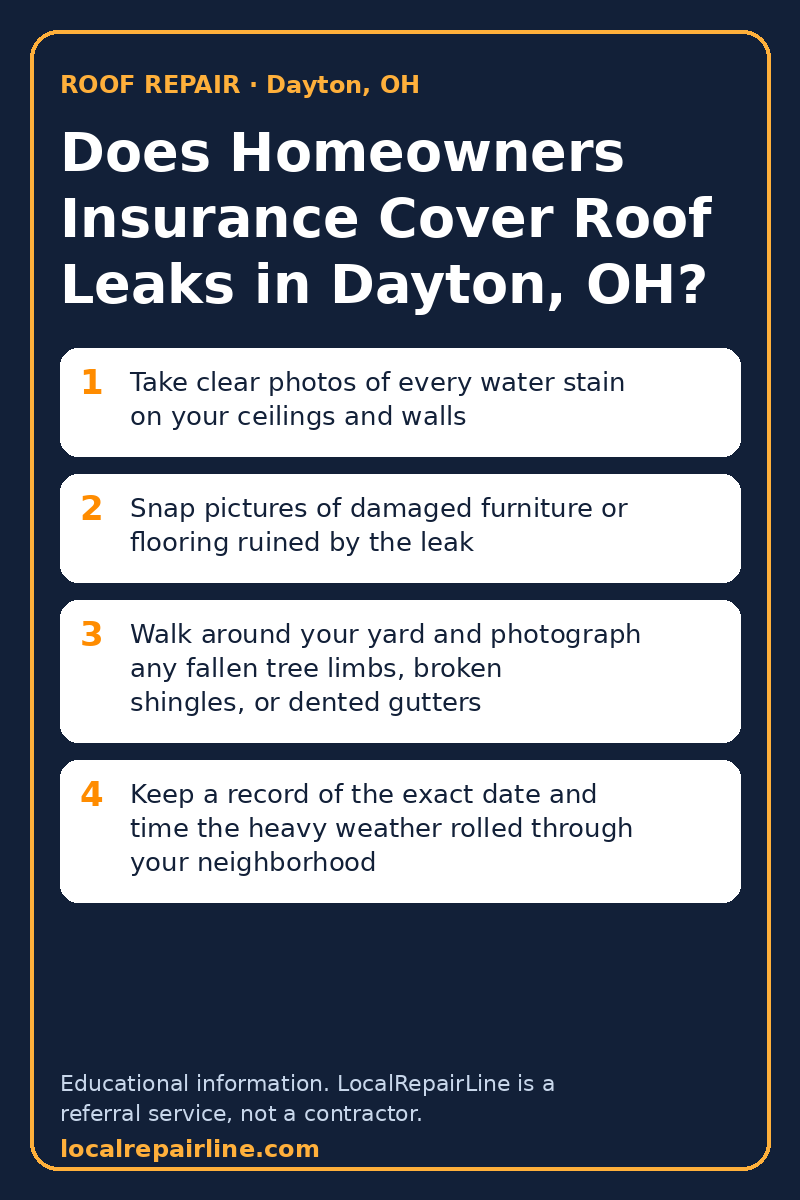
Common Policy Exclusions Every Dayton Homeowner Must Know
Insurers hold homeowners responsible for keeping their property in good shape. If your roof is past its prime and simply wears out, the claim will likely get denied.
Frequent heavy winter snowfall followed by rapid melting puts immense pressure on roof valleys and ice damming. If water backs up behind an ice dam and leaks inside, some policies exclude it unless you have a specific rider.
Gradual leaks are another tricky area. If a pipe boot or chimney flashing degrades slowly over five years and leaks every time it drizzles, the insurer will likely call it a maintenance failure. They expect you to catch those things before rot sets in.
How Freeze-Thaw Cycles and Storms Impact Claim Approvals
Local weather creates a frustrating gray area for insurance adjusters. Significant seasonal temperature swings cause roofing materials to expand and contract, leading to premature sealant breakdown.
This constant shifting weakens flashing around chimneys, vents, and skylights. When a heavy rainstorm hits a roof with weakened flashing, water gets inside easily.
Adjusters often look at this damage and blame normal wear and tear instead of the recent storm. They might argue that the seal was already failing before the wind blew. Be prepared to show evidence of specific storm events that forced the water through those vulnerable spots.
Step-by-Step Guide to Documenting Roof Damage for Your Insurer
Filing a successful claim requires solid proof. Do not wait for the adjuster to find everything on their own.
- Take clear photos of every water stain on your ceilings and walls.
- Snap pictures of damaged furniture or flooring ruined by the leak.
- Walk around your yard and photograph any fallen tree limbs, broken shingles, or dented gutters.
- Keep a record of the exact date and time the heavy weather rolled through your neighborhood.
When the homeowner realizes they need professional documentation of hidden wind or ice damage before talking to their insurance adjuster, it is time to bring in backup. This is the exact moment to consult this local service page instead of guessing at the cause of the leak. An independent inspection gives you objective facts about whether wind ripped the shingles loose or if the materials simply aged out.
Working With Public Adjusters and Local Roof Inspectors
Sometimes an insurance company denies a claim that you feel strongly should be covered. When this happens, you have options.
A local roof inspector can provide a detailed report showing granule loss, creased shingles, or compromised flashing. This report serves as your primary evidence during a dispute.
If the insurance company still refuses to pay and you suspect a valid claim was wrongfully denied, you can hire a public adjuster. Public adjusters work for you, not the insurance company. They inspect the roof, look your policy, and negotiate directly with the insurance provider for a fair payout. Keep in mind that hiring outside help adds costs, and those expenses vary by house.
What to Do If Your Insurance Claim Gets Denied
A denial letter stings, but it does not have to be the final word. Read the denial letter carefully to see which specific exclusion the company cited.
Gather your inspection reports and weather data from the date of the storm. If the insurer claims the damage was pre-existing, your roofing contractor can help prove otherwise with photographic evidence of sudden wind or hail impact.
You can request a re-inspection through your insurance provider and present your new evidence. Staying polite, persistent, and factual gets much better results than getting angry on the phone.
FAQ
Will insurance pay for a full roof replacement if only a small section leaks?
Insurance usually only pays to repair the damaged portion of the roof unless matching materials are no longer available. If the old shingles are discontinued and a patch would make your roof look mismatched, some policies require the insurer to pay for a full slope or total replacement. Costs vary by house and policy language.
How long do I have after a storm to file a roof claim in Ohio?
Most insurance policies require you to report damage within a specific timeframe, often one year from the date of the storm. Waiting too long makes it much harder to prove that a specific weather event caused the leak rather than subsequent wear and tear.
Does insurance cover roof leaks caused by lack of maintenance?
No, standard homeowners insurance explicitly excludes damage caused by neglect or ordinary aging. If a leak happens because you ignored missing shingles or cracked caulking for years, you will have to pay for the repairs out of your own pocket.
Will filing a roof claim cause my insurance rates to increase?
Filing a claim for weather-related damage like a severe storm can sometimes cause your rates to go up, even though weather events are considered no-fault claims. Insurance companies often adjust rates across entire zip codes after widespread storm damage hits the region.
Need a roof repair pro in Dayton, OH?
Talk to an independent local contractor who serves your area.
📞 Call (888) 815-2998Roof repair in Dayton, OHCall hours: 8am–8pm ET, 7 days