Furnace Making Loud Banging Noise in Newark, DE? What to Check
A furnace making loud banging noise Newark DE homeowners hear on the first cold night of fall can be alarming. Sometimes it's just metal ductwork stretching as it heats up. Other times it's a delayed ignition, which deserves a shutdown and a service call.
The trick is knowing which one you're hearing. The timing of the bang tells you most of what you need to know.
Furnace Making Loud Banging Noise Newark DE: Match the Sound to the Timing
Stand near the furnace or a main duct and listen through a full heating cycle. Notice when the bang happens.
- At startup, right as the burners light: a deep boom or thump. This is the one to take seriously.
- A few seconds after the blower starts, or while it runs: a tinny pop or "oil can" sound in the ducts. Usually a nuisance, not a danger.
- At shutdown, as things cool: ticking, popping, or a single bang as metal contracts. Usually harmless, but worth a look if it's loud.
That one question, "when does it happen?", separates a sound you can live with for a while from a problem you shouldn't ignore.
Need an HVAC repair pro in Newark, DE?
Talk to an independent local contractor who serves your area.
📞 Call (833) 669-0233HVAC repair in Newark, DECall hours: 8am–8pm ET, 7 daysYour call may first be answered by a short screening service that asks what the problem is and where you are. Stay on the line and you will be connected to an independent local pro.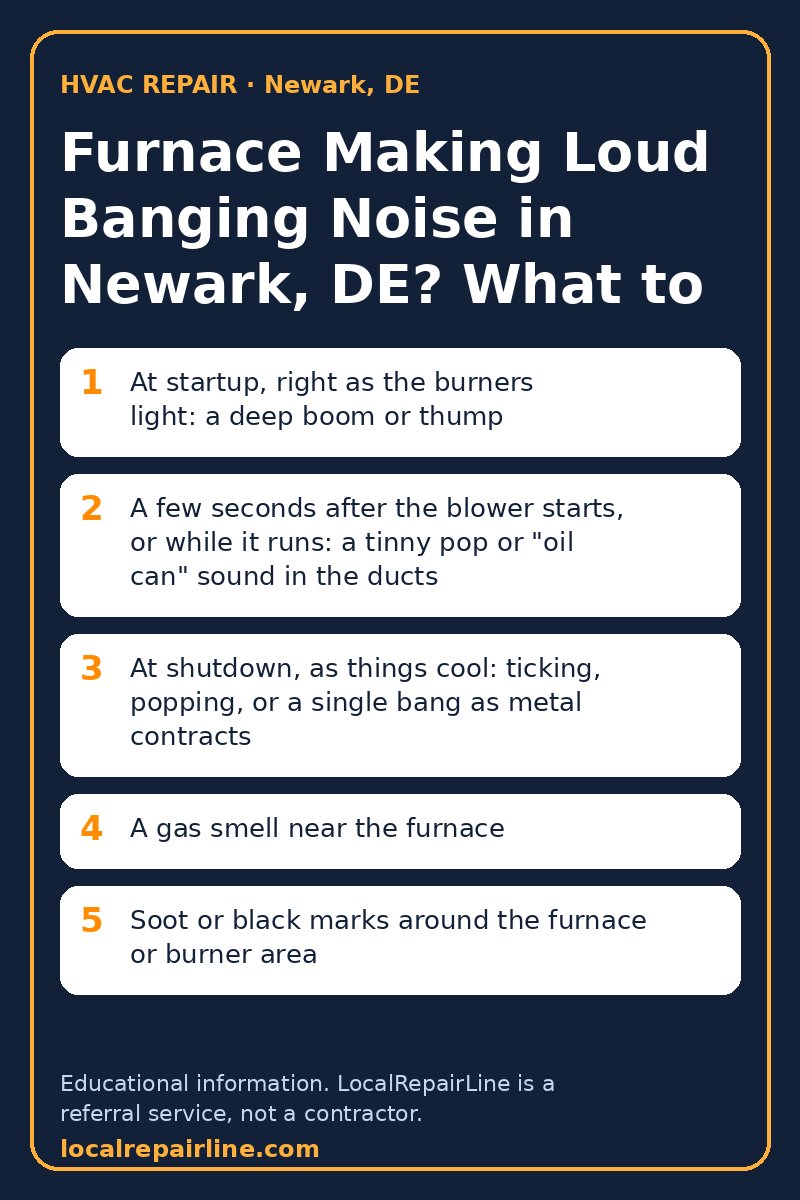
Bangs at Startup: Delayed Ignition and Dirty Burners
A boom when the burners light usually means gas built up for a moment before it caught fire. When it finally ignites, you get a small blast inside the furnace instead of a smooth flame.
Common causes include dirty or clogged burners, a weak or dirty igniter or flame sensor, or a gas supply issue. Dust and debris can settle on burners while the furnace sits idle, which matters in a region where the heat may be off for months.
Why it matters: repeated small blasts put stress on the combustion chamber and heat exchanger. A cracked heat exchanger can let combustion gases, including carbon monoxide, get where they shouldn't. That's why a boom at ignition is worth having checked rather than ignored.
Warning signs that go with a startup bang
- A gas smell near the furnace
- Soot or black marks around the furnace or burner area
- A yellow, orange, or flickering flame instead of a steady blue one
- A bang that repeats every cycle or gets louder over time
- A carbon monoxide alarm going off
If you notice any of these, don't keep running the furnace to see what happens. This is the point to stop guessing and talk to a local HVAC pro in Newark, DE, such as Local Repair Line. Burners, igniters, and the gas valve are not DIY territory.
Bangs During the Run or at Shutdown: Ductwork Expansion and Oil Canning
When the furnace runs, warm air pushes through sheet metal ducts. The metal heats up and expands, then shrinks as it cools. That movement can cause popping or banging, especially in long straight runs or near where ducts connect.
Ducts expanding and contracting
A pop or bang a minute or two after startup, or again after the blower stops, often points here. The sound is usually in the walls, ceiling, or basement, not inside the furnace cabinet. It tends to be the same pop, in the same spot, every cycle.
Oil canning
Large, flat duct panels can flex in and out with a loud boom or thunk, like the bottom of an old oil can. It often shows up when air pressure in the duct changes quickly as the blower kicks on or off.
Oil canning is usually more annoying than dangerous. Still, it can hint that the system is moving more air than the ducts can handle, which brings us to airflow.
Airflow Problems That Make Furnaces Bang: Filters, Closed Vents, Undersized Ducts
Air that can't move freely builds pressure, and pressure makes ducts bang. Restricted airflow can also make the furnace run hot, which is hard on parts.
The usual suspects:
- A clogged filter. A common and simple thing to check, and easy to fix yourself.
- Closed or blocked vents. Closing registers in unused rooms may seem like a way to save heat, but it can raise pressure in the ducts.
- Blocked return grilles. Furniture, rugs, or boxes can choke off the air coming back to the furnace.
- Undersized or restricted ductwork. If the ducts were never sized well for the system, or have crushed or kinked sections, banging may continue no matter how often you change the filter.
This is where homeowners can overspend. A bang that comes from a clogged filter or a duct problem is sometimes treated as a furnace failure, and a replacement gets discussed when the real fix was airflow. Rule out the simple stuff first, and ask a technician to show you where the airflow problem is before agreeing to a new unit.
Why the First Cold Snap in Newark Exposes Problems
Newark has real winters, with cold stretches, snow, and the occasional nor'easter. Summers are hot and humid, so the furnace often sits idle for months.
That long break matters. Dust settles on burners and in the ducts, and a filter may have been left in place all summer or fall. Then the first real cold snap arrives, the furnace fires up under heavy demand, and any hidden problem announces itself with a bang.
Spring and fall add another twist. Big day-to-night temperature swings mean the heat cycles on and off often. Each cycle makes ductwork expand and contract, so duct pops are most noticeable in shoulder seasons.
A practical habit: run the furnace for a full cycle on a mild fall day, before you actually need it. If something sounds wrong, you'll have time to get it looked at before you're relying on the heat every day.
Safe Steps to Take Right Now (and What Not to Try Yourself)
Here is a short checklist you can work through safely:
- Note when the bang happens: startup, during the run, or shutdown. Write it down, along with what you smell or see.
- Check the air filter. Turn the furnace off at the thermostat, pull the filter, and replace it if it's dirty.
- Open supply vents and clear return grilles so air can move easily.
- Look at the flame through the viewing area only if your furnace has one and it's safe to do so. A steady blue flame is normal. Don't open the burner compartment.
- Restart the furnace and listen again. If the bang is gone, you may have solved an airflow problem.
- If it still bangs at startup, shut it off and call a local pro.
What not to do
- Don't clean or adjust the burners, igniter, or gas valve yourself.
- Don't remove panels to "look around" with the gas on.
- Don't keep using a furnace that booms at ignition.
- Don't ignore a carbon monoxide alarm.
If you smell gas, leave the house right away and call your gas utility or 911 from outside. Don't flip switches or use a lighter. The same goes for a carbon monoxide alarm: get everyone outside and call 911.
What a Technician Will Check and When Repair Beats Replacement
A technician will usually start with the basics and work toward the cause:
- Inspect and clean the burners
- Test the igniter and flame sensor
- Check gas pressure and the gas valve
- Inspect the heat exchanger for cracks or damage
- Look at the filter, blower, and airflow
- Check duct size, connections, and any crushed sections
Costs vary by house. What you end up paying depends on what's causing the bang, so the diagnosis comes first. Labor, access to the furnace, and the age of the equipment all play a part.
Repair usually makes sense when the cause is a dirty burner, a worn igniter or sensor, a clogged filter, or a duct issue. Replacement is more likely to come up when the heat exchanger is cracked, especially on an older furnace where the repair would be a large share of the cost of new equipment.
Ask the technician to explain what they found and show you if possible. If replacement is suggested, ask whether airflow or ductwork was ruled out first.
FAQ
Why is my furnace making a loud bang when it turns on?
Most often it's delayed ignition. Gas collects for a moment before it lights, and the burst makes a boom. Dirty burners, a weak igniter, or a flame sensor problem are common causes, so shut the furnace off and have it checked.
Is a banging furnace dangerous?
It depends on the sound and the timing. Duct pops during the run or at shutdown are usually harmless. A boom at ignition, especially with a gas smell, soot, or a flickering flame, can point to a serious problem, so it's worth having a technician check it out.
Why does my furnace bang when it shuts off?
As the blower stops, the ducts cool and contract, and the metal can pop or bang. Sudden pressure changes can also make flat duct panels flex. If it's a single pop at the same spot each time, it's usually a nuisance, but loud or worsening bangs are worth a duct and airflow check.
How much does it cost to fix a furnace that bangs?
Costs vary by house. The price depends on the cause, since a filter, burner, igniter, sensor, duct, or heat exchanger issue each involves different parts and labor. Ask a technician to explain the cause first so you know whether you're paying for a small repair or a major one.
Need an HVAC repair pro in Newark, DE?
Talk to an independent local contractor who serves your area.
📞 Call (833) 669-0233HVAC repair in Newark, DECall hours: 8am–8pm ET, 7 days