Furnace Not Turning On in Wilmington DE? Check This First
A furnace not turning on Wilmington DE homeowners notice usually shows up at the worst moment: the first sharp cold night, or the middle of a winter storm. The house feels fine at bedtime and chilly by morning.
Before you assume the worst, there are several safe checks you can do in a few minutes. Many no-heat calls come down to something small. This guide walks through those checks, explains what different symptoms usually mean, and tells you when to stop guessing and call someone.
Furnace Not Turning On Wilmington DE: What Local Winters Expose
Wilmington has four real seasons. Summers are hot and humid, and winters regularly dip below 32°F. Your furnace likely sat untouched for months, then got asked to run hard the first time the temperature dropped.
That long idle stretch matters. Dust settles on parts, and a flame sensor can pick up a thin film that keeps it from "seeing" the flame. In a high-efficiency furnace, humid summer air can also leave a condensate drain or trap gummed up or blocked. A worn igniter or tired motor may have been fine last March and quit this October.
Winter storms and nor'easters add stress. Snow, ice, and wind keep heating systems running for long stretches. A weak part that limped along in mild weather often gives out when the system never gets a break.
Older Mid-Atlantic homes add another wrinkle. An aging furnace, a dirty filter nobody remembered, and a tired thermostat can all be in play at once. That's why a methodical check beats a quick purchase.
Need an HVAC repair pro in Wilmington, DE?
Talk to an independent local contractor who serves your area.
📞 Call (833) 669-0233HVAC repair in Wilmington, DECall hours: 8am–8pm ET, 7 daysYour call may first be answered by a short screening service that asks what the problem is and where you are. Stay on the line and you will be connected to an independent local pro.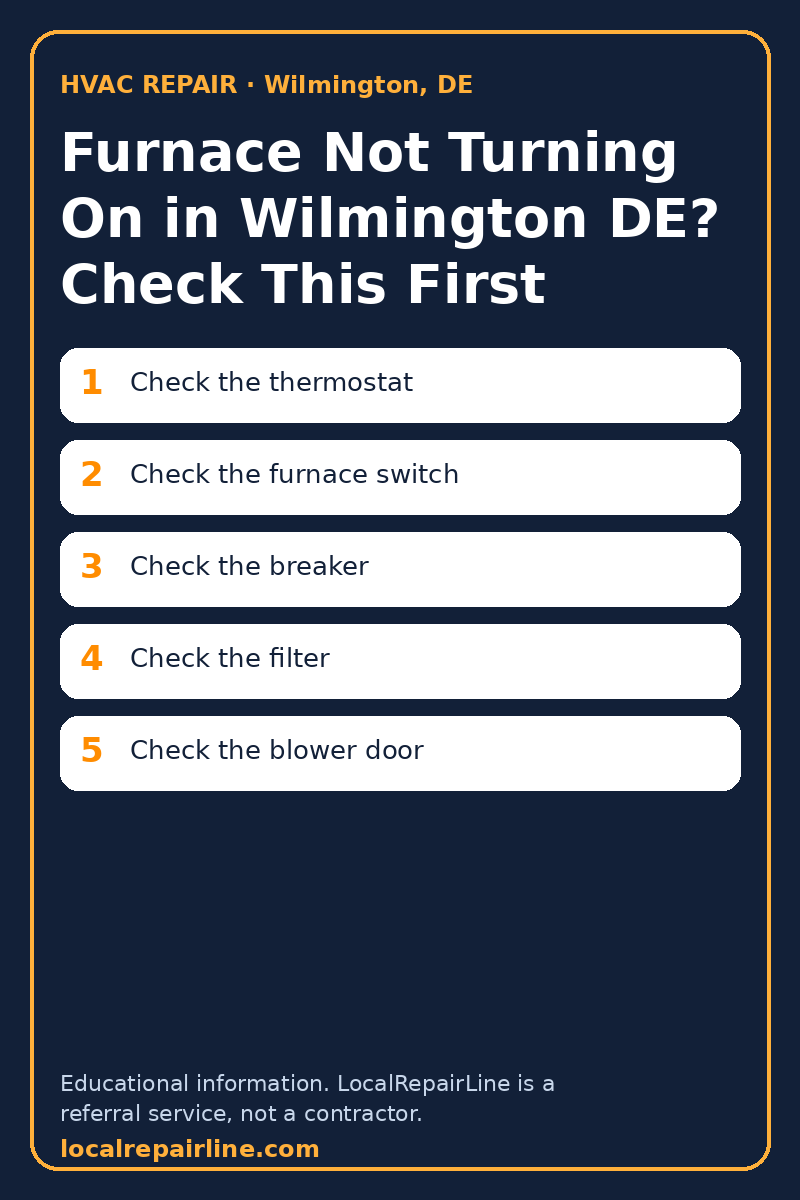
Start Here: Thermostat, Power, Filter, and Switch Checks
Work through these in order. They're safe for most homeowners and take little time.
- Check the thermostat. Set it to Heat, then raise the temperature a few degrees above the room temperature. If the screen is blank, replace the batteries.
- Check the furnace switch. Look for a light-switch-style power switch on or near the furnace, often on a wall or the side of the unit. Make sure it's on.
- Check the breaker. Find the furnace breaker in your electrical panel. If it tripped, flip it fully off, then back on once.
- Check the filter. Slide it out and hold it up to the light. If you can barely see through it, replace it.
- Check the blower door. Many furnaces won't run unless the front panel is seated correctly, because a small safety switch senses it. Make sure it's fully in place.
- Look at the vents and outdoor pipes. If your furnace has plastic intake or exhaust pipes outside, make sure snow, ice, or leaves aren't blocking them.
If you have a gas furnace, also confirm the gas valve near the unit is in the open position, with the handle running parallel to the pipe. Don't touch anything that smells like gas, and see the safety section below.
What a reset really means
Some furnaces have a simple reset: turn the power switch off, wait about 30 seconds, and turn it back on. Try that once. If it starts and then stops again, the system is telling you something is wrong. Repeated resets just hide the problem.
Some units also have a small red reset button near the burner area. Don't keep pressing it. It's tied to a safety control, and it trips for a reason.
Decode the Symptom: Silent, Clicking, Blower Only, or Shuts Off Fast
How your furnace fails tells you a lot. Here's what each pattern usually points to.
- Completely silent, no lights: Often a power problem. Think breaker, switch, a blown fuse on the control board, a door switch, or a failed transformer. A thermostat with dead batteries can go over the same.
- Clicking, then nothing: The furnace is trying to start. Common causes are a dirty or weak igniter, a gas supply problem, or a flame sensor that can't confirm the flame.
- Draft inducer runs, but no flame: This usually points to an igniter, gas valve, or pressure switch issue. In a high-efficiency unit, a blocked condensate drain can also trip the pressure switch.
- Blower runs, but the air is cold: The fan is working, but burners aren't lighting or are shutting off. Check that the thermostat fan setting is on Auto, not On.
- Starts, then shuts off fast: This is short cycling. A dirty flame sensor, a clogged filter causing overheating, or a restricted vent are common reasons.
- Tries a few times, then stops (lockout): Many furnaces lock out after several failed ignition attempts. That protects the system and usually means one of the problems above.
Look for the light code
Many furnaces have a small LED visible through a window in the blower door. It blinks in a pattern that matches a chart, often on a sticker inside the door. Write down the pattern or take a photo. A tech can use it to narrow down the problem quickly, and it keeps you from paying for a part you didn't need.
Gas, Pilot, and Safety Warning Signs You Should Never Ignore
Some signs mean stop troubleshooting right away.
- You smell gas (a rotten-egg odor): Don't flip switches, use a lighter, or try to restart anything. Leave the house and call your gas utility or emergency services from outside.
- Your carbon monoxide alarm sounds: Get everyone outside into fresh air and call for help. Don't go back in to investigate.
- You see soot, scorch marks, or yellow flames: These can point to poor combustion or venting trouble.
- You hear loud bangs or smell burning plastic or metal: Turn the system off and leave it off.
If you have an older furnace with a standing pilot light, relighting it's only worth trying if you follow the manufacturer's instructions on the unit, and only if you smell no gas. If the pilot won't stay lit after one careful attempt, stop. A pilot that keeps going out can point to a failing thermocouple or a draft or venting issue.
Working carbon monoxide detectors are a smart move before every heating season. Check the batteries when you check the filter.
What Techs Typically Find and What Repairs Usually Cost
A lot of no-heat calls trace back to a short list of causes. Common ones include:
- A dirty flame sensor
- A cracked or worn igniter
- A clogged filter that caused overheating and a safety shutoff
- A blocked condensate drain or trap
- A failed pressure switch or inducer motor
- A bad control board
- A tired blower motor or capacitor
Costs vary by house and by the exact part, so there's no honest single number. Some problems are simple, like a dirty flame sensor or a clogged filter. Igniters, switches, and capacitors are common wear parts that a tech can test and replace. Inducer motors, blower motors, and control boards are bigger components, and pinning down the problem takes more testing. Cracked heat exchangers and major component failures are where the replacement conversation often starts.
Labor, part availability, and how hard the furnace is to reach all change the total. When you call a local pro such as Local Repair Line, ask for the cause in plain language, and ask what the repair covers.
This is also where people regret fast decisions. Replacing a thermostat or a whole furnace makes little sense if the real problem was a dirty sensor or a clogged drain. A clear diagnosis comes first.
Repair or Replace: Questions to Ask on an Older Furnace
If your furnace is old, a repair recommendation can start a bigger conversation. That's normal. A fair conversation sounds like questions and explanations, not pressure.
Ask the tech:
- What exactly failed, and what caused it?
- Is this likely a one-time fix, or a sign of other parts wearing out?
- Can you show me the failed part or the reading that points to it?
- Is the heat exchanger in good shape?
- What would you expect to be the next part to fail?
Weigh the answers against the furnace's age, its repair history, and how comfortable your home has been. A modest repair on a furnace that has run well often makes sense. Several repairs in a row on an aging unit is a different story.
If replacement comes up, get the reasoning in writing and take your time when you can. Costs vary by house, so compare more than one explanation before you decide.
FAQ
Why is my furnace not turning on even though the thermostat seems fine?
The thermostat may be sending the call for heat, but the furnace may not be getting power or may be locked out on a safety control. Check the furnace switch, the breaker, the blower door, and the filter. If those look fine, a failed igniter, flame sensor, pressure switch, or control board could be the cause.
Is it safe to keep resetting my furnace?
Try one reset by turning the power off for about 30 seconds and then back on. If the furnace starts and stops again, more resets only hide the problem. Pressing the red reset button over and over is also a bad idea, since it protects a safety control.
Why does my furnace click but not start?
Clicking usually means the furnace is trying to light the burners. A dirty or weak igniter, a gas supply problem, or a flame sensor that can't confirm the flame are common reasons. A dirty flame sensor is among the simpler fixes, but cleaning it takes care, so many homeowners leave it to a tech.
How much will a furnace repair cost in Wilmington?
Costs vary by house, the part that failed, and how hard the furnace is to reach. A filter swap or sensor cleaning is a different kind of job than a motor or control board repair, so the total depends on what actually failed. Ask for the cause and what the repair includes before you agree to the work.
When should I stop troubleshooting and call for help?
Stop right away if you smell gas, your carbon monoxide alarm sounds, or you notice soot, scorch marks, or burning smells. Call for help if the furnace locks out again after one reset, or if the simple checks don't turn up the problem. If you aren't comfortable with a step, skip it and bring in a pro.
Need an HVAC repair pro in Wilmington, DE?
Talk to an independent local contractor who serves your area.
📞 Call (833) 669-0233HVAC repair in Wilmington, DECall hours: 8am–8pm ET, 7 days