Furnace Repair Huber Heights, OH: Check This Before You Call
If you're searching for furnace repair Huber Heights OH, chances are the house is getting cold and you want answers fast. The first real cold snap of an Ohio winter is when it usually happens. Every furnace in town gets asked to run hard at once, and the ones that sat idle since spring are the first to complain.
This guide covers what the symptoms mean, what you can safely check yourself, what drives repair cost, and when to stop guessing and call a local pro.
Signs Your Furnace Needs Repair, Not Just a Reset
Some problems clear up with a thermostat tweak. Others are your furnace telling you something is wearing out.
Watch for these:
- Blowing cold or lukewarm air while the blower runs
- Short-cycling, where it starts, runs briefly, shuts off, and repeats
- Banging, rattling, squealing, or grinding noises
- Won't start at all, or clicks but never lights
- Uneven heat, with some rooms staying cold
- A burning or gas smell, or a yellow, flickering flame instead of a steady blue one
A single odd noise on startup isn't always a crisis. A noise that repeats every cycle, or gets louder week to week, deserves a closer look.
Need an HVAC repair pro in Dayton, OH?
Talk to an independent local contractor who serves your area.
📞 Call (833) 669-0233HVAC repair in Dayton, OHCall hours: 8am–8pm ET, 7 daysYour call may first be answered by a short screening service that asks what the problem is and where you are. Stay on the line and you will be connected to an independent local pro.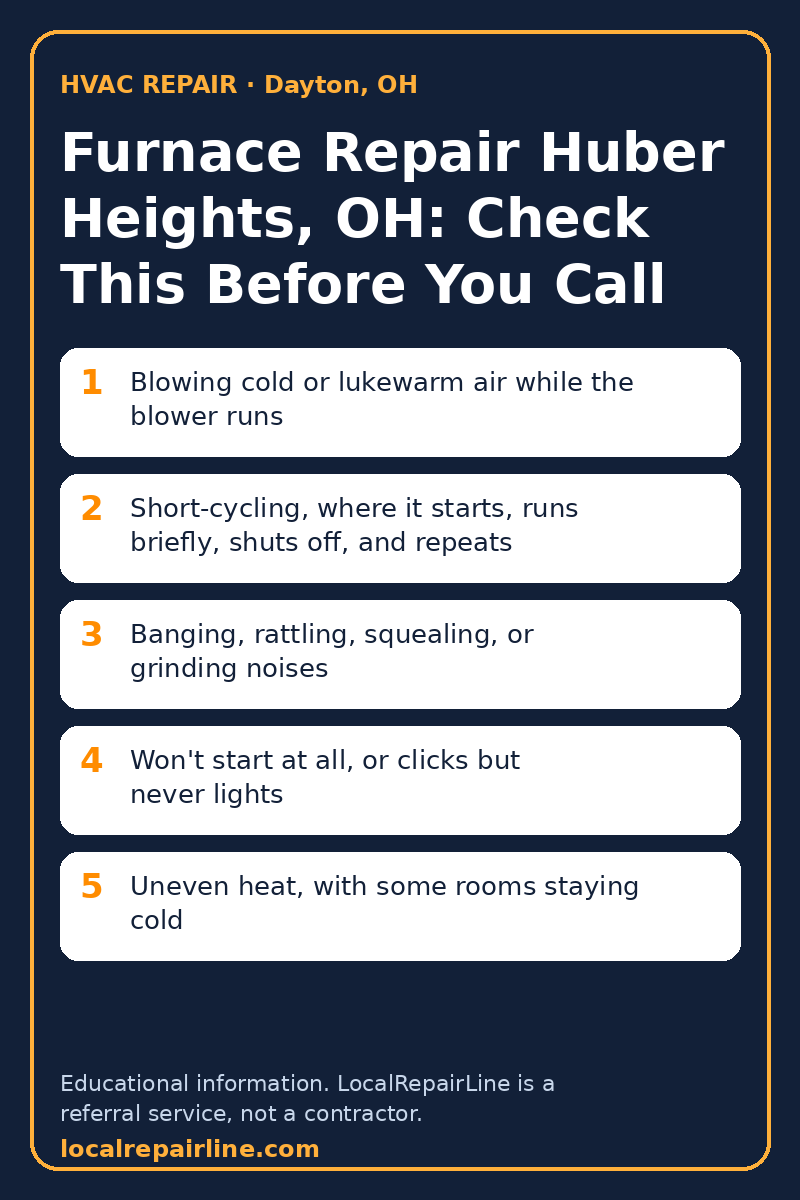
Safe Checks You Can Do Before Calling a Pro
Start with the simple stuff. It takes about ten minutes and sometimes solves the problem.
- Check the thermostat. Make sure it's set to "heat," the temperature is set above the room temperature, and the batteries are fresh if it uses them.
- Check the filter. A clogged filter chokes airflow and can make the furnace overheat and shut down. Swap it if it looks gray and packed.
- Check the power. Look for the switch on or near the furnace (it looks like a light switch) and make sure it's on. Then check the breaker panel for a tripped breaker.
- Check the gas supply. Confirm the gas valve handle near the furnace is in the open position and other gas appliances, like the stove or water heater, are working.
- Check the vents. Make sure supply registers are open and nothing is blocking them. If your furnace has a white plastic exhaust or intake pipe outside, make sure snow or debris isn't covering it.
Stick to the outside of the unit. Don't open sealed compartments, bypass safety switches, or poke around the burners.
Still No Heat? Stop Guessing and Call a Local Pro
If the thermostat, filter, power, and gas all check out and the furnace still won't ignite, short-cycles, bangs or grinds, or gives off a burning smell, this is the point to talk to a local HVAC pro in Huber Heights, OH, such as the team at https://localrepairline.com. Shut the furnace off at the switch first. Repeatedly restarting a unit that's failing can make the problem worse.
If you smell gas or your carbon monoxide alarm sounds, don't wait. Get everyone out of the house and call the gas company or emergency services from outside.
Common Furnace Problems in Ohio Winters and What Causes Them
Ohio's four seasons are hard on heating equipment. A furnace can sit unused for months, then run nearly nonstop once temperatures drop. Dust, wear, and small issues that didn't matter in October show up fast.
Here are the usual suspects:
- Dirty flame sensor. Buildup keeps the sensor from detecting the flame, so the furnace lights, then shuts itself off. This is a classic cause of short-cycling.
- Worn igniter. Igniters weaken with age. The furnace may click or glow but never light.
- Clogged filter or restricted airflow. The unit overheats and a safety switch shuts it down.
- Failing blower motor or capacitor. You may hear humming, squealing, or grinding, or get weak airflow.
- Control board or thermostat trouble. Electrical faults can cause erratic behavior or a dead unit.
- Blocked condensate drain or exhaust vent on high-efficiency furnaces, especially in freezing weather.
Humid Miami Valley summers matter here too. The same blower, ductwork, and electrical parts that run your air conditioner carry the load in winter. A summer of hard use can leave them worn right when you need heat.
Furnace Repair Huber Heights OH: What It Involves and What Affects the Cost
A repair visit usually starts with diagnosis. The technician checks the thermostat signal, safety switches, igniter, flame sensor, airflow, and any error codes the control board has stored. Then they explain what failed and what it will take to fix.
Costs vary by house, and no honest article can give you a fixed number. These factors move the price:
- The part. A flame sensor cleaning or small sensor swap is generally on the lower end. A blower motor or control board typically costs more, and a cracked heat exchanger is a different conversation entirely.
- Diagnosis and labor. Hard-to-reach furnaces take longer to work on.
- Furnace age and model. Older or less common units can mean harder-to-find parts.
- Timing. Evening, weekend, or holiday visits are sometimes priced differently than regular weekday appointments, so it's fair to ask how the company handles it.
Ask for the diagnosis, the repair, and the cost explained in plain terms before work begins. If something doesn't add up, it's reasonable to ask questions.
Repair or Replace? How to Decide With an Older Furnace
A furnace's lifespan depends on the unit, the installation, and how well it's been maintained. Once yours is well into its later years, every repair deserves a second thought.
Replacement starts to make more sense when:
- The furnace is old and nearing the end of its useful life
- You've had repairs in back-to-back seasons
- A single repair is approaching a large share of what a new furnace would cost
- The heat exchanger is cracked or corroded
- Heating bills keep climbing without a clear reason
- Rooms are uneven or the unit runs constantly just to keep up
Repair usually makes sense when the furnace is younger, has been reliable, and the failed part is a straightforward fix.
The repair costs people tend to regret
Two patterns stand out. The first is patching an aging unit again and again. Each repair feels small, but together they can add up to a good chunk of a replacement, and you still have an old furnace.
The second is ignoring a small problem until it fails on the coldest night. A weak igniter or noisy blower is easier to sort out on a mild day, when you can compare options without a cold house pushing your decision.
When to Shut It Off and Call a Huber Heights Technician
Turn the furnace off and call a local technician if you notice any of these:
- It won't ignite after you've done the safe checks
- It cycles on and off repeatedly
- You hear banging, grinding, or screeching
- You smell burning, hot metal, or anything unusual
- You see soot, water pooling around the unit, or a yellow flame
A gas smell or a carbon monoxide alarm is different. Leave the house right away, then call the gas company or emergency services from outside. Headaches, dizziness, nausea, or a stuffy feeling that clears when you leave the house can also point to carbon monoxide.
What to tell the technician
Having these details ready speeds up diagnosis and helps you get an accurate answer:
- How old the furnace is, and the brand if you know it
- Exactly what it's doing (no heat, cold air, clicking, cycling, noise)
- When the problem started and whether it's getting worse
- Any error code or blinking light pattern on the control board
- The thermostat settings and the last time the filter was changed
- What you already checked, and any recent repairs
How to Avoid a Breakdown on the Coldest Night
A little prep in early fall goes a long way. A test run on a mild day shows you how the furnace is doing before heating season starts.
- Run it early. Turn the heat on for a test run on a mild fall day and listen and smell for anything off.
- Change the filter before heating season, and check it monthly while the furnace is running hard.
- Keep the area clear around the furnace and all vents and registers.
- Test your carbon monoxide alarms and replace batteries.
- Consider a tune-up before heating season, so a technician can look over the igniter, flame sensor, and blower while nothing is urgent.
FAQ
Why is my furnace running but blowing cold air?
Start with the thermostat and the filter. A thermostat set to "fan" instead of "heat" will move air without warming it, and a clogged filter can cause the furnace to overheat and shut the burners off while the blower keeps going. If both check out, a dirty flame sensor or worn igniter is a common cause, and that's a good time to call a pro.
How much does furnace repair cost in Huber Heights?
Costs vary by house, so it's hard to name a fair
Need an HVAC repair pro in Dayton, OH?
Talk to an independent local contractor who serves your area.
📞 Call (833) 669-0233HVAC repair in Dayton, OHCall hours: 8am–8pm ET, 7 days