What to Do When Furnace Isn't Working in Columbus, OH
You wake up, pull back the blankets, and feel cold air before your feet even touch the floor. The vents are quiet, the house is losing warmth, and another Central Ohio winter front has settled over the city.
Knowing what to do when furnace isn't working Columbus OH mornings can keep a minor annoyance from turning into a frozen household. A few simple checks can help you figure out if the problem is something you can fix in five minutes or if it's time to call in an expert.
Immediate safety measures to take before inspecting equipment
Before you flip switches or open utility room doors, take three seconds to check your senses. Your safety comes first, especially when dealing with natural gas and electrical heating equipment.
If you smell an odor like rotten eggs or sulfur, that's mercaptan, the additive put into natural gas so you can detect leaks. Do not touch any light switches, don't attempt to turn off the furnace, and don't use a phone inside the house. Get everyone outside into fresh air immediately, and call your natural gas utility or local emergency services from your car or a neighbor's porch.
The same rule applies if your carbon monoxide detectors are sounding. Carbon monoxide is invisible and odorless, and a malfunctioning furnace heat exchanger is a common culprit. Evacuate the house right away and call for emergency assistance from outside.
If you notice an acrid, burning electrical smell or see smoke near the furnace cabinet, head straight to your main electrical panel and switch off the heating circuit breaker. Never try to manually light a modern furnace with a match or lighter if the electronic igniter fails to fire.
Need an HVAC repair pro in Columbus, OH?
Talk to an independent local contractor who serves your area.
📞 Call (833) 669-0233HVAC repair in Columbus, OHCall hours: 8am–8pm ET, 7 daysYour call may first be answered by a short screening service that asks what the problem is and where you are. Stay on the line and you will be connected to an independent local pro.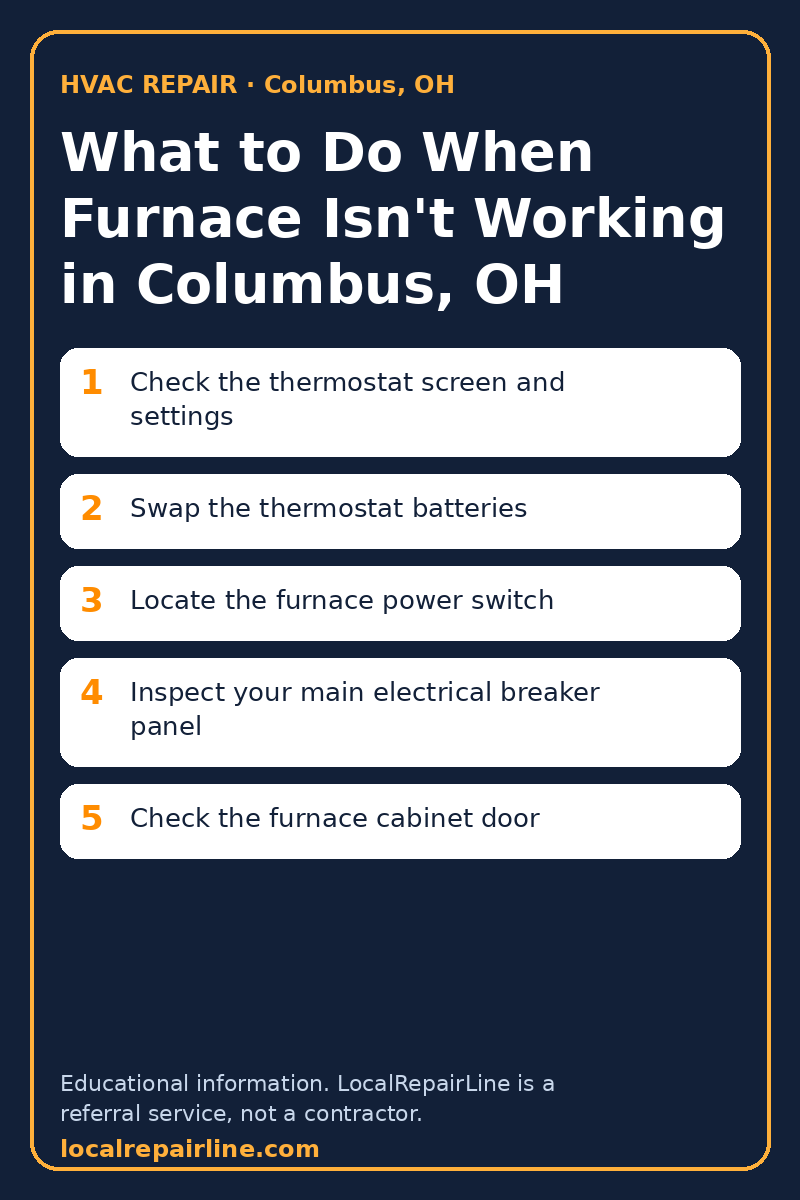
What to do when furnace isn't working Columbus OH: switches and thermostat settings
Many heating outages turn out to be simple control issues. You can run through these quick steps before looking deeper into the equipment:
- Check the thermostat screen and settings. Make sure the switch is firmly set to "Heat" rather than "Cool" or "Off." Bump the set temperature at least five degrees above the current room temperature to call for heat.
- Swap the thermostat batteries. If the display is blank or flashing a battery icon, low voltage might prevent the thermostat from sending the run signal to the control board.
- Locate the furnace power switch. This looks like an ordinary light switch, often mounted directly on the side of the furnace cabinet or on a nearby wall or ceiling joist. Family members sometimes flip this switch by accident thinking it turns on a basement light.
- Inspect your main electrical breaker panel. Look for a tripped switch in the panel box. A tripped breaker will sit halfway between "On" and "Off." Push it all the way to "Off" first, then back to "On."
- Check the furnace cabinet door. Most modern units have a safety interlock push-button behind the main service panel. If the door panel is loose or knocked out of alignment, the switch pops out and cuts all power to the system.
Checking filters and airflow registers for blockages
A dirty air filter is one of the most common reasons a furnace shuts down unexpectedly. When damp autumn air transitions rapidly into bone-chilling winter winds, Central Ohio heating systems face sudden, intense stress. Your furnace runs longer cycles to keep up, pulling high volumes of household air through the filter.
When that filter fills with pet hair and dust, the furnace can't pull enough air across the heat exchanger. Heat builds up rapidly inside the cabinet until a safety limit switch trips to keep the metal from cracking. The burner shuts off, leaving the blower motor pushing room-temperature or chilly air through your ductwork.
Slide the filter out and hold it up to a light. If you can't see light through the media, replace it immediately. While you're checking airflow, walk your main living spaces to ensure heavy furniture, drapes, or rugs aren't covering your supply registers or return grilles. Restricted return air causes the same overheating shutdowns as a clogged filter.
Inspecting exterior intake and drain lines for ice accumulation
Central Ohio endures prolonged stretches of frigid winter temperatures driven by Canadian cold fronts. In Columbus, frequent winter temperature swings around the frost threshold cause repeated thawing and severe ice buildup on exterior walls.
If you have a high-efficiency furnace, it vents through white PVC pipes that exit through the side of your home rather than an old metal chimney flue. Look outside where those pipes exit your foundation or wall.
- Snowdrifts and snowdrifts: Heavy drifting snow can completely cover intake and exhaust pipe terminations close to the ground, starving the burner of combustion air.
- Hanging icicles: Water dripping from overflowing gutters can coat the pipe openings in thick ice, choking off the draft.
- Frozen exhaust vapor: High-efficiency furnaces produce acidic water vapor that condenses at the exhaust tip. When temperatures plummet below zero, that vapor can freeze into solid rings of ice inside the pipe opening.
- Frozen drain lines: The condensation produced inside the furnace drains away through small plastic tubing. If that drain line runs through an unconditioned crawlspace or exits outside, it can freeze solid, backing water up into the furnace collector box.
When water or air can't move freely, the internal pressure switch stays open, and the furnace will refuse to light. Clear snow and ice away from exterior pipes by hand or with warm water. Never hammer on frozen PVC pipes with shovels or hammers, as cold plastic cracks easily.
Reading control board flash codes and safety lockouts
If your thermostat is calling for heat, the switch is on, and the vents are clear, look at the furnace itself. Most units built in the last twenty years have a small, clear glass peephole in the lower blower door.
Look through that sight glass to find a small LED light on the control board inside. Do not take the door off yet, because removing the door cuts the safety switch and clears the memory.
Count the light flashes. The light usually blinks in a distinct sequence, such as three steady red flashes, a pause, and then three flashes again. Some systems use a combination of rapid and slow blinks.
Find the diagnostic chart printed on the inside of the access panel or on the cabinet exterior. That chart acts as a translator. Common flash sequences indicate:
- Pressure switch errors: The furnace senses that the draft motor can't move air, often due to a blocked exterior PVC pipe, clogged drain, or failed switch.
- High-limit switch open: The unit overheated, usually pointing to an air filter problem or a failing indoor blower motor.
- Ignition failure or rollout: The unit tried to light three times, failed to sense a flame, and entered a safety lockout.
- Reversed electrical polarity: The unit detects that the wiring power and neutral lines are inverted, preventing safe electronic ignition.
When a furnace enters a safety lockout, it will usually sit idle for one to three hours before attempting to fire again. Writing down the exact flash pattern gives you a clear explanation of what the equipment is doing.
When DIY steps end and calling a local heating professional is essential
There is a clear line between basic homeowner checks and tasks that require specialized diagnostic gauges, electrical meters, and combustion analyzers.
The turning point occurs when basic thermostat, power switch, and vent inspections fail to restore heat, pointing to electrical diagnostic error codes or ignition failures that carry safety and carbon monoxide hazards. Working around natural gas lines, testing high-voltage capacitors, or removing burner assemblies without proper training puts your home at risk.
This is the point to connect with a local HVAC professional in Columbus, OH through localrepairline.com to diagnose the problem safely. When you schedule service, ask them to put the scope and parts in writing before work starts. A written breakdown of the work protects you from surprises and makes sure both sides agree on the repair. Costs vary by house, depending on whether you need a simple flame sensor cleaning, a new draft inducer motor, or a major control board replacement.
While you wait for a technician to arrive during a bitter cold snap, take practical steps to protect your home:
- Open cabinet doors beneath kitchen and bathroom sinks so warm room air reaches the plumbing.
- Let faucets on exterior walls run at a steady, pencil-lead-thin trickle to prevent supply lines from freezing.
- Close doors to unused bedrooms and seal drafts along exterior door thresholds with rolled-up towels.
- Run safe space heaters on flat, hard floors, keeping them at least three feet away from curtains, furniture, and blankets.
FAQ
Why is my furnace blowing cold air instead of heat?
This usually happens when the furnace overheats due to a dirty filter, tripping the high-limit switch. The burners turn off for safety, but the blower keeps running to cool the unit down. It can also occur if the pilot or electronic igniter fails to light the gas, or if the thermostat fan setting was switched to "On" instead of "Auto."
How do I reset my furnace after it stops running?
First, lower your thermostat setting below room temperature. Next, turn off the furnace power switch on the cabinet or flip the furnace breaker in your main electrical panel for sixty seconds. Switch the power back on, set the thermostat five degrees above room temperature, and watch for normal startup. If the furnace attempts to light and shuts down again, don't continue resetting it.
How long can a home go without heat before pipes burst in winter?
In sub-freezing Ohio weather, a well-insulated home usually stays safe for twenty-four to thirty-six hours before inside temperatures fall toward freezing. In poorly insulated homes or during severe sub-zero cold snaps, pipes along outside walls or in crawlspaces can freeze in as little as eight to twelve hours. Keep your interior faucets trickling to buy extra time while waiting for repairs.
What does it mean if my furnace is clicking but won't ignite?
The clicking sound is the ignition sequence starting, where the control board attempts to spark an igniter or open the main gas valve. If the burner fails to catch fire after a few seconds, the problem is often a dirty flame sensor, a worn hot surface igniter, or an interrupted gas supply. Because gas valves and ignition controls involve fuel combustion, these parts need hands-on attention from a technician.
Need an HVAC repair pro in Columbus, OH?
Talk to an independent local contractor who serves your area.
📞 Call (833) 669-0233HVAC repair in Columbus, OHCall hours: 8am–8pm ET, 7 days