Why Your Grand Rapids Furnace Keeps Shutting Off Fast
When your heater starts acting up on a freezing morning, it's more than just a minor annoyance. If your furnace keeps shutting off after a few minutes in Grand Rapids, MI, you're dealing with a common heating glitch known as short cycling. Your system kicks on, blows a little bit of heat, and then shuts right back down before the house actually warms up.
Grand Rapids experiences heavy lake-effect snowfall and prolonged sub-freezing winter temperatures that force heating systems to run continuously under high stress. When your furnace can't complete a normal heating cycle, your home gets chilly fast, and your energy bills start climbing. Spring and autumn bring rapid daily temperature fluctuations, causing heating systems to cycle unpredictably throughout the day. High humidity levels during seasonal transitions can affect outdoor intake and exhaust ventilation, triggering automatic safety shutdowns.
Here's why it happens, and what to do.
What Is Furnace Short Cycling?
Short cycling means your furnace cuts out prematurely before reaching the temperature set on your thermostat. Modern heating systems have built-in safety controls designed to protect the equipment from catching fire or damaging internal parts. When a sensor notices something is off, it kills power to the burners immediately.
Unfortunately, this constant stopping and starting puts a lot of wear and tear on the blower motor and the igniter. Instead of running in long, efficient stretches, the system constantly strains to get started.
Need an HVAC repair pro in Grand Rapids, MI?
Talk to an independent local contractor who serves your area.
📞 Call (833) 669-0233HVAC repair in Grand Rapids, MICall hours: 8am–8pm ET, 7 daysYour call may first be answered by a short screening service that asks what the problem is and where you are. Stay on the line and you will be connected to an independent local pro.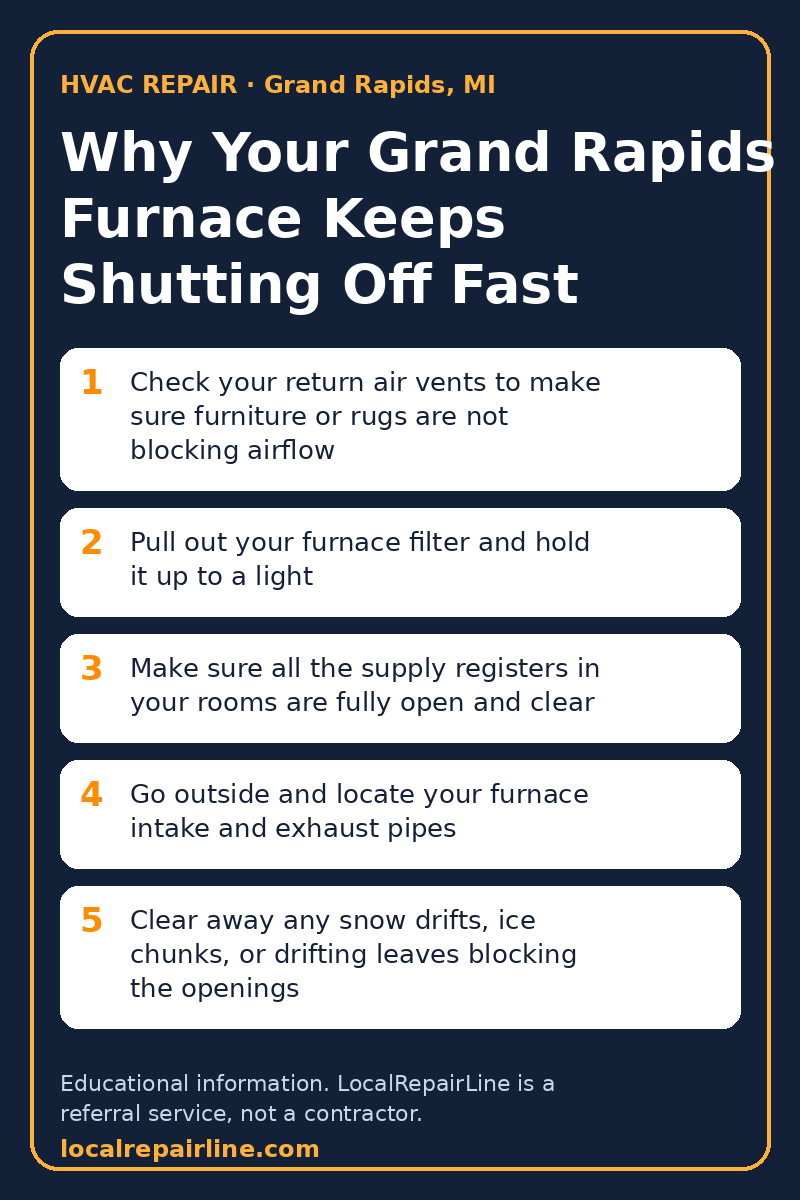
Restricted Airflow and Dirty Filters
The most common reason for a furnace to shut down quickly is a lack of proper airflow. If the air filter is choked with dust, pet hair, and debris, the heat exchanger gets too hot very fast.
- Check your return air vents to make sure furniture or rugs aren't blocking airflow.
- Pull out your furnace filter and hold it up to a light. If you can't see light through it, replace it immediately.
- Make sure all the supply registers in your rooms are fully open and clear.
No airflow, no heat. The safety controls shut the burners off to keep the furnace from overheating.
Flame Sensor Issues and Ignition Failure
Your furnace needs to prove it has a real flame before it keeps the gas valve open. A small metal rod, called the flame sensor, sits right in the path of the burners to detect this heat.
Over time, a thin layer of carbon soot or corrosion builds up on this rod. When that happens, the sensor can't read the flame, and the control board shuts the gas off within seconds of lighting up.
Cleaning a flame sensor is fairly straightforward if you're comfortable turning off the power and gas. You gently rub the metal rod with a piece of fine emery cloth or a dollar bill until the shiny metal shows again.
Overheating and Limit Switch Lockouts
Inside your furnace sits a high limit switch, which acts as the main safety guard against overheating. If the temperature inside the unit climbs past a safe threshold, this switch trips and cuts the burners.
Spring and autumn bring rapid daily temperature fluctuations, causing heating systems to cycle unpredictably throughout the day. These shoulder seasons also create stubborn condensation issues in modern high-efficiency furnace vents. If moisture gets trapped or fails to drain properly, it leads to premature limit switch lockouts.
Persistent limit switch trips point to a cracked heat exchanger or dangerous carbon monoxide risk, making professional diagnostic tools necessary. When this happens, it's time to contact https://localrepairline.com instead of guessing. A technician has the proper combustion analyzers and tools to test the integrity of the heat exchanger safely.
Venting Obstructions Caused by Lake-Effect Weather
High-efficiency furnaces vent exhaust gases and pull in combustion air through PVC pipes leading directly outside your house. Grand Rapids experiences heavy lake-effect snowfall and prolonged sub-freezing winter temperatures that can easily block these exterior openings.
If heavy wet snow or ice piles up against your direct-vent pipes, the pressure switch inside the furnace trips. This safety feature stops the furnace from running so dangerous exhaust gases don't back up into your living space.
- Go outside and locate your furnace intake and exhaust pipes.
- Clear away any snow drifts, ice chunks, or drifting leaves blocking the openings.
- Check the pipes for cracks or sagging sections where water might pool and freeze.
High humidity levels during seasonal transitions can also affect outdoor intake and exhaust ventilation, triggering automatic safety shutdowns. Keeping these vents clear is one of the easiest ways to prevent unexpected mid-winter shutoffs.
When to Call a Grand Rapids Heating Professional
Some furnace issues require more than a quick filter swap or a cleared snow drift. If you've cleaned the flame sensor, replaced the air filter, and cleared the outdoor vents, but the system still shuts down, you need expert help.
Electrical control boards, failing gas valves, and draft inducer motor failures require specialized testing equipment. A local heating technician can accurately read error codes and test electrical currents without risking damage to the equipment or your home.
FAQ
Why does my furnace blow warm air for two minutes and then shut off?
This usually means your furnace is overheating or failing to register a steady flame. When the internal temperature climbs too fast due to restricted airflow, the high limit switch trips to shut down the burners. Alternatively, a dirty flame sensor fails to detect the fire, causing the control board to cut the gas supply as a safety precaution.
Can a dirty air filter cause my furnace to keep shutting down?
Yes, a clogged air filter is the single most common culprit behind short cycling. When the filter blocks airflow, heat builds up rapidly inside the furnace cabinet. The safety switches detect this dangerous heat spike and turn off the burners to prevent internal damage.
How much does it cost to replace a faulty flame sensor?
Flame sensors are relatively inexpensive parts, usually costing just a small amount on their own. If you hire a technician to diagnose and replace it, the total cost will include local labor rates and a service dispatch fee. Costs vary by house and the specific brand of your heating system.
Is it safe to keep resetting my furnace when it locks out?
Repeatedly resetting your furnace when it keeps locking out isn't safe. Those lockouts are designed to protect you from serious hazards like carbon monoxide leaks or electrical fires. If clearing a snow-blocked vent or changing a filter doesn't fix the issue, stop resetting the unit and call a professional.
Need an HVAC repair pro in Grand Rapids, MI?
Talk to an independent local contractor who serves your area.
📞 Call (833) 669-0233HVAC repair in Grand Rapids, MICall hours: 8am–8pm ET, 7 days