AC Not Cooling in Gahanna OH? Practical Homeowner Guide
You walk past the thermostat on a muggy afternoon, and the screen says seventy-two, but the room feels heavy and stale. You put your hand up to a supply register, and the air coming out is lukewarm. Dealing with an ac not cooling Gahanna OH homes during a humid stretch is miserable, but you don't need to panic right away.
Sometimes the fix takes two minutes with no tools. Other times, the equipment is telling you to shut it down before an expensive part breaks. Here is how to figure out what is happening, what you can check on your own, and when to let a technician take over.
Immediate triage for an ac not cooling Gahanna OH
Before tearing into panels or making phone calls, run through these basic checks. Small mistakes happen, especially during late spring when cool Ohio mornings suddenly turn into baking afternoons.
- Check the thermostat setting. Make sure the switch is set to "Cool" and not "Heat" or "Off." Next, verify that the fan switch is set to "Auto" rather than "On." When the fan is set to "On," the indoor blower runs continuously even when the outdoor unit is resting, which blows uncooled, humid air through your vents.
- Check your indoor air filter. Pull the filter out of your furnace or air handler cabinet. If you can't see light through it, replace it right now. A choked filter cuts airflow so severely that the system can't transfer heat.
- Check the breaker panel. Head to your main electrical panel. Central air systems use two separate breakers: one for the indoor blower and one for the outdoor condenser. If the outdoor breaker tripped, the indoor fan will keep blowing room-temperature air while the compressor sits silent.
- Check the outdoor disconnect box. Look at the small metal box mounted on the exterior wall near your outdoor unit. Ensure the handle or pull-out block is fully seated in the on position.
If those four checks look normal and the vents are still warm, you're dealing with an equipment or airflow fault.
Need an HVAC repair pro in Columbus, OH?
Talk to an independent local contractor who serves your area.
📞 Call (833) 669-0233HVAC repair in Columbus, OHCall hours: 8am–8pm ET, 7 daysYour call may first be answered by a short screening service that asks what the problem is and where you are. Stay on the line and you will be connected to an independent local pro.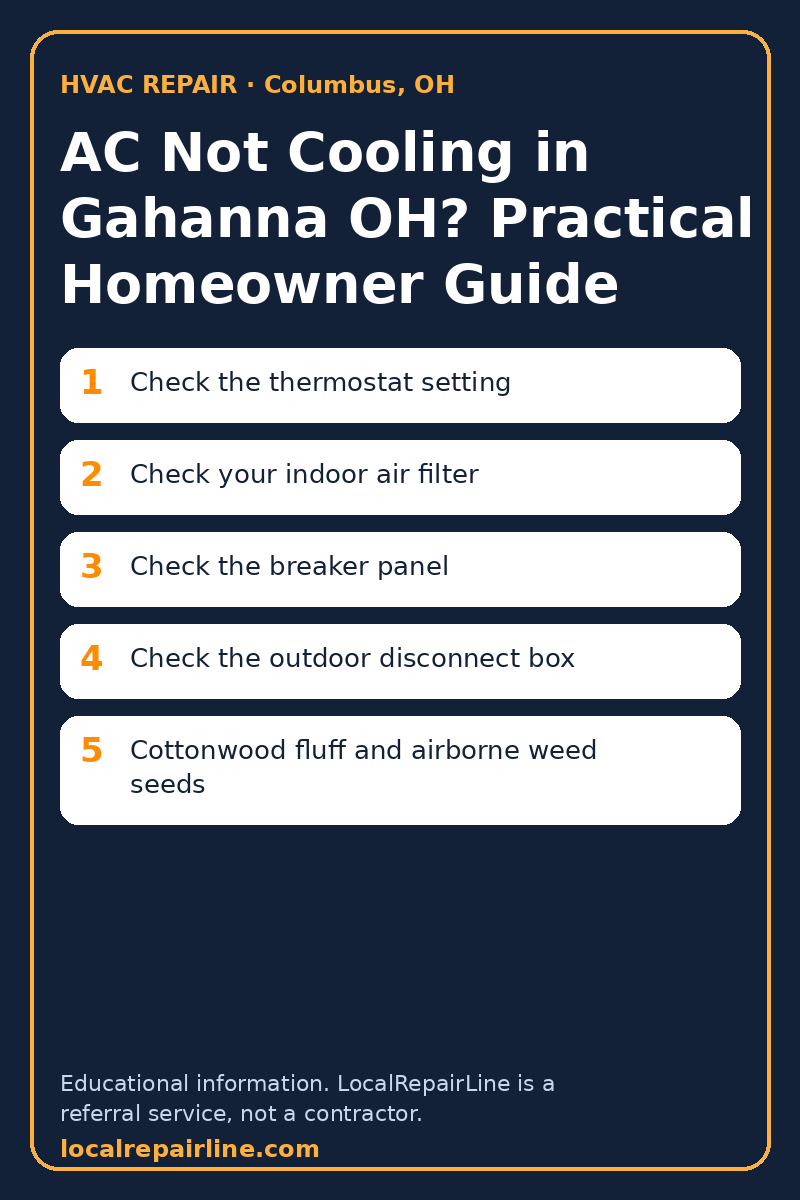
Why your home feels sticky and warm even with the AC running
Gahanna summers bring sustained, thick humidity that tests your cooling equipment every single day. Air conditioners are designed to do two jobs: lower the dry-bulb air temperature and pull moisture out of the air.
When your cooling system runs, moisture condenses on the cold indoor evaporator coil, collecting into droplets that run down a drain line. If the system is struggling with low airflow or restricted heat transfer, it can't pull that moisture out effectively.
You might notice the thermometer reading a reasonable temperature, yet your skin feels clammy and your living room feels like a greenhouse. A cooling system that runs endlessly without lowering humidity is usually running with a partially blocked coil, low airflow, or a cooling cycle that's cutting off too early.
Clogged outdoor units: how summer debris restricts heat release
Your outdoor unit, called the condenser, has one primary job: take the heat gathered from inside your house and dump it outdoors. It pulls outside air through thousands of thin aluminum fins across hot copper coils.
Summer thunderstorms around central Ohio routinely blow heavy tree debris, pollen, and dust across yards. When that dirt mixes with damp air, it forms a felt-like mat across the condenser fins.
Common debris that blocks airflow includes: * Cottonwood fluff and airborne weed seeds * Fresh lawn clippings blown directly against the metal cabinet * Dirt and silt kicked up by heavy downpours * Overgrown hostas, shrubs, or weeds planted too close to the sides
When air can't move freely through the outdoor fins, the unit can't shed heat. The refrigerant inside stays boiling hot, head pressure spikes, and the compressor's internal thermal limit switch will trip to save the motor from melting.
You can shut the power off at the outdoor disconnect and gently rinse the fins with a standard garden hose. Spray from the top down at a downward angle. Never use a high-pressure washer, because high pressure will crush the soft aluminum fins flat and permanently choke the airflow.
Iced evaporator coils and what happens when airflow drops
Take a look at the copper pipes running into your indoor furnace or air handler cabinet. Do you see white frost or a thick layer of ice encasing the insulated pipe?
When air can't move across the indoor coil, the refrigerant inside can't absorb heat. The coil temperature plummets below thirty-two degrees, and the moisture washing off your indoor air flash-freezes into a solid block of ice.
A choked filter, closed supply dampers, or dirt caked on the coil itself can trigger this freeze. However, an iced coil is also a classic sign that your system has developed a refrigerant leak.
If you see ice along the line or around the indoor cabinet, turn the system off at the thermostat immediately. Leaving an iced unit running forces the compressor to pump liquid refrigerant instead of vapor, which can destroy the motor in short order.
This is the exact point where guessing becomes risky. Rather than letting the unit run until the compressor burns out, switch the system to off and get in touch with a local HVAC technician in Gahanna, OH to find the root cause.
Float switch trips: the hidden reason your outdoor unit shuts down
Central Ohio's heavy moisture load leads to another common failure that confuses homeowners: the condensate float switch trip.
As your air conditioner wrings gallons of water out of the air daily, that water drops into an internal pan and flows through a white PVC pipe to a floor drain or a small pump. Over time, algae and household dust form a thick sludge inside that pipe.
When the drain clogs, the water backs up into the pan. Most modern setups include an overflow safety switch, located either in the drain line or the secondary drain pan. This safety switch contains a small plastic float.
When water rises, the float lifts and breaks the low-voltage control wire going outside. The outdoor condenser shuts down instantly to prevent water from overflowing through your ceilings or floorboards, but your indoor furnace blower keeps running.
You end up with a fan that blows warm air nonstop while the outdoor unit refuses to turn on. Clearing the drain line with a wet-dry vacuum at the exterior drain termination can sometimes drop the float and restore cooling, but if the pan fills again within hours, the trap or line needs mechanical clearing.
When to turn the system off and schedule professional service
Some repairs are safe to handle with basic household supplies, but other symptoms mean the system must stay off until a professional can test the mechanical components.
Shut the system down at the thermostat if you run into any of the following: * You hear a sharp buzzing, clicking, or grinding sound from the outdoor unit. * You smell electrical burning or hot plastic near the vents or the equipment. * The indoor coil or outdoor line set is covered in visible ice. * Water is leaking onto drywall, into your subfloor, or around the base of the furnace. * The outdoor breaker trips repeatedly after being reset once.
Never reset a tripped AC breaker more than one time. Breakers trip to prevent electrical fires caused by shorted wires or locked compressor motors.
When you call the LocalRepairLine team, describe what you checked, whether the outdoor fan was spinning, and whether you noticed any frost or water. Before work starts, ask them to put the scope of work and required parts in writing.
Costs vary by house, depending on the age of your system, the type of refrigerant it uses, and whether the issue is a simple electrical contactor or a deep leak inside the coil. Shutting the system down early protects your equipment from severe secondary damage while you wait for service.
FAQ
Why is my AC running but not cooling the house?
This usually happens when the indoor fan is working, but the outdoor unit has lost power or shut down on safety. Common culprits include a tripped outdoor breaker, a clogged condensate float switch that cut power to the condenser, or a dirty air filter that choked airflow.
How long does it take for an iced AC coil to thaw completely?
A frozen evaporator coil typically takes between four and twelve hours to melt entirely. You can turn the thermostat from "Cool" to "Off" and switch the fan setting to "On" to move room-temperature air over the coil and speed up melting. Keep towels nearby, because melting ice can easily overflow a standard drain pan.
Can a dirty air filter completely stop an AC from cooling?
Yes, a severely choked filter blocks the air your blower needs to transfer heat out of the house. Without proper airflow, the indoor coil can't warm up, causing it to freeze solid into an ice block that stops cooling completely.
Why is water pooling around my indoor furnace or air handler?
Water pooling around the indoor unit usually points to a clogged condensate drain line or an overflowing drain pan. High summer humidity forces the unit to extract gallons of water every day, and if algae or debris blocks the drain pipe, that water spills straight onto your floor.
Need an HVAC repair pro in Columbus, OH?
Talk to an independent local contractor who serves your area.
📞 Call (833) 669-0233HVAC repair in Columbus, OHCall hours: 8am–8pm ET, 7 days