AC Not Cooling Reynoldsburg OH: Troubleshooting Guide
You walk past a supply vent expecting a brisk chill, but you only feel a weak drift of room-temperature air. The thermostat is set to 72, yet the indoor display shows 77 and keeps climbing as the afternoon sun beats down on your roof.
When you face an ac not cooling Reynoldsburg OH summers will quickly turn your living space stuffy and sticky. Before assuming your compressor has quit for good, you can check several common failure points yourself. A few simple troubleshooting steps can help you pinpoint the issue or narrow down what to tell a technician.
Quick checks you can do when the air blows warm
System failures often stem from small, overlooked settings or neglected maintenance items. You can run through this quick checklist before touching any tools:
- Verify the thermostat mode and fan setting. Make sure the switch is set to COOL and not HEAT or OFF. Switch the fan from ON to AUTO, because the ON setting keeps the blower running even when the cooling cycle finishes, pushing unconditioned air through your vents.
- Inspect the breaker panel. Air conditioning systems rely on two separate circuits: one for the indoor air handler and one for the outdoor condenser. If the outdoor breaker trips while the indoor breaker stays on, your indoor blower will circulate warm air throughout the house.
- Examine your air filter. A filter blanketed in dust, pet hair, and lint suffocates the system. Slide it out and hold it up to a light; if light can't pass through, swap it out for a clean one right away.
If those three items look normal, the problem likely lies deeper inside the cooling equipment or the drainage setup.
Need an HVAC repair pro in Columbus, OH?
Talk to an independent local contractor who serves your area.
📞 Call (833) 669-0233HVAC repair in Columbus, OHCall hours: 8am–8pm ET, 7 daysYour call may first be answered by a short screening service that asks what the problem is and where you are. Stay on the line and you will be connected to an independent local pro.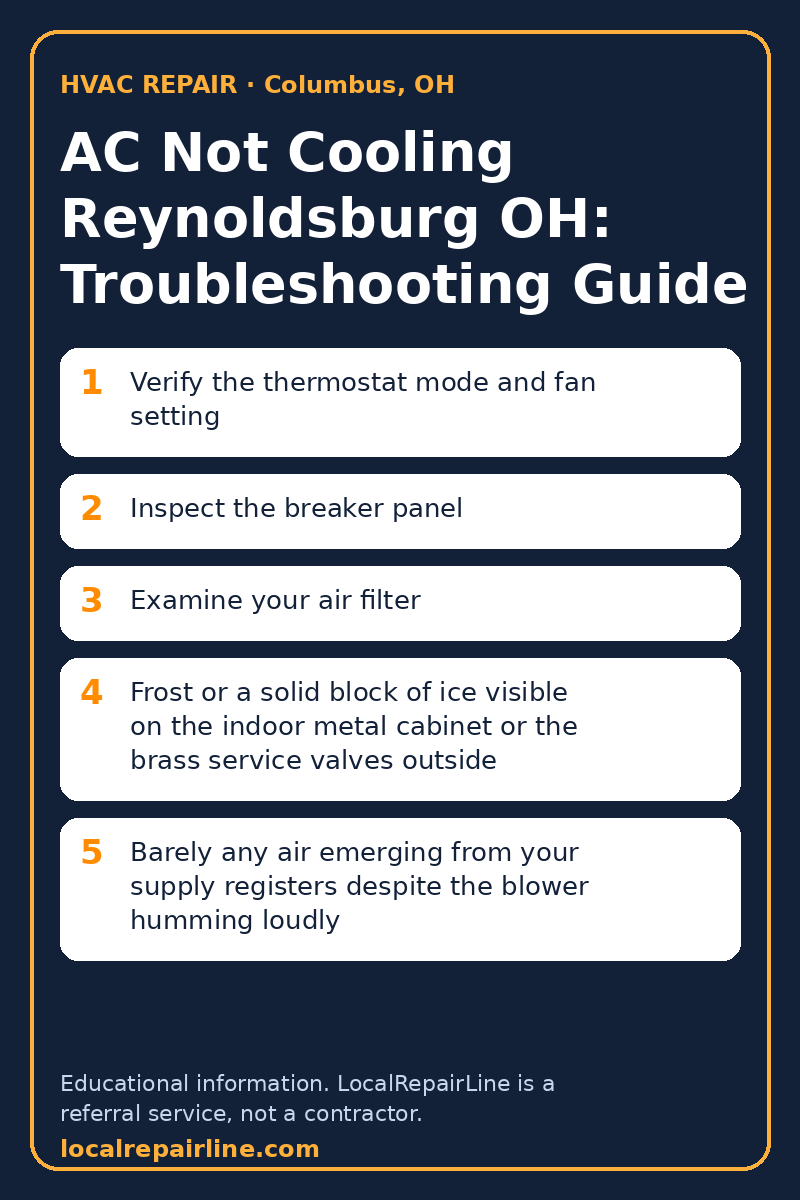
Why cooling trouble is often just a clogged drain line
Central Ohio's humid continental climate brings heavy moisture during July and August. Reynoldsburg experiences hot, muggy summers with sustained dew points that force cooling equipment to run prolonged dehumidification cycles. Significant daytime-to-evening temperature shifts cause heavy condensation to collect continuously inside your indoor cabinet.
Your air conditioner removes moisture from the air as it cools. That water drips off the cold evaporator coil into a small plastic drain pan and exits your home through a PVC condensate line. Over time, that damp pipe becomes an ideal breeding ground for algae, bacterial slime, and trapped dust.
When the drain line clogs, water backs up into the pan. Modern installations include a small safety device called a float switch wired directly to the pan or the drain line. When water rises, the float lifts and cuts power to the outdoor condenser or the entire system to protect your ceiling, drywall, and subfloors from water damage.
Homeowners often hear the indoor fan blowing, step outside, see the outdoor unit sitting silent, and assume the compressor has suffered a fatal breakdown. In reality, the equipment shut off intentionally because of water management issues. Clearing the drain with a wet-dry vacuum on the outdoor exit line or pouring a cup of white vinegar down the indoor access tee can sometimes restore operation once the pan empties.
How to spot a frozen coil and thaw it safely
When airflow drops or the system runs low on refrigerant, the indoor evaporator coil can't absorb heat properly. The surface temperature plunges below 32 degrees, causing moisture from the air to freeze across the metal fins instead of draining away.
Watch for these clear warnings of a freeze-up:
- Frost or a solid block of ice visible on the indoor metal cabinet or the brass service valves outside.
- Barely any air emerging from your supply registers despite the blower humming loudly.
- Water dripping onto the floor or pooling inside the furnace cabinet.
If you suspect ice, shut the cooling system off at the thermostat immediately. Leaving it running with ice on the coil can overheat the compressor and ruin it.
Switch the thermostat fan setting from AUTO to ON while leaving the system set to OFF. The fan will draw warm indoor air across the frozen metal to speed up the thawing process.
Lay old towels around the base of the indoor unit to catch runoff, as melting ice can easily overwhelm a standard drain pan. Never scrape or chip at the ice with screwdrivers or knives, as you could puncture the soft aluminum fins or copper tubing.
Outdoor unit troubles after spring storms
Central Ohio springs are wet and windy, scattering tree blossoms, helicopter seeds, and pollen across your yard. Sudden early-summer heat spikes frequently follow damp spring weather, catching outdoor condensing units covered in lingering tree debris and pollen.
Your outdoor unit relies on thin aluminum fins to release heat pulled from inside your home. When those fins become caked in grime, the unit can't shed heat, driving operating pressures and internal temperatures to dangerous levels.
Take a close look at the outdoor cabinet:
- Clear away tall grass, weeds, and brush to maintain at least two feet of open space around the perimeter.
- Look for thick mats of cottonwood fuzz or dried mud plastered against the metal louvers.
- Check the top fan grille for sticks, pine needles, and accumulated leaves dropped during recent windstorms.
You can clean light surface dirt yourself. Shut off the outdoor electrical disconnect switch mounted on the exterior wall nearby.
Then, take a standard garden hose with an adjustable nozzle and spray the fins gently from the top down, washing away the dirt. Never use a high-pressure washer, as the intense spray will bend the delicate aluminum fins and choke off outdoor airflow permanently.
Electrical failures that need professional attention
Air conditioners endure intense electrical strain when restarting during peak afternoon heat. Several critical parts inside the outdoor service panel handle this high-voltage demand, and they degrade over time due to heat cycles, power surges, and age.
The run capacitor functions like a temporary battery, providing the voltage jolt needed to start and steady the compressor and outdoor fan motor. When a capacitor weakens or bulges, the motor can't spin.
Similarly, the contactor acts as a heavy-duty switch that pulls in to deliver high-voltage power whenever the indoor thermostat calls for cooling. Contactors often develop pitted metal faces, carbon deposits, or insect blockages that prevent power from reaching the mechanical parts.
If you inspect the indoor air handler and discover ice forming along the copper refrigerant lines, water pooling around the base due to an overflowing drain pan, or hear a humming sound from an outdoor unit whose fan refuses to spin, stop testing the controls.
This is the point where you should reach out to Local Repair Line to find an experienced professional instead of guessing. Trying to force a stalled motor to spin or poking around high-voltage capacitors with household tools poses serious shock hazards and can burn out expensive motors in seconds.
What happens during a professional AC inspection
When an experienced technician arrives at your home, they follow a systematic diagnostic process rather than simply swapping parts at random. Understanding their process helps you evaluate what your system genuinely needs.
A proper cooling evaluation typically includes several standard diagnostic steps:
-
Capacitor and contactor testing: The technician uses a multimeter to measure the microfarad rating of each capacitor. If the reading drops more than five to ten percent below the rating stamped on the case, replacement is recommended. They will also inspect the contactor for electrical arcing and burnt contact points.
-
Refrigerant pressure analysis: Using a set of digital manifold gauges, the technician measures the suction and liquid line pressures alongside actual pipe temperatures. This allows them to calculate superheat and subcooling values, which show whether the refrigerant charge matches factory specifications or if a line leak exists.
-
Static pressure and temperature split testing: By taking air temperature readings before and after the indoor coil, the technician checks the delta T, which should usually fall between 16 and 20 degrees. Testing static pressure inside the ductwork reveals whether airflow bottlenecks are starving the system.
-
Electrical amp draws: Measuring the running amps on the blower motor, outdoor fan, and compressor helps catch mechanical friction before a motor seizes completely.
Repair costs vary by house depending on equipment age, system design, and the specific failed components. Simple repairs like clearing a primary drain or replacing a standard capacitor sit on the modest end of the scale, whereas tracing refrigerant leaks or replacing a failed fan motor require significantly more labor.
Always ask them to put the scope and parts in writing before work starts so you can make an informed decision for your home.
FAQ
Why is my air conditioner running continuously without lowering the temperature?
A system that runs nonstop without dropping the indoor temperature usually suffers from choked airflow, a heavy coating of dirt on the coils, or low refrigerant levels. Central Ohio humidity also forces the unit to spend significant energy pulling water from the air before sensible room temperatures begin to fall. If your filter is clean and the outdoor unit is clear of weeds, an internal mechanical issue is likely preventing proper heat transfer.
Can a clogged furnace filter prevent an air conditioner from cooling properly?
Yes, a severely clogged filter restricts the volume of warm air passing across the evaporator coil. Without sufficient warm air to heat the refrigerant flowing through the tubing, the coil quickly drops below freezing and develops a thick blanket of ice. Once iced over, air can't pass through the coil at all, causing supply vents to blow weak, warm air.
What should I do if I see frost or ice on my cooling lines?
Turn your air conditioner off at the thermostat right away to protect your compressor from catastrophic liquid floodback. Switch your thermostat fan setting to ON to circulate room-temperature air across the coil and melt the ice naturally. Place towels around the indoor equipment base to collect water, and leave the system off until a technician can locate the underlying airflow blockage or refrigerant leak.
How long should an air conditioner take to cool down a home during hot weather?
Under normal conditions, a properly sized air conditioner should lower indoor temperatures by roughly one degree every 30 to 45 minutes. During extreme heat spikes with high humidity, that rate slows considerably because the system must dedicate significant capacity to wringing moisture out of the air. If your system runs for several hours during moderate weather without moving the thermostat a single degree, something is wrong.
Need an HVAC repair pro in Columbus, OH?
Talk to an independent local contractor who serves your area.
📞 Call (833) 669-0233HVAC repair in Columbus, OHCall hours: 8am–8pm ET, 7 days