Does Insurance Cover Frozen Pipes Pittsburgh PA? What to Know
If you're asking does insurance cover frozen pipes Pittsburgh PA homeowners deal with every winter, the short version is: often yes, but not always. It depends on how the pipe failed, what you did to prevent it, and how your policy is worded.
Here's how that plays out in a Pittsburgh winter, and what to do before you call your insurer.
Short Answer: Does Insurance Cover Frozen Pipes Pittsburgh PA?
Some homeowners policies address sudden, accidental water damage from a pipe that freezes and bursts, but whether yours does depends on its exact wording. That typically means the repair of the damage the water caused, like soaked drywall, ruined flooring, and damaged belongings.
The catch is the fine print. Some policies spell out a duty to take "reasonable care" to keep the home heated, so look for that wording in yours. If the heat was off, or the house sat empty, a claim can get tougher.
Your policy is the final word. Read the water damage section and the exclusions, or ask your agent to explain them in plain terms.
Need a plumbing repair pro in Pittsburgh, PA?
Talk to an independent local contractor who serves your area.
📞 Call (833) 350-0420Plumbing repair in Pittsburgh, PACall hours: 8am–8pm ET, 7 daysYour call may first be answered by a short screening service that asks what the problem is and where you are. Stay on the line and you will be connected to an independent local pro.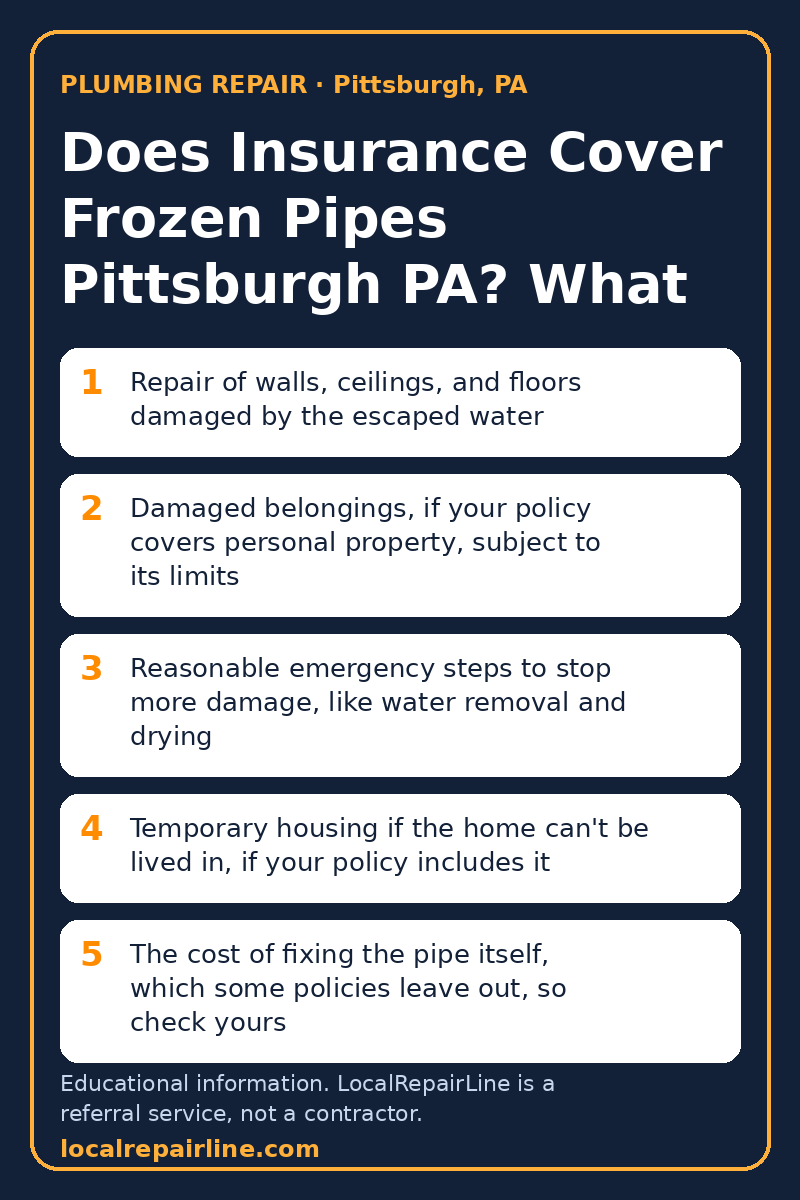
What a Standard Policy May Cover (and What It May Not)
Pittsburgh winters swing between hard cold snaps and milder thaws. A pipe can crack during the freeze and only start leaking once things warm up. Whether that counts as a freeze-related burst is up to your insurer and your policy wording, so a clear record of what happened helps.
Coverage under a typical policy may include:
- Repair of walls, ceilings, and floors damaged by the escaped water
- Damaged belongings, if your policy covers personal property, subject to its limits
- Reasonable emergency steps to stop more damage, like water removal and drying
- Temporary housing if the home can't be lived in, if your policy includes it
Things that are often excluded or limited:
- The cost of fixing the pipe itself, which some policies leave out, so check yours
- Damage from slow leaks or long-term wear
- Water that came from outside, like groundwater or surface flooding
- Damage you could have prevented or didn't act on quickly
That point on outside water matters here. Pittsburgh springs bring heavy rain and snowmelt, and a wet basement in March isn't always a frozen pipe problem. Flood and seepage may be treated differently than a burst supply line under your policy, so the cause matters.
Where Pittsburgh Frozen Pipe Claims Can Run Into Trouble: Heat, Vacancy, and Maintenance Clauses
Disputes often come down to a few policy clauses. Knowing them ahead of time helps you avoid common traps.
The "maintain heat" clause
Your policy may include a clause asking you to use reasonable care to keep the building heated, or to shut off and drain the water system if you can't. A furnace that failed without your knowledge is a different situation from turning the heat way down to save money, and your policy wording may treat them differently.
Evidence can help show what "reasonable" looked like in your case. Thermostat settings, fuel delivery records, and a repair history for the heating system are all worth keeping.
Vacancy or extended absence
If the house was empty or you were away for a while, some policies limit coverage. The wording varies, and so do the time limits. Check what counts as "vacant" or "unoccupied" in your policy before you leave for a long winter trip.
Maintenance and neglect
A policy may exclude damage when the pipe failed from age, corrosion, or an old problem you ignored. A pipe that froze because it ran through an uninsulated exterior wall is a gray area. It could be read as a weather event or as a maintenance issue, depending on the policy language and the facts.
This is where a plumber's written note on what failed and why can help.
First 60 Minutes After a Pipe Bursts: Protect Your Claim and Your Home
Your policy likely expects you to limit the damage quickly. You'll also want proof of what caused it. Do both at once.
- Shut off the main water. Know where it's before you need it. Turn it off and open a faucet or two to drain the lines.
- Stay safe around electricity. If water is near outlets, panels, or appliances, stay out and shut off power only if you can do it from a dry spot.
- Take photos and video. Capture the burst pipe, the water, wet walls, ceilings, floors, and any damaged belongings before you move anything.
- Stop the spread. Move valuables, mop up what you safely can, and run fans if the area is safe. Keep every receipt.
- Save the damaged pipe section. Don't toss it. It shows the split and helps document that a freeze caused the failure.
- Call your insurer to report the loss. Ask what they need and what emergency work they'll accept.
Call a local plumbing pro now, not later
This is the point to bring in a local plumber in Pittsburgh, PA, such as through localrepairline.com, rather than guessing. If water is flowing or a line is frozen solid, you've shut off the main and taken your photos, so the next move is a professional.
A plumber can thaw or repair the line safely and find the real cause of failure. Ask for a written note describing what failed, where, and why. That short document can help support your claim if questions come up.
Don't try to thaw a pipe with an open flame. It's a fire risk, and it can make the damage worse.
Frozen but Not Burst: Is a Thawing Pipe Covered?
A pipe that's frozen but still intact is a gray area. No water damage usually means no damage to claim.
Your policy may not pay to thaw a pipe or do preventive work, since nothing has been damaged yet. Policies can treat this differently, so ask your agent instead of assuming.
Still, document it. Take photos of the frost, the location, and any unheated space involved. If the pipe cracks after thawing, those early records show you acted fast.
Watch for warning signs during a cold snap:
- Little or no water from a faucet
- Frost on an exposed pipe
- Strange sounds when water finally starts flowing
- A damp spot appearing after temperatures rise
Pittsburgh thaws can hide a split pipe until the ice melts and water starts moving. If you suspect damage, shut off the main and call a plumber.
Repair Cost vs. Deductible: Should You File at All?
Not every burst pipe is worth a claim. Sometimes the repair costs less than your deductible, so filing would pay you nothing.
Costs vary by house. A single split in an accessible basement pipe is a very different job than water running through a finished ceiling or wall. The extent of the water damage drives most of the bill.
Think through these tradeoffs:
- Deductible size. If total repairs come in under it, a claim won't pay out.
- Claim history. Ask your agent how a claim could be recorded and whether it might affect renewal or pricing.
- Hidden damage. Wet insulation or drywall can add costs you don't see yet.
- Big losses. If water spread widely, a claim is often worth it.
A fair approach is to get a plumber's written assessment and repair scope first. Then talk to your agent about how a claim might affect you. Some people call just to ask questions before filing, and that's reasonable. Ask your agent up front whether a general question gets recorded.
Winterizing Pittsburgh Pipes So You Never Have to Find Out
Prevention is much cheaper than a claim, and it also supports the "reasonable care" your policy may expect.
Before the cold arrives:
- Insulate pipes in basements, crawl spaces, garages, and exterior walls
- Disconnect outdoor hoses and shut off exterior spigots if your house allows
- Seal air leaks near pipes where cold can sneak in
- Keep the heat on, even when you travel
- Open cabinet doors under sinks on exterior walls during hard cold
- Let a faucet drip during the worst stretches
- Know where your main shutoff is and make sure it works
If you'll be gone for a while, consider asking a trusted person to check on the house. Some people also have a plumber drain the system for long absences.
FAQ
Does homeowners insurance cover a burst pipe from freezing in Pennsylvania?
It can, but it depends on your policy and the facts, such as whether the burst was sudden and accidental and whether the home was kept reasonably heated. Your policy may treat the resulting water damage separately from the cost of fixing the pipe itself, so ask your agent how each is handled. Check your policy language, since details differ between insurers.
Will my insurance pay if my pipes froze but didn't burst?
Usually not, since there's no damage yet to pay for. Thawing and preventive work are commonly treated as maintenance. Ask your agent, and document the frozen pipe with photos in case it cracks later.
Does insurance cover frozen pipes if I was away or the house was vacant?
It depends on the policy. Many have limits or conditions for homes that are vacant or unoccupied for a set period, and some require you to shut off and drain the water system. Read those terms before you travel in winter.
Will filing a frozen pipe claim raise my homeowners insurance rates?
It can, depending on your insurer and your claim history. Claims may stay on your record and affect renewal. If the repair cost is close to your deductible, it's worth talking with your agent before you file.
Need a plumbing repair pro in Pittsburgh, PA?
Talk to an independent local contractor who serves your area.
📞 Call (833) 350-0420Plumbing repair in Pittsburgh, PACall hours: 8am–8pm ET, 7 days