Does Insurance Cover Frozen Pipes in Springfield, OH? A Guide
If you're typing "does insurance cover frozen pipes Springfield OH" into a search bar, you probably have a cold house, a trickle that stopped, or a wet ceiling. The answer depends on one thing first: is the pipe only frozen, or has it burst?
Policies differ, so treat this as a guide to the questions to ask, not a ruling on your claim. Your policy and your agent have the final word.
Frozen Pipe vs. Burst Pipe: Why the Difference Matters to Your Claim
A frozen pipe is blocked with ice but still in one piece. Water won't come out of the faucet, but nothing is leaking. In that case, there's usually no damage to claim. You're looking at a thaw, which is a maintenance cost most homeowners pay themselves.
A burst pipe is different. Ice can crack or split the pipe, and the water often shows up only after things warm up and the ice plug melts. That's when floors, drywall, and ceilings get soaked.
Claims usually begin with that water damage, and sometimes with the repair of the broken pipe itself. That's why the line between "frozen" and "burst" matters so much.
A pipe can also be frozen in one spot and split in another. If you can't tell which one you have, treat it as possibly burst until someone checks.
Need a plumbing repair pro in Springfield, OH?
Talk to an independent local contractor who serves your area.
📞 Call (833) 350-0420Plumbing repair in Springfield, OHCall hours: 8am–8pm ET, 7 daysYour call may first be answered by a short screening service that asks what the problem is and where you are. Stay on the line and you will be connected to an independent local pro.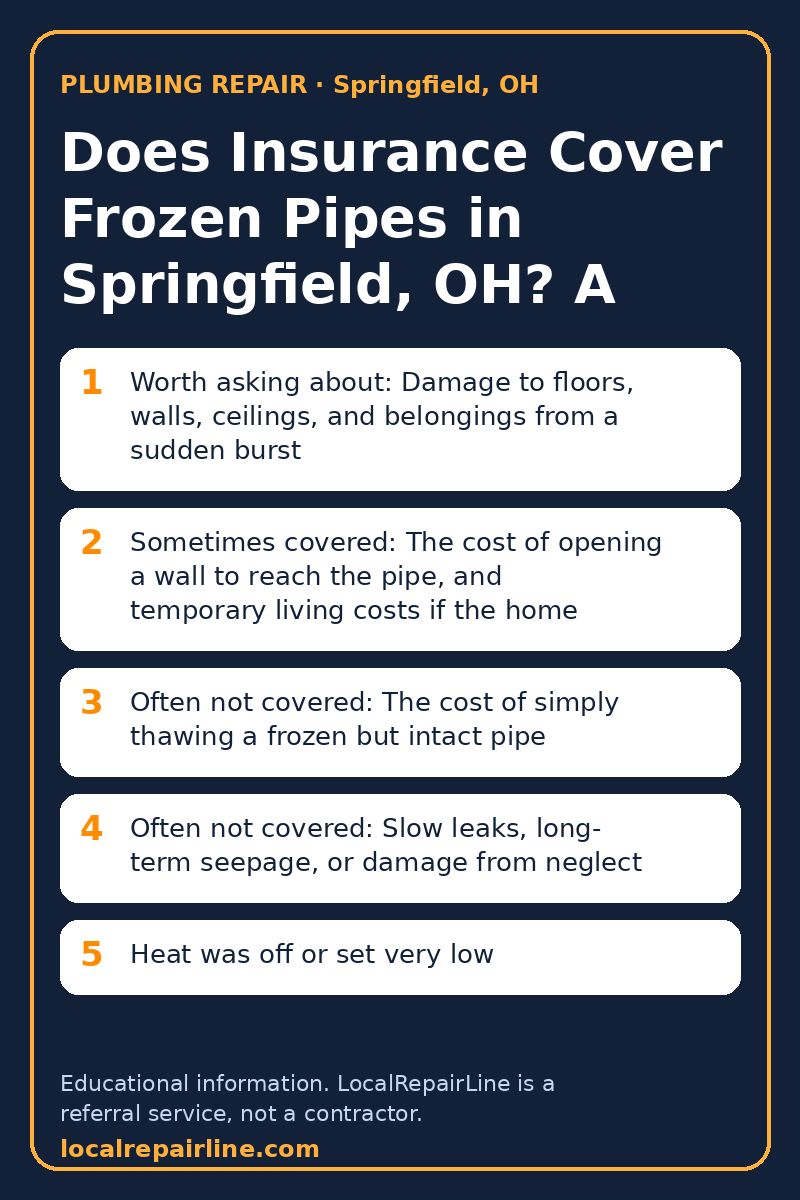
Does Insurance Cover Frozen Pipes Springfield OH Homes Deal With? What Policies Typically Pay
Whether your policy covers a pipe that bursts because of ice depends on its wording. Look for the section on sudden and accidental water damage, and ask your agent how it applies. Some policies also pay to tear into a wall or floor to reach the break. Others limit that part, so ask.
Here's how it commonly breaks down. Exact terms vary by policy:
- Worth asking about: Damage to floors, walls, ceilings, and belongings from a sudden burst.
- Sometimes covered: The cost of opening a wall to reach the pipe, and temporary living costs if the home can't be used.
- Often not covered: The cost of simply thawing a frozen but intact pipe.
- Often not covered: Slow leaks, long-term seepage, or damage from neglect.
You'll also have a deductible. If the damage is small, it may be less than the deductible, and a claim may not make sense. Costs vary by house, so get the repair scope in writing before you decide.
Ask your agent how your policy treats the pipe repair itself versus the resulting damage. They are often handled differently.
Conditions That Can Get a Frozen Pipe Claim Denied
Check whether your policy asks you to take "reasonable care." That can mean keeping the house warm enough to prevent freezing, so read the exact wording. Policies often spell this out with conditions like "heat maintained."
Here are common issues that can cause trouble with a claim:
- Heat was off or set very low. Many policies expect you to keep the home heated.
- The home sat vacant. Some policies limit coverage if a house is empty for a set period. Check the wording.
- Water wasn't shut off when it was required. If you leave a home unheated, a policy may expect you to drain the system.
- The pipe was in an unheated area. Some policies treat crawl spaces, detached garages, or outbuildings differently.
- It looks like long-term damage. Rust, old drips, or past leaks can look like "wear and tear" instead of a sudden break, and many policies treat those differently.
- You waited. Letting water run for days without stopping it or trying to limit damage may cause problems, since many policies expect you to take reasonable steps to prevent further loss.
Ohio winters make this tricky. A cold snap followed by a thaw, then another cold snap, can make the timeline matter, so be ready to say what you did and when. Pipes can weaken over repeated cycles, and a burst may show up days after the cold passed.
Keep notes on when the heat went on or off and when you first noticed trouble. Those details can matter.
What to Do in the First Hour: Protect Your Home and Your Claim
Take a breath and work through these steps in order. Your goal is to stop more damage and keep proof of what happened.
- Shut off the main water supply. Know where it's before you need it. If you can't find it or can't turn it, say so when you call for help.
- Turn off the power to wet areas if it's safe. If water is near outlets, panels, or appliances, stay out and don't touch anything.
- Open faucets and let the pipe drain once the water is off. This relieves pressure and lowers the amount of water that can leak out.
- Take photos and video before you clean up. Show the pipe, the water, and every wet surface.
- Move belongings out of the way. Protect what you can, and keep damaged items in case your insurer wants to see them.
- Save the broken pipe section. If a piece comes out, keep it. It can show how and where the pipe failed.
Don't use open flames, a torch, or a heat source you can't control to thaw a pipe. That's a fire risk.
When to Call a Local Plumber Before You Call Your Insurer
This is the point to talk to a local plumbing pro in Springfield, OH instead of guessing, and you can find one through https://localrepairline.com. If water is running, a pipe is visibly split, or a line is still frozen behind a wall, you need someone to stop the water, find the break, and fix it.
You can still call your insurer right away to report the loss. But a plumber is the one who can:
- Stop the leak and make the system safe.
- Find where the pipe failed and why.
- Check for other weak spots nearby.
- Put their findings in writing.
That last item matters. A written report that says the pipe burst because of ice, where it happened, and what condition the pipe was in can back up your account of what happened. Without it, you may have only your own description. Ask the plumber to note the location, the cause, and the repairs made, and to take photos.
Plumbers don't decide your coverage, and they can't tell you how a claim will turn out. What they can do is give you clear facts to hand over.
Document the Damage: What to Gather for Your Claim
Whoever handles your claim will likely want evidence. The more you collect early, the easier it is to explain what happened.
Gather these:
- Wide photos of each room, then close-ups of damage.
- Video walking through the affected areas.
- A list of damaged belongings, with age and approximate value if you know them.
- Receipts for emergency repairs, drying, or temporary lodging.
- The plumber's written findings.
- The damaged pipe section.
- Notes on thermostat settings and when you left or returned, if you were away.
Don't throw out wet materials until you've checked with your insurer, unless they pose a health or safety risk. If you must remove something, photograph it first.
Mold can start in damp spaces if drying is delayed. Tell your insurer how you're drying the area, and keep the paperwork.
Springfield Winters and Vacant or Unheated Spaces: Where Pipes Fail First
Springfield has four real seasons, and winter can be hard. Arctic air can reach southwest Ohio fast, and then a milder stretch follows. That up-and-down pattern is rough on plumbing.
The first places to fail tend to be the ones that don't get much heat:
- Crawl spaces
- Garages, especially with water lines on the walls
- Pipes inside exterior walls
- Spots near a drafty window, door, or vent
- Basements or utility areas with little warmth
If you're leaving for a few days or the house will sit empty, keep the heat on at a safe setting, and let your insurer know if it will be vacant for a while. Opening cabinet doors under sinks on exterior walls helps warm air reach pipes. A slow drip from a faucet on a cold night can also help keep water moving.
If you know a pipe has frozen before, have a plumber look at insulation or rerouting before the next cold snap. Costs vary by house, so get the repair plan in writing.
FAQ
Does homeowners insurance cover a burst pipe from freezing?
It can, depending on your policy, since the wording on sudden and accidental water damage varies. Coverage may apply to the resulting water damage and sometimes to the access work needed to repair the pipe. Read the conditions on heat, vacancy, and neglect, then ask your agent how they apply.
Will my insurance pay to thaw frozen pipes if nothing has burst yet?
Your policy may treat it as a maintenance cost rather than a claim, since a frozen pipe that hasn't broken may have no damage to claim. Your agent can confirm how your policy reads. Call a plumber if you can't tell whether the pipe has split.
Need a plumbing repair pro in Springfield, OH?
Talk to an independent local contractor who serves your area.
📞 Call (833) 350-0420Plumbing repair in Springfield, OHCall hours: 8am–8pm ET, 7 days