Does Insurance Cover Furnace Repair in Cleveland, OH? A Guide
Your house is getting cold, and you're searching does insurance cover furnace repair Cleveland OH. The honest answer is sometimes, but less often than you'd hope.
Homeowners insurance may help when something sudden and outside the normal life of the furnace damages it, depending on your policy. Many policies exclude a furnace that simply wore out, so check yours. Here's how to tell which one you have, and what to do while you wait.
Short Answer: Does Insurance Cover Furnace Repair Cleveland OH Homes Need?
A homeowners policy may cover furnace damage from a sudden event, like a fire, a power surge from a lightning strike, or a burst pipe that floods the equipment, depending on how the policy is worded. It generally doesn't cover a furnace that quit because of age, rust, dirt, or a part that wore out.
Policies differ, so read yours or call your agent to ask what it says about "mechanical breakdown" and "wear and tear." Look for those two phrases, since they affect how a furnace failure may be treated.
A home warranty is a separate product with different rules. We'll get to that below.
Need an HVAC repair pro in Cleveland, OH?
Talk to an independent local contractor who serves your area.
📞 Call (833) 669-0233HVAC repair in Cleveland, OHCall hours: 8am–8pm ET, 7 daysYour call may first be answered by a short screening service that asks what the problem is and where you are. Stay on the line and you will be connected to an independent local pro.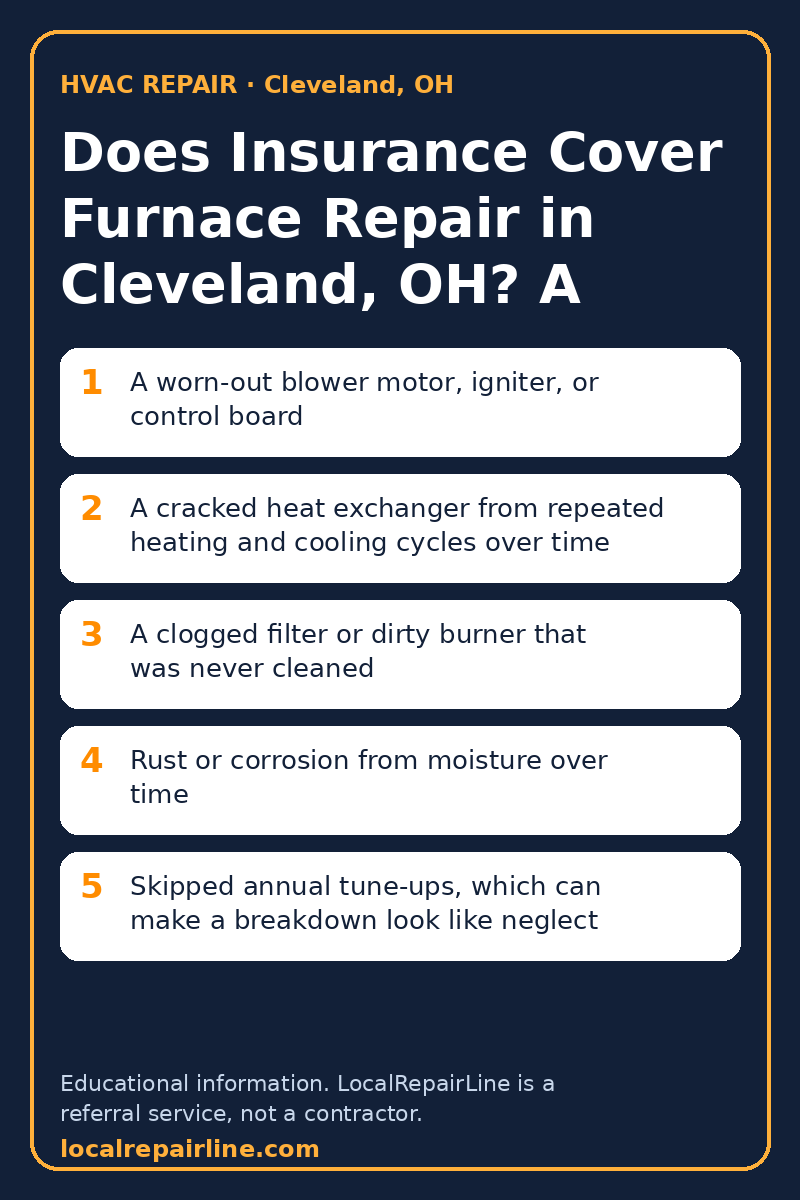
What Insurance Almost Never Pays For (Wear, Age, and Neglected Maintenance)
Cleveland furnaces work hard. Winters are long and cold, lake-effect snow rolls in off Lake Erie, and the system can run for months with few breaks. Fall and spring swings add another strain, because the furnace cycles on and off many times a day.
All that running wears parts out. A furnace that quits in a January cold snap is usually showing the result of gradual wear, which many policies list as excluded. Age matters here too, especially in an older home with an older furnace.
Common reasons a claim gets denied:
- A worn-out blower motor, igniter, or control board
- A cracked heat exchanger from repeated heating and cooling cycles over time
- A clogged filter or dirty burner that was never cleaned
- Rust or corrosion from moisture over time
- Skipped annual tune-ups, which can make a breakdown look like neglect
- General age, with no single event behind the failure
Summers here are warm and humid, and the same ductwork and blower often serve both heating cooling. That means the system rarely gets a true rest. A full year of heavy use can look like the cause of a breakdown.
Covered Causes: Fire, Electrical Surges, Burst Pipes, and Storm Damage
Some events can put a furnace claim on solid ground. These are sudden, specific, and not caused by neglect.
- Fire or smoke damage: If a fire in the home damages the furnace or its venting, that's generally the kind of loss policies are written for.
- Electrical surge: A lightning strike or utility surge that fries a control board may qualify. Some policies limit surge coverage, so check.
- Burst pipes or water damage: A pipe that breaks and floods a basement furnace can be a covered water loss, depending on the cause.
- Storm damage: A fallen tree, ice, or wind damage to the exterior unit, flue, or vent could count.
- Vandalism or theft: Rare, but it can apply.
Even then, the cause has to be proven. Ask your insurer whether the policy pays only for the damaged part or also for upgrades or code changes. Costs vary by house, and so do payouts.
Home Warranty vs. Homeowners Insurance for Cleveland Furnaces
These two get mixed up all the time. They cover different things.
Homeowners insurance protects against sudden losses. A home warranty is a service contract that may cover breakdowns from normal use, which is the very thing insurance skips.
Warranty plans often come with limits:
- Coverage caps on how much they'll pay per repair or per system
- Exclusions for pre-existing conditions or poor maintenance
- A service fee each time a technician comes out
- Requirements to use the plan's own contractors
- Terms that may let the plan deny a repair if a part is found to be improperly installed or out of code
If you already have a warranty, read the furnace section closely and ask about proof of past maintenance. If you don't have one, buying a plan after the furnace is already acting up usually won't help, since many plans treat that as a pre-existing problem.
How to Document Furnace Damage and File a Claim Step by Step
How you record the problem matters. A claim over a sudden event is much stronger when you can show what happened and when. A claim that looks like gradual wear may be denied.
- Stay safe first. If you smell gas, leave the house and call your gas utility from outside. If a carbon monoxide alarm sounds, get everyone out and call for help.
- Take dated photos and video. Capture the furnace, the area around it, any soot, water, scorch marks, a tripped breaker, and the thermostat.
- Write down the timeline. Note when the heat stopped, what you heard or smelled, and whether there was a storm, outage, or flood.
- Gather records. Pull together past tune-up invoices, filter changes, and any earlier repair notes.
- Get a written diagnosis. Ask a technician to put the cause of failure in writing.
- Call your insurer. Report the loss, ask about your deductible, and ask what they need next.
- Keep damaged parts if you can. Don't let a tech toss a failed part before you've asked your insurer whether they need to see it.
Why the written diagnosis matters
A report from a qualified technician is the main way to separate a sudden covered event from slow wear. Your insurer may ask for one, so it helps to get it early.
When the Furnace Is Out in a Cold Stretch, Call a Local HVAC Pro
This is the point to talk to a local HVAC pro in Cleveland, OH instead of guessing. Do it if the furnace is out during a cold stretch, or if you see warning signs like:
- A gas smell
- Soot around the furnace or vents
- A breaker that keeps tripping
- A suspected cracked heat exchanger
A qualified technician can look for the cause, tell you whether the equipment is safe to run, and give you a written report you may be able to use if you file a claim, and this homeowner resource can help you know what to expect. You don't have to wait for a claim decision before you call. Timelines vary by insurer, so ask yours how long a look usually takes while you sort out heat for the house.
An unheated house in a hard freeze can also put the plumbing at risk, which would add a second repair to deal with. Tell the technician you may file a claim so they document the findings with that in mind.
For temporary warmth, use only heaters made for indoor use, keep them away from curtains and bedding, and never run a gas oven or grill for heat. Make sure your carbon monoxide alarms work.
Repair or Replace? Weighing Cost Against Your Deductible in a Cleveland Winter
Before you file, compare the repair cost to your deductible. If the repair costs about what the deductible is, or less, a claim won't put money in your pocket.
A claim can also affect your premium or renewal, depending on your insurer. Ask your agent how a small claim might be handled before you file one.
Think about these factors:
- Furnace age: An older unit with a major failure often points toward replacement.
- Repair cost vs. replacement cost: If a repair is a large share of a new system's price, replacing may make more sense.
- Repeat breakdowns: Several repairs in a few winters are a sign the system is near the end.
- Efficiency: Newer furnaces may use less fuel over a long heating season.
- Cooling side: If your system also handles summer cooling, ask whether replacing both parts together makes sense.
Policies often exclude replacing a furnace that simply aged out, so check your wording. Plan on paying for that yourself unless a covered event caused the loss.
FAQ
Does homeowners insurance cover a furnace that just stopped working?
Often not. Many standard policies exclude failures from age, wear, or a lack of maintenance, but wording varies, so check yours. If a covered event like a fire, surge, or burst pipe caused the failure, you may have a claim.
Does a home warranty cover furnace repair, and what does it exclude?
It can, if you have a plan that includes heating and the breakdown comes from normal use. Plans often exclude pre-existing problems, poor maintenance, and repairs above a coverage cap. You'll usually pay a service fee per visit, too.
Will insurance pay to replace an old furnace?
Generally no, unless a covered event destroyed it. Age alone isn't a covered cause. Even after a covered loss, the payout may be based on the policy's terms rather than a brand-new up
Need an HVAC repair pro in Cleveland, OH?
Talk to an independent local contractor who serves your area.
📞 Call (833) 669-0233HVAC repair in Cleveland, OHCall hours: 8am–8pm ET, 7 days