Does Insurance Cover Furnace Repair in Fort Wayne, IN?
The furnace quits on a January night, the house starts to cool, and you search "does insurance cover furnace repair Fort Wayne IN" on your phone. It's a fair question, and the honest answer is "sometimes, but not for the reason most people hope."
Here's how coverage usually works, how an adjuster is likely to see your situation, and what to do if the answer is no.
The Short Answer: Does Insurance Cover Furnace Repair Fort Wayne IN?
Whether your policy pays depends on its wording, but the question usually comes down to the cause. Damage from a sudden event your policy names, such as fire, lightning, or a windstorm, is worth raising with your insurer. A furnace that simply wore out or broke down is a different situation, so check whether your policy lists wear or mechanical breakdown as exclusions.
So the cause matters more than the symptom. A furnace that won't turn on is the same problem whether lightning fried the control board or the blower motor gave out after years of use. Only the first is likely to be a claim.
Policies differ, so read yours or call your agent. Look for the sections on covered perils, exclusions, and anything about mechanical breakdown.
Need an HVAC repair pro in Fort Wayne, IN?
Talk to an independent local contractor who serves your area.
📞 Call (833) 669-0233HVAC repair in Fort Wayne, INCall hours: 8am–8pm ET, 7 daysYour call may first be answered by a short screening service that asks what the problem is and where you are. Stay on the line and you will be connected to an independent local pro.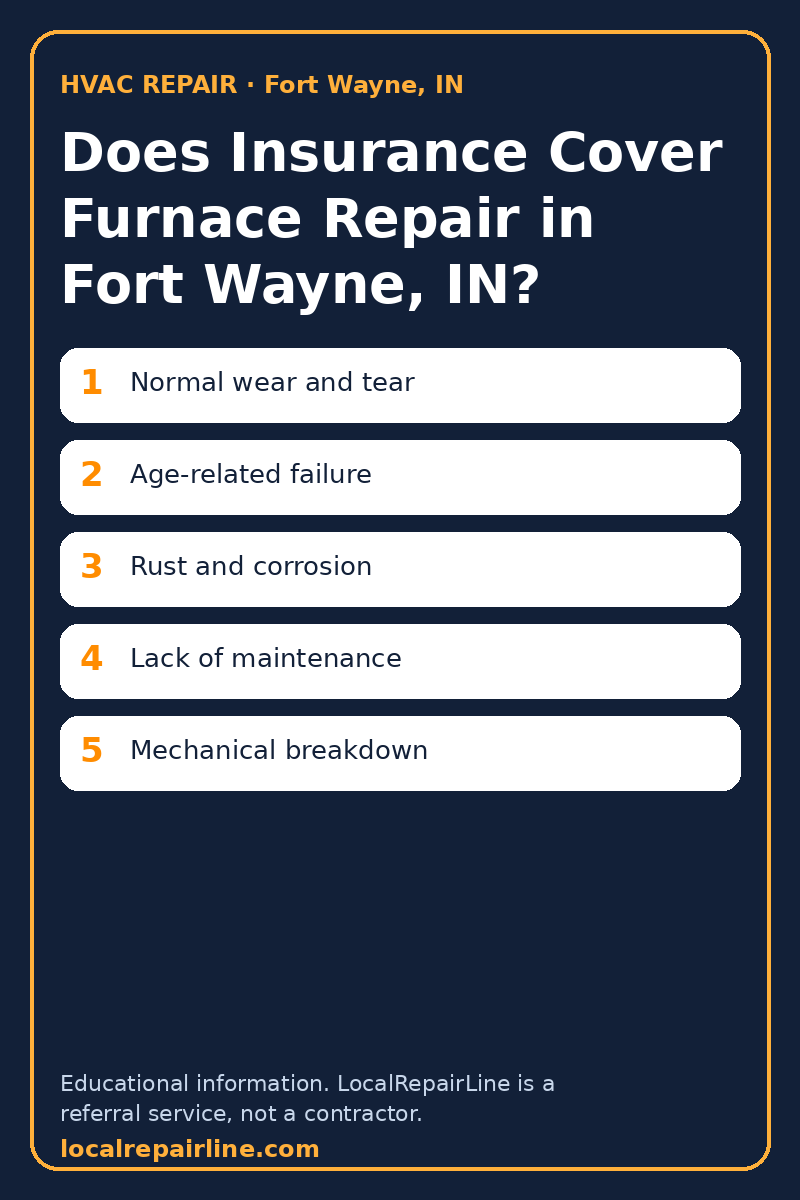
What Insurance Won't Pay For: Wear, Age, and Maintenance Issues
Many furnace failures come from age or wear, and those are the ones to check against your policy's exclusions. Homeowners policies are generally written around sudden losses, not routine upkeep, so maintaining and replacing aging parts is usually left to you.
Common exclusions include:
- Normal wear and tear. Motors, igniters, and bearings wear out over time.
- Age-related failure. A furnace that reaches the end of its life isn't a loss, it's a replacement you've been due for.
- Rust and corrosion. A cracked heat exchanger from long-term corrosion is usually a maintenance and age issue.
- Lack of maintenance. Dirty filters, clogged drains, and skipped tune-ups may be cited under a policy's maintenance or neglect exclusions.
- Mechanical breakdown. Check your policy for language about mechanical breakdown, since failures that come from the equipment itself may be excluded.
A useful question to ask yourself is whether something outside the furnace damaged it suddenly or the furnace failed on its own. If it's the second, coverage is unlikely, though your policy wording has the final say.
Fort Wayne Scenarios: Power Surges, Storm Damage, and Cold-Snap Breakdowns
Fort Wayne's weather gives you a few realistic situations. Here's how each tends to look from an adjuster's side.
The furnace dies during a deep-cold snap
Northeast Indiana winters bring snow, ice, and long stretches of very low temperatures. A furnace running nearly nonstop is more likely to fail, and cold-snap breakdowns are common.
But the cold didn't damage the furnace from outside. Running hard exposes weak parts, and that's treated as wear. Don't expect coverage unless something else happened, like a frozen pipe bursting and flooding the equipment.
A storm-related power surge
Spring and summer thunderstorms are common here, and so are surges. If a lightning strike or a utility surge damages your control board or blower motor, that's a sudden, outside cause and worth asking your agent about.
The catch is proof. A technician who can point to burned components or surge damage, along with the date of the storm, gives you a much stronger claim than a general "it stopped working." Some policies treat surge damage differently from lightning damage, so ask your agent which one applies.
An older home's aging system
A furnace that's well past its expected life and quits is usually treated as an age and wear issue, which many policies exclude. Adjusters look at age, maintenance records, and the condition of the parts.
If the furnace is old and failing, a repair-versus-replace conversation with a technician will probably serve you better than a claim.
Other Coverage to Check: Home Warranty, Manufacturer Warranty, and Equipment Breakdown
Homeowners insurance isn't your only possible source. These are easy to overlook.
Manufacturer parts warranty
Many furnaces come with a parts warranty from the manufacturer. Some require registration after installation, so check your paperwork or the unit's label for the model and serial number.
Parts coverage often doesn't include labor, and it may have conditions like proof of professional installation or maintenance. Costs vary by house and by what failed.
Home warranty
A home warranty is a service contract, not insurance. It's built to cover breakdowns from normal use, which is exactly what insurance skips.
It's worth checking if you already have one, but read the fine print. Look at the service fee per visit, coverage limits, exclusions for pre-existing conditions, and whether it requires maintenance records. Whether buying one is worth it depends on the age of your equipment and how much you value predictable costs.
Equipment breakdown endorsement
Some insurers offer an add-on, often called equipment breakdown coverage, that can cover mechanical or electrical failure of home systems. Availability and terms vary by insurer.
If you don't have it, ask your agent what it would cover and what it costs to add. Don't expect it to apply to a breakdown that's already happened.
Should You File a Claim? Deductibles vs. Repair Costs
A covered claim isn't always a smart claim. Run the math before you call.
Compare three things:
- Your deductible. Check the amount on your policy declarations page.
- The likely repair bill. A control board or a blower motor costs far less than a full replacement, and costs vary by house.
- The possible effect on future premiums. Policies and insurers differ, so ask your agent how a claim, even a small one, might affect your renewal pricing or eligibility.
If the repair is likely to come in near or below your deductible, filing usually doesn't make sense. You'd pay the same out of pocket and still have a claim on your record.
If the damage is major, like a surge that took out the furnace and other equipment, filing is more likely to pay off. Ask your agent general questions first. A question doesn't have to turn into a claim.
How to Document Furnace Damage So a Claim Goes Smoothly
Good records can decide whether a claim is approved. Do this as soon as it's safe.
- Photograph everything. Take pictures of the furnace, any visible damage, the breaker panel, and the model and serial labels.
- Write down the timeline. Note the date and time of the storm or outage, when you noticed the problem, and any sounds or smells.
- Keep damaged parts. If a technician replaces a part, ask to keep it until the claim is settled.
- Get a written diagnosis. Ask for a report that states what failed and what likely caused it.
- Save your maintenance records. Filter changes and tune-up invoices show you looked after the system.
- Keep receipts. Repairs, temporary heaters, and diagnostic fees may matter later.
What to Do Right Now If Your Furnace Stops Working
Start with the simple, safe checks.
- Check the thermostat. Confirm it's set to heat, the temperature is above the room's, and the batteries are fresh if it uses them.
- Check the breaker and the furnace switch. A tripped breaker or a switched-off service switch can look like a dead furnace.
- Check the filter. A badly clogged filter can cause shutdowns.
- Protect the house. In a cold snap, close off unused rooms and keep faucets from sitting in the coldest spots. Use safe supplemental heat, and never run a gas oven or an outdoor grill for warmth.
If you smell gas, leave the house and call your gas utility or emergency services from outside. Don't flip switches or try to relight anything.
When to call a local pro
Once the basic checks don't bring the heat back, call a local heating technician, and this homeowner resource can help you find furnace repair in Fort Wayne. Tell them what you've already tried, and ask them to put the likely cause in writing. If you think a storm or surge was involved, take photos before any parts are removed.
FAQ
Does homeowners insurance cover a furnace that just stops working?
Usually not. Policies tend to exclude wear, age, and mechanical breakdown. Coverage is more likely when a sudden event your policy names, like lightning or fire, caused the damage.
Is a power surge covered?
It can be, but it depends on your policy. Some treat surge damage differently from lightning damage, so ask your agent which applies. A technician's written diagnosis and the storm date make a claim easier to support.
Is a home warranty better than insurance for furnace repairs?
They do different jobs. A home warranty is a service contract meant to cover breakdowns from normal use, while insurance covers sudden losses. Check the per-visit fee, coverage limits, and exclusions before deciding, since costs vary by house.
Should I file a claim for a small furnace repair?
Probably not if the repair is near or below your deductible. You'd pay the same out of pocket and still have a claim on record. Ask your agent general questions first, since asking doesn't start a claim.
Need an HVAC repair pro in Fort Wayne, IN?
Talk to an independent local contractor who serves your area.
📞 Call (833) 669-0233HVAC repair in Fort Wayne, INCall hours: 8am–8pm ET, 7 days