Does Insurance Cover Furnace Repair in South Bend, IN?
You're standing in a cold house, and the question is does insurance cover furnace repair South Bend IN homeowners deal with every winter. The answer depends on why the furnace failed, not just that it did.
This guide covers what standard policies usually pay for, what they don't, and how to protect yourself while you sort it out.
Short Answer: Does Insurance Cover Furnace Repair South Bend IN Homeowners Face?
Usually not, if the furnace simply wore out. Homeowners policies generally focus on sudden, accidental damage from events your policy names. Aging equipment is often treated as a maintenance issue, but your own policy wording is what counts.
If a covered event damaged the furnace, though, you may have a claim. Think fire, a lightning-related power surge, or certain kinds of water damage.
South Bend's heating season is long. After months of lake-effect cold, a furnace that quits on the coldest night is often just tired. Many policies treat wear as a maintenance matter, so a failure like that may not be a covered loss.
Policies differ, so read yours or call your agent with specific questions.
Need an HVAC repair pro in South Bend, IN?
Talk to an independent local contractor who serves your area.
📞 Call (833) 669-0233HVAC repair in South Bend, INCall hours: 8am–8pm ET, 7 daysYour call may first be answered by a short screening service that asks what the problem is and where you are. Stay on the line and you will be connected to an independent local pro.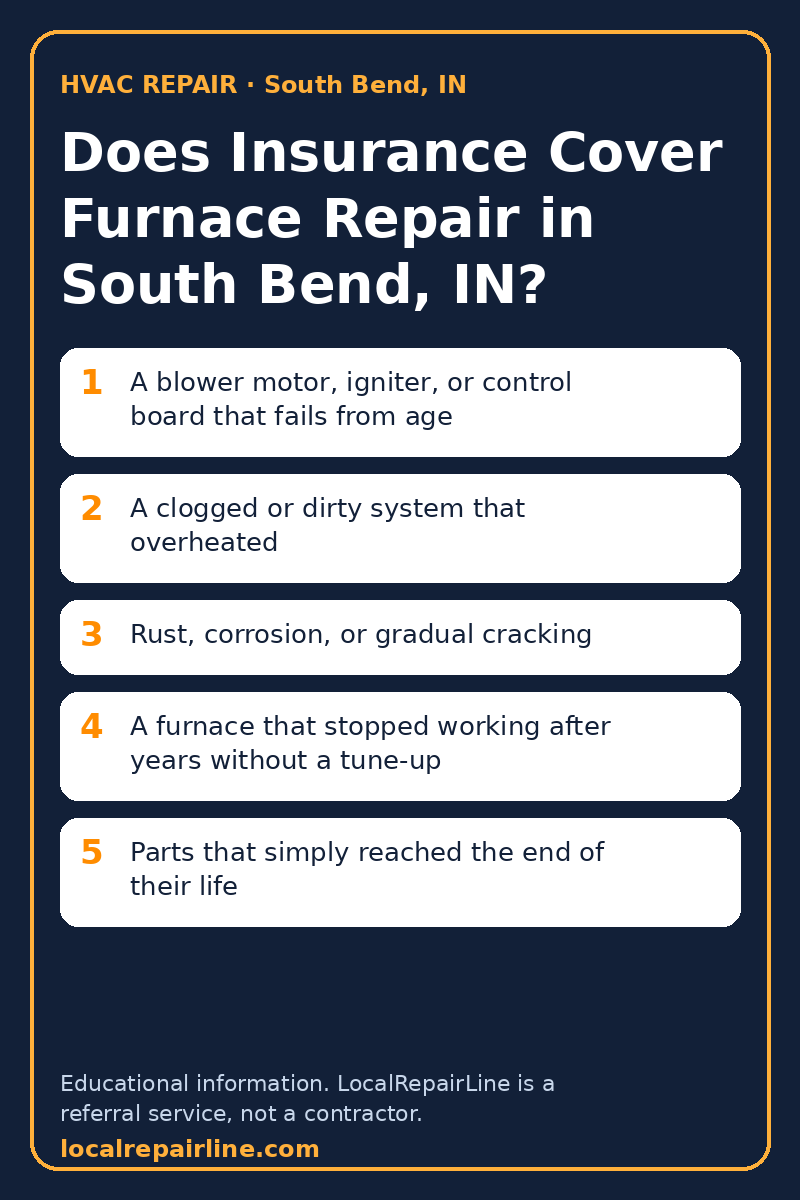
What Insurance Usually Won't Cover (Wear, Age, and Maintenance Issues)
Policies often include exclusions for damage that builds up over time or comes from lack of upkeep, so look at the exclusions section of yours. A furnace that runs through a long heating season puts real stress on moving parts, and those parts eventually give out.
Here's what typically falls outside coverage:
- A blower motor, igniter, or control board that fails from age
- A clogged or dirty system that overheated
- Rust, corrosion, or gradual cracking
- A furnace that stopped working after years without a tune-up
- Parts that simply reached the end of their life
That last one stings. A part that quits on a snowy January night feels sudden, but coverage generally turns on the underlying cause, not on how sudden the failure felt.
Then there's the "neglect" problem. If you ignored obvious warning signs, like weeks of strange noises or repeated shutdowns, that could complicate a claim that might otherwise have gone through. That's why documentation matters, and we'll get to it below.
Covered Events That Can Damage a Furnace: Fire, Power Surge, and More
Some events are different, because they come from outside the furnace. If one of these hits, the furnace damage may be part of a legitimate claim.
Fire and smoke
If a fire starts in or near your furnace area, it may be a covered event, depending on your policy and the cause. The cause still matters. A fire from a sudden electrical fault reads differently than damage from long-term neglect.
Power surge
A lightning strike or a utility-side surge can fry a control board or other electronics. Some policies cover surge damage and some limit it, so check your wording. A technician's note that points to electrical damage, not a worn part, can help.
Burst pipes after a heat outage
This one is tied to winter. If the furnace dies and pipes burst, the water damage may be covered even if the furnace itself isn't. Your policy may expect you to take reasonable steps to protect the home from further damage, so check your wording and keep the house from getting dangerously cold.
So the furnace repair might be on you, while the resulting water damage might be on the policy. Ask your agent how your policy treats that split.
Cracked heat exchanger
This is a gray area. A crack from age or repeated heating cycles is usually treated as wear. A crack tied to a sudden event is a different conversation. Either way, a cracked heat exchanger is a safety issue, not just a repair bill.
Other Ways to Cover the Bill: Home Warranty, Manufacturer Warranty, and Equipment Breakdown Add-Ons
If homeowners insurance won't pay, you may have other options. Check these before paying out of pocket.
Home warranty. These plans are separate from insurance and often cover breakdowns from normal wear. They come with service fees, coverage limits, and exclusions, and some require their own approved technician. Read the contract, especially around maintenance requirements and pre-existing conditions.
Manufacturer warranty. A newer furnace may still have parts coverage. Labor is often not included, and some warranties require proof of installation or regular maintenance. Dig out your paperwork or look up the model number on the unit.
Equipment breakdown add-on. Some insurers offer an endorsement that covers mechanical or electrical failure of home systems. If you added one, it may apply. If you're not sure, ask your agent.
Costs vary by house, plan, and furnace age, so compare the service fee and likely repair cost before choosing a route.
How to Document Furnace Damage Before You File a Claim
Good records can help a legitimate claim and protect you from a "neglect" denial. Start while the problem is fresh.
- Take photos and video of the furnace, any visible damage, scorch marks, water, or error codes on the control board.
- Write down the timeline. Note when it stopped, what you heard or smelled, and whether a storm or outage happened first.
- Save maintenance records, such as past tune-ups, filter changes, and service invoices.
- Get a written diagnosis from a qualified technician that states the likely cause of failure in plain terms.
- Keep damaged parts if the technician removes them, unless your insurer says otherwise.
- Don't toss anything until the adjuster has had the chance to see it.
The written diagnosis is the piece people skip. A note that says "failed from a power surge" reads very differently from "failed from age." Ask the technician to describe what they found and avoid guessing about causes they can't confirm.
An honest report may say the failure was wear. That's still useful, because it tells you not to waste time on a claim that won't pay.
Claim or Pay Out of Pocket? Weighing Your Deductible and Premium Risk
Even when something is covered, filing isn't automatic. Compare a few things first.
- Your deductible. If the repair costs about the same as your deductible, a claim may pay little or nothing.
- Your claims history. Ask your agent whether a claim could affect your renewal or pricing.
- The size of the loss. A major fire or water event is worth filing. A small repair often isn't.
- Your insurer's rules. Some companies treat even inquiries differently, so ask general questions before describing a specific loss.
Costs vary by house, and so does the effect on premiums. Depending on your insurer and policy, a claim may affect your renewal or pricing, so weigh that against the cost of a smaller repair. For a bigger loss, filing may make sense.
If you're unsure, ask your agent how a claim would affect your policy before you file. You can also ask your agent what the deductible would be for the specific type of loss.
What to Do the Moment Your Furnace Quits in a South Bend Winter
Lake-effect snow can pile up fast, and cold snaps can last. A dead furnace here deserves a steady, practical response, since a cold house can be hard on your pipes and uncomfortable or unsafe to stay in.
Here's what to do right away:
- Check the basics. Look at the thermostat settings, the breaker, the furnace switch, and the filter.
- Keep warm in one room. Close off unused rooms and use blankets. Never use a gas oven, grill, or camp stove to heat the house.
- Protect pipes. Open cabinet doors under sinks on exterior walls and let a faucet drip if the house is getting very cold.
- Pay attention to carbon monoxide. If an alarm sounds or anyone feels dizzy or sick, get outside and call emergency services.
This is the point where you stop guessing. If your furnace is old, worn, or won't restart, talk to a local HVAC pro in South Bend, IN, and this homeowner resource can help you know what to expect. A qualified technician can help identify the cause, talk through your repair options, and put their findings in writing, which may be useful if you decide to file a claim.
Whether your policy pays for a furnace that fails from age or wear depends on its wording, so read it when you have a calm moment. In the meantime, keep your photos and notes as you go, and you can sort out the paperwork once the house is warm again.
FAQ
Does homeowners insurance cover furnace repair or replacement?
Sometimes, but only when a covered event caused the damage, such as a fire or certain power surges. Normal wear, age, and poor maintenance are typically excluded. Check your policy wording or ask your agent.
Will insurance pay for a furnace that just stopped working from old age?
Usually not. Standard homeowners policies treat age-related failure as a maintenance issue, not a sudden loss. A home warranty or equipment breakdown add-on is more likely to help in that situation.
Does a home warranty cover furnace repair, and is it worth it?
Many home warranties cover breakdowns from normal wear, but they have service fees, limits, and exclusions. Whether it's worth it depends on your furnace's age, the plan's cost, and how strict the maintenance requirements are. Read the contract closely before you sign, and compare the service fee against what a typical repair might cost in your house.
Need an HVAC repair pro in South Bend, IN?
Talk to an independent local contractor who serves your area.
📞 Call (833) 669-0233HVAC repair in South Bend, INCall hours: 8am–8pm ET, 7 days