Emergency Furnace Repair Akron OH: What to Do When Heat Dies
When your furnace quits during an Akron cold snap, the house cools faster than you expect. Lake-effect snow, wind, and an older drafty house can turn a minor problem into a stressful night. This guide covers emergency furnace repair in Akron, OH, as a "first 60 minutes" plan: stay safe, run the quick checks, protect your pipes, and give a technician what they need to show up prepared.
Is Your Furnace Problem Really an Emergency?
Not every heating problem needs a middle-of-the-night call. Some do need action right now.
Treat it as an emergency if any of these apply:
- You smell gas or a rotten-egg odor near the furnace.
- A carbon monoxide alarm is sounding.
- You see soot, scorch marks, or smoke around the furnace.
- You hear loud banging, scraping, or screeching.
- The house is dropping toward the point where pipes or vulnerable people are at risk.
It's more of an urgent annoyance if the furnace runs but heats poorly, cycles on and off, or makes a new but mild noise. In mild weather you can wait for a normal appointment. In a hard cold snap, no heat is a real problem even without danger signs, especially with young children, older adults, or anyone medically fragile at home.
Akron has four distinct seasons, so your furnace sits idle all summer and then works hard from fall through early spring. A sudden Northeast Ohio cold snap can push it to run nonstop. That is often when a worn igniter, tired blower motor, or weak part finally gives out.
Need an HVAC repair pro in Akron, OH?
Talk to an independent local contractor who serves your area.
📞 Call (833) 669-0233HVAC repair in Akron, OHCall hours: 8am–8pm ET, 7 daysYour call may first be answered by a short screening service that asks what the problem is and where you are. Stay on the line and you will be connected to an independent local pro.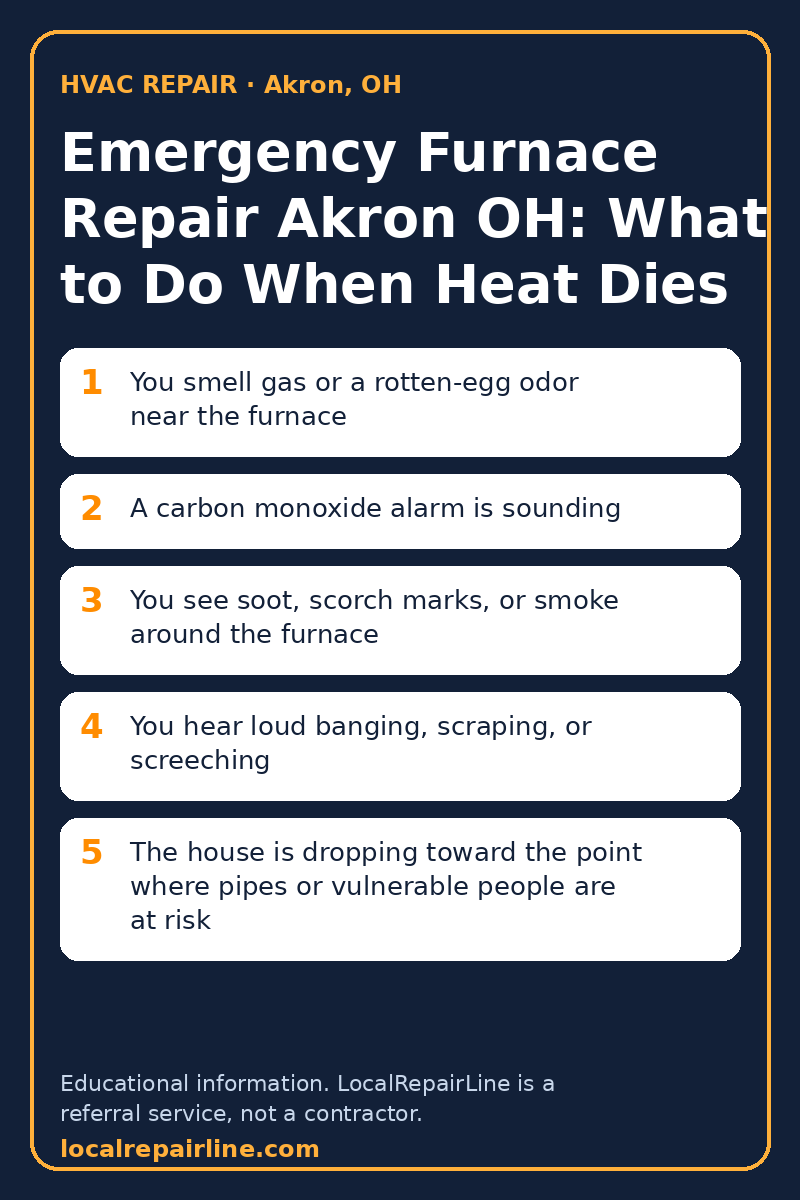
Safety First: Gas Smells, Carbon Monoxide, and When to Leave the House
Do this before anything else. Your own safety matters more than getting the furnace running.
If you smell gas
Get everyone out, including pets. Don't flip light switches, use a lighter, or try to find the leak. Once you're outside and away from the house, call your gas utility's emergency line or 911. This isn't a job for a repair company's dispatcher. Wait for the utility or fire department to say it's safe before going back in.
If a carbon monoxide alarm sounds
Take it seriously every time. Carbon monoxide is odorless, and a failing furnace or cracked heat exchanger can release it.
- Get everyone outside into fresh air.
- Call 911 from outside.
- Don't go back in until responders clear the house.
Headache, dizziness, nausea, and confusion that ease when you leave the house are warning signs. If you don't have working CO alarms, put one on your shopping list for after the emergency, on each level and near sleeping areas.
Soot, banging, or burning smells
Shut the furnace off at the thermostat. If it's safe, turn off the furnace power switch too. Don't keep restarting it. Soot and violent banging mean something is wrong with combustion, and repeated restarts can make it worse.
Quick Checks Before You Call: Thermostat, Filter, Pilot, Breaker
If you have no gas smell and no alarms, a few simple checks can get you running again. Don't remove panels or touch anything that needs tools.
- Thermostat. Set it to "Heat" and a few degrees above the room temperature. Replace the batteries if it has them. A blank screen is a clue.
- Air filter. A badly clogged filter can make the furnace overheat and shut itself down. Slide it out, and if you can't see light through it, swap in a fresh one.
- Power. Check the breaker for the furnace. Also look for a switch that looks like a light switch on or near the furnace, since it's easy to knock off by accident. Flip it back on once only.
- Gas supply. Check whether your stove or water heater works. At the furnace's gas shutoff, the handle should run in line with the pipe when open. If you smell gas at any point, stop and go back to the safety section.
- Pilot light (older models only). Many newer furnaces have electronic ignition and no pilot. If yours has one, follow the instructions printed on the furnace to relight it. If it won't stay lit, stop.
- Snow and ice at the outside vents. Many newer furnaces vent through plastic pipes on an exterior wall. After lake-effect snow or drifting, those pipes can get blocked and trigger a shutoff. Gently clear snow away by hand.
While you're at the furnace, look through the small window for a blinking light. Count the flashes and take a photo of the code chart and the model label. You'll want those later.
When the checks don't work: call a local pro
This is the point to talk to a local HVAC pro in Akron, OH, such as Local Repair Line, instead of guessing. Make the call if:
- The thermostat, filter, power, and gas supply all look fine and the furnace still won't start.
- It starts, then shuts down again after a few minutes.
- You smelled gas, heard loud banging, saw soot, or had a CO alarm sound. Handle the safety side first (utility or 911), then have a qualified technician inspect the furnace before using it again.
Repeated resets and DIY repairs on gas equipment aren't worth the risk. A trained technician can test the safety controls and find the actual cause.
Keeping Your Home and Pipes Safe During an Akron Cold Snap
While you wait, the goal is to hold heat in and keep water moving.
- Shrink your living space. Pick one or two interior rooms and close the doors. Hang blankets over drafty windows and roll towels against door gaps. Older homes leak heat badly.
- Open cabinet doors under kitchen and bathroom sinks, especially along exterior walls, so warmer room air reaches the pipes.
- Let a faucet drip on the coldest side of the house. Moving water is harder to turn to ice.
- Know your main water shutoff. If a pipe does burst, you'll want to find it fast.
- Check the usual trouble spots. Pipes in unheated basements, crawl spaces, garages, and exterior walls are the most exposed.
- Dress in layers and use warm blankets. Close curtains at night, but open south-facing ones during sunny hours.
If an outage will run long in deep cold, ask the technician or a plumber whether draining the water system makes sense for your house.
Is a space heater safe?
Electric space heaters can work as short-term help if you use them carefully. Plug them straight into a wall outlet, not an extension cord or power strip. Keep them well away from bedding, curtains, and furniture, and never leave one running while you sleep or leave the house.
Never use a gas oven, charcoal grill, camp stove, or generator indoors or in an attached garage to heat your home. Those can produce deadly carbon monoxide.
Common Emergency Furnace Failures and What Causes Them
Costs vary by house, furnace type, parts availability, and the time of day you call. Here's the general pattern, from smaller to larger repairs.
- Dirty flame sensor or worn igniter. Common reasons a furnace tries to start and then quits. These are small parts that a technician can often reach without taking much apart, though access varies by furnace.
- Thermostat or wiring problems. Often a modest repair, though tracing a wiring issue can take time.
- Blower motor or capacitor. The capacitor is typically a smaller part. A full blower motor is a bigger part and a bigger job.
- Control board or pressure switch. These take more work to diagnose, and how easy the part is to get can depend on the furnace's age and model.
- Cracked heat exchanger. This is a serious safety issue. It often pushes the repair-or-replace decision.
Before you book, ask whether an emergency or after-hours call is billed differently. Ask what the service call fee covers, whether it applies toward the repair, and whether you'll get a price before any work begins.
FAQ
What should I tell the technician when I call?
Share the furnace's make and model, how old it is, and what it did before it quit. Mention any blinking light codes, odd noises, or smells, and which quick checks you already tried. A photo of the model label and code chart helps them bring the right parts.
Can I keep using the furnace if it only works some of the time?
It's smart not to rely on it. A furnace that starts and then shuts down is often protecting itself from a problem like overheating or poor venting. Leave it off if you've had soot, banging, a gas smell, or a CO alarm, and have a technician check it first.
Is it better to repair or replace an older furnace?
It depends on the age, the condition, and the repair needed. A small part on an otherwise healthy furnace usually makes sense to fix. A cracked heat exchanger or repeated breakdowns on an aging unit often push people toward replacement, and costs vary by house.
How can I help prevent a winter breakdown?
Change the filter on a regular schedule and keep the area around the furnace clear. Keep outdoor vent pipes clear of snow and debris. Having the furnace checked before the cold season starts gives a technician the chance to catch worn parts early.
Need an HVAC repair pro in Akron, OH?
Talk to an independent local contractor who serves your area.
📞 Call (833) 669-0233HVAC repair in Akron, OHCall hours: 8am–8pm ET, 7 days