Emergency Furnace Repair Wilmington DE: What to Do First
The house is getting cold, the furnace is silent, and it's dark outside. If you're searching for emergency furnace repair in Wilmington DE, a few calm steps in the first few minutes can keep everyone safe and help you describe the problem clearly.
This guide helps you sort out what's safe to check yourself, what's a stop-everything situation, and how to get help without making a rushed, expensive decision.
Is Your Furnace Failure a True Emergency? Signs That Make It Urgent
Not every dead furnace is a crisis. A house that's cool but holding steady on a mild fall evening can usually wait for a sensible appointment.
It becomes urgent when any of these are true:
- The indoor temperature is dropping steadily and a hard cold snap is forecast.
- Someone in the home is an infant, elderly, ill, or otherwise sensitive to cold.
- You smell gas or something burning.
- A carbon monoxide alarm is going off.
- The furnace is repeatedly clicking, shutting down, or making new loud noises.
Wilmington's raw, damp winters make a cold house feel worse than the thermometer says. A nor'easter with wind and ice can also make travel harder, so it helps to start the quick checks while the house is still comfortable.
Need an HVAC repair pro in Wilmington, DE?
Talk to an independent local contractor who serves your area.
📞 Call (833) 669-0233HVAC repair in Wilmington, DECall hours: 8am–8pm ET, 7 daysYour call may first be answered by a short screening service that asks what the problem is and where you are. Stay on the line and you will be connected to an independent local pro.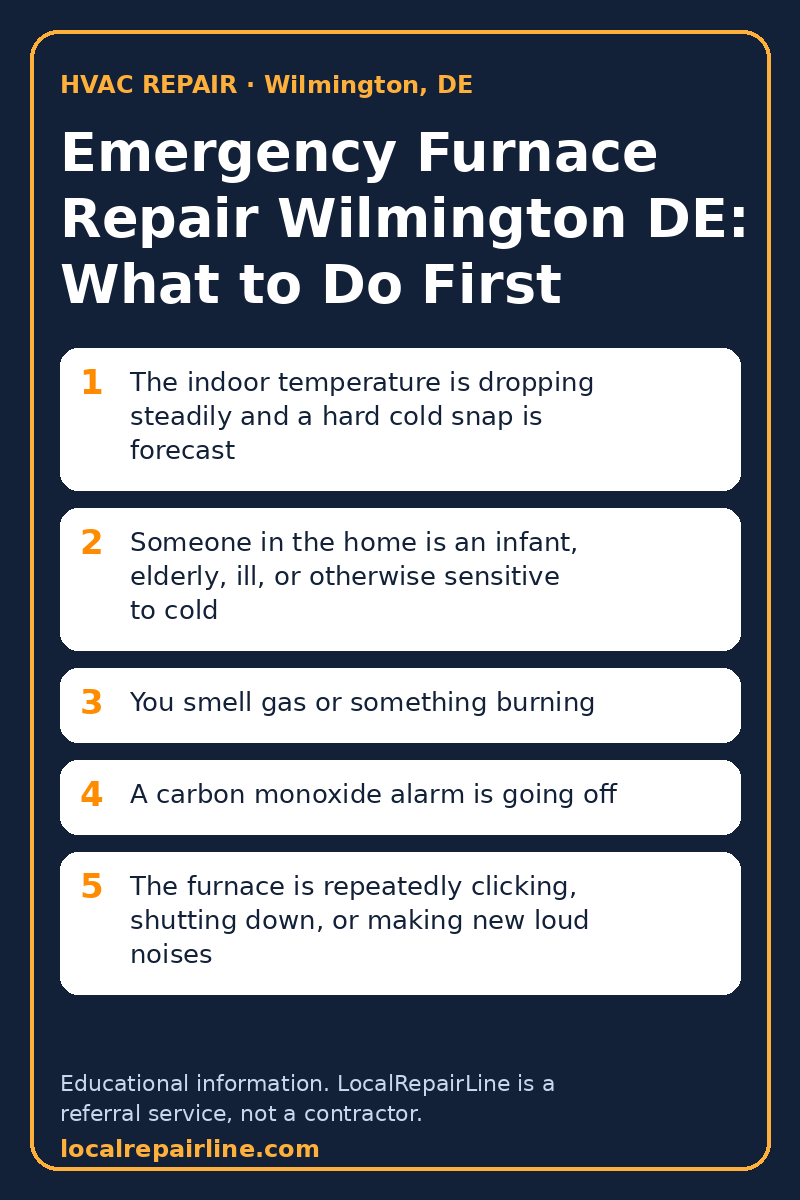
Safety First: Gas Smells, Carbon Monoxide Alarms, and When to Leave the House
Do this part before anything else. It outranks every repair tip in this article.
If you smell gas
Leave the house right away, and bring everyone, pets included. Don't flip light switches, use a lighter, or try to relight a pilot.
Once you're outside and away from the house, call your gas utility and 911. Don't go back in until you've been told it's safe.
If a carbon monoxide alarm sounds
Treat it as real. Get everyone into fresh air immediately and call 911.
Headache, dizziness, nausea, and confusion can all point to carbon monoxide, and a gas furnace is one possible source. Don't silence the alarm and keep using the furnace. Have the appliance checked by a qualified pro before it runs again.
Quick Checks Before You Call: Thermostat, Filter, Breaker, and Pilot or Igniter
If there's no gas smell and no alarm, a few simple checks are reasonable. Work through them in order:
- Thermostat: Set it to "heat" and raise the target several degrees above room temperature. Replace the batteries if the screen is blank or dim.
- Power: Check that the furnace switch (it often looks like a light switch near the unit) is on, and look at the breaker panel for a tripped breaker.
- Filter: Pull it out and look. If it's packed with dust, swap in a clean one of the right size, since a clogged filter can cause the furnace to overheat and shut itself off.
- Gas supply: Confirm the valve on the gas line to the furnace is open, meaning the handle runs in line with the pipe. Check that other gas appliances, like your stove, are working.
- Igniter or pilot: Look at your furnace's label or manual. Many newer models have an electronic igniter you shouldn't touch, and if yours has a pilot, only relight it if the manual walks you through it and there's no gas odor.
Reset the furnace once if the manual says so. Don't keep resetting it over and over, because repeated failed starts point to a problem that needs a pro.
When guessing stops being smart
If you've done these checks and the furnace still won't start, or the house is losing heat toward the point where pipes are at risk, that's the moment to talk to the LocalRepairLine team, a local HVAC pro in Wilmington, DE. The same goes for a gas smell, a burning odor, repeated clicking, or a carbon monoxide alarm.
Don't open up the furnace cabinet or poke at gas parts to save time. A wrong guess here can turn a simple repair into a safety problem.
Common Reasons Furnaces Quit During a Wilmington Cold Snap
Summers here are hot and humid, so your heating system may sit idle for months. Then the first truly cold night arrives and it has to run hard for the first time since last winter. That's when weak parts tend to show themselves.
Spring and fall add their own wear. Mild days and chilly nights make the furnace cycle on and off repeatedly, which is tough on igniters, sensors, and blower motors.
Common culprits include:
- A worn or dirty igniter or flame sensor
- A clogged filter or restricted airflow
- A failing blower motor or capacitor
- A thermostat problem or loose wiring
- A blocked condensate drain or vent on some high-efficiency models
- A control board that has stopped responding
A technician has to diagnose which one it is. Costs vary by house, and a small part can be simple while a major component is not.
Keeping Your Home Safe While You Sort Out Repairs (Pipes, Pets, and Family)
While you wait, the goal is to keep people warm and keep water from turning to ice in your pipes.
- Close doors to unused rooms and gather everyone in one smaller space.
- Layer clothes, use blankets, and cover windows with heavy curtains.
- Open sink cabinet doors on exterior walls so room air can reach the pipes.
- Let a faucet drip slowly on a cold night if pipes run through unheated areas.
- Find your main water shutoff now, in case a pipe does give way.
- Check on elderly neighbors or relatives, and keep pets in the warm room.
Space heaters and ovens
An electric space heater can help if you follow the rules. Plug it straight into the wall, keep it clear of bedding and curtains, and never leave it running while you sleep or are out of the house.
Don't use the oven or stovetop to heat your home. Also never run a grill, camp stove, generator, or kerosene heater indoors, because they can produce carbon monoxide.
Repair or Replace? Making the Call Without Regret
A cold house makes people want to fix the problem at any price. That's exactly when regret happens.
If the issue is a modest part on a furnace that has otherwise worked fine, repair usually makes sense. If the unit is older, has needed repeated fixes, or the technician points to a major failure, replacement deserves a real look.
Here's a sensible way to think about it:
- Ask what failed and why, in plain words.
- Ask whether the fix is likely to hold, or whether other worn parts are close behind.
- Compare the repair cost to the cost of a new system, and factor in how often you've paid for repairs lately.
- If a safety issue is involved, such as a cracked heat exchanger or a venting problem, listen carefully to the technician's explanation and ask to see it.
Replacing a furnace takes planning, sizing, and a written scope of work. If you're not facing a safety shutdown, it's reasonable to get the heat back on with a repair or a temporary fix and make the bigger decision once the house is warm and you can think clearly.
FAQ
How do I know if my furnace problem is a real emergency?
It's an emergency if you smell gas, a carbon monoxide alarm is sounding, or the house is losing heat during a hard cold snap. It's also urgent if an infant, an older adult, or someone who is ill is in the home. If the house is only a little cool and holding steady, a regular appointment is usually fine.
Can I relight the pilot light myself?
Only if your furnace has a standing pilot, the manual walks you through the steps, and there's no gas odor at all. Many newer furnaces use an electronic igniter that you shouldn't touch. If you smell gas or the pilot won't stay lit, leave it alone and call a pro.
What should I do if the furnace dies and my pipes might freeze?
Keep everyone in one smaller, warmer room and open sink cabinet doors on exterior walls. Let a faucet drip slowly if pipes run through unheated spaces, and know where your main water shutoff is. If the house keeps losing heat, contact a local HVAC pro to talk through your options.
How much does emergency furnace repair cost?
Costs vary by house. The final bill depends on which part failed, how easy it is to reach, and whether the furnace is old enough that parts are harder to find. Ask the technician to explain the problem and the repair options in plain words before work starts.
Should I repair or replace my furnace after a breakdown?
A modest repair on a furnace that has otherwise run well usually makes sense. If the unit is older, keeps needing repairs, or has a major failure like a cracked heat exchanger, replacement deserves a serious look. Unless there's a safety shutdown, you can often restore heat first and decide on a new system once the house is warm and you can think clearly.
Need an HVAC repair pro in Wilmington, DE?
Talk to an independent local contractor who serves your area.
📞 Call (833) 669-0233HVAC repair in Wilmington, DECall hours: 8am–8pm ET, 7 days