Furnace Blowing Cold Air in Fort Wayne, IN? Causes and Fixes
If you typed furnace blowing cold air Fort Wayne IN into a search bar, you're probably standing next to a vent with a cold draft on your hands. Fort Wayne winters don't give you much patience for that. The good news is that the cause is often something small. The trick is knowing which checks are safe for you and which ones belong to a pro.
Is It Normal for a Furnace to Blow Cool Air at Startup?
Sometimes, yes. When a furnace kicks on, the burners light first and the blower waits until the heat exchanger warms up. In the first minute or so, the air coming out may feel lukewarm or even cool, especially at vents far from the furnace.
Many furnaces are set up this way on purpose, so they don't push cold air through the house. If the air turns warm within a couple of minutes, that's normal.
Here's the line between normal and a real problem:
- Normal: Cool air for a short stretch at the start, then steady warm air until the thermostat is satisfied.
- Not normal: Air that stays cold the whole cycle, warm air that fades back to cold, or a furnace that starts and stops over and over.
Fort Wayne's hot, humid summers leave a furnace sitting idle for months. On the first truly cold night of fall, a weak part or a dusty sensor often shows itself. A little startup oddness in that first run can be worth a closer look.
Need an HVAC repair pro in Fort Wayne, IN?
Talk to an independent local contractor who serves your area.
📞 Call (833) 669-0233HVAC repair in Fort Wayne, INCall hours: 8am–8pm ET, 7 daysYour call may first be answered by a short screening service that asks what the problem is and where you are. Stay on the line and you will be connected to an independent local pro.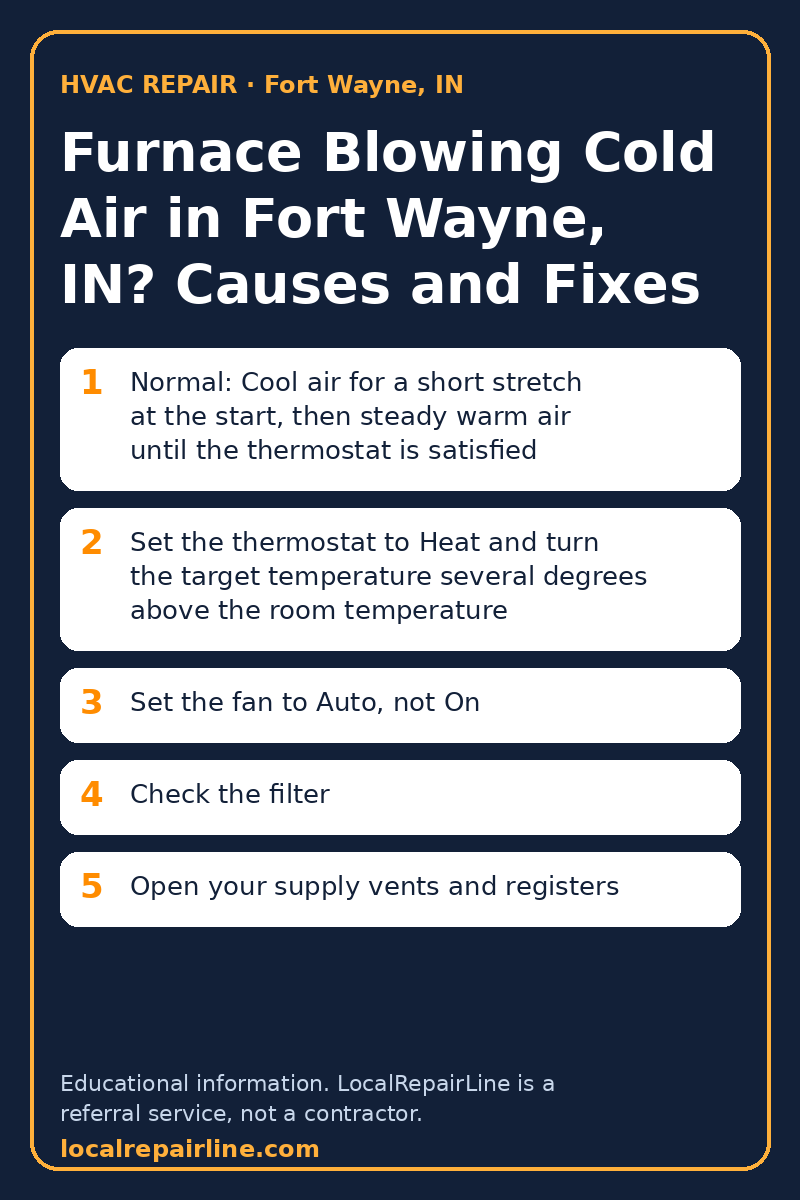
Quick Checks Before You Call: Thermostat, Filter, Vents, and Breaker
Start with the simple stuff. Spring and fall in northeast Indiana swing between warm afternoons and cold nights, so thermostats get switched between heat and cool a lot. It's easy for a setting to end up wrong.
Run through this short checklist:
- Set the thermostat to Heat and turn the target temperature several degrees above the room temperature.
- Set the fan to Auto, not On. With the fan on "On," the blower runs constantly, even between heating cycles, and that air can feel cool.
- Check the filter. If it's gray, clogged, or you can't remember the last time you changed it, swap in a clean one of the right size.
- Open your supply vents and registers. Make sure furniture, rugs, or closed dampers aren't blocking them.
- Check the breaker and the furnace switch. The furnace usually has a wall switch that looks like a light switch near the unit. Make sure it's on and the front panel is seated properly.
If you have a smart thermostat, check the batteries or power and look for a schedule or "away" mode that's overriding your setting.
Furnace Blowing Cold Air Fort Wayne IN: Common Winter Causes
Once the basics are ruled out, a handful of causes show up again and again. Work through them from simplest to most involved, since the easy ones are quick to rule out.
Dirty or clogged air filter
A badly clogged filter chokes airflow. The furnace can overheat, and a safety switch shuts the burners off while the blower keeps running. That's how you get air that was warm and then turns cold.
Burners that won't stay lit
A dirty flame sensor, a weak ignitor, or a pilot problem can all shut the flame off. The fan then keeps pushing unheated air. The next section covers this one in more detail.
Overheating and limit switch trips
Blocked vents, a dirty blower, or restricted return air can make the furnace run too hot. The limit switch cuts the burners as a safety step. If it keeps happening, something is restricting airflow and needs a pro's eyes.
Condensate or drain trouble
A high-efficiency furnace makes water as it burns fuel. If the drain line clogs or the pan fills, a safety switch can stop the heat. Cold weather can also make drain and vent problems worse.
Gas supply or ductwork issues
A closed gas valve or an interrupted gas supply means no flame. Leaky or uninsulated ducts running through a cold attic or crawlspace can also cool the air before it reaches the room, though that usually means lukewarm air rather than fully cold.
Pilot Light, Ignitor, and Flame Sensor: Why the Burners Shut Off
If the blower runs but the air is cold, the burners may not be staying on. Here's what usually sits behind that.
Pilot light. Older furnaces have a standing pilot. If it's out, the furnace can't heat. Some units have relighting instructions printed on the furnace itself. If you aren't completely comfortable following them, or the pilot keeps going out, stop and call a pro.
Hot surface ignitor or spark ignitor. Most newer furnaces light the burners electronically. If you hear repeated clicking and never see a flame, the ignitor, gas flow, or a control part may be the issue.
Flame sensor. This thin metal rod sits in the burner flame and tells the furnace that the fire is lit. When it gets coated with residue, it can't "see" the flame, so the furnace shuts the gas off after a few seconds. The burners light, then drop out, and the furnace tries again.
A dirty flame sensor is a classic small repair. Cleaning it is typically a short job for a technician, and it doesn't call for a new furnace. If someone suggests replacing the whole furnace because of a sensor problem, ask what was tested and get a second opinion if it doesn't add up.
A note on safety: if you smell gas, don't touch switches or try to relight anything. Leave the house and contact your gas utility or emergency services from outside.
Heat Pump or Dual-Fuel System? Defrost Mode vs. a Real Problem
Not every system that blows cool air is broken. If you have a heat pump, the air it delivers is usually warm, but not as hot as furnace air. It can feel cool against your skin even when it's working properly.
Heat pumps also run defrost mode in cold, damp weather. The outdoor unit warms itself to melt frost, and during that cycle you may feel cooler air indoors, see steam from the outdoor unit, or hear the system change sounds. Defrost typically lasts a short time, and then normal heating resumes.
Dual-fuel systems pair a heat pump with a gas furnace. In very cold weather, the system should switch over to the furnace. Systems with auxiliary heat use electric heat strips to help out.
Signs something is wrong:
- Cool air continues long after a defrost cycle should have ended.
- The outdoor unit is buried in ice or snow, or ice is building up heavily.
- Auxiliary heat never turns on during a cold snap, and the house keeps losing ground.
You can gently clear snow from around the outdoor unit and keep it clear of drifts. Don't chip at ice with tools, since you can damage the coil. If the system seems stuck, that's a call for a pro.
Repair or Replace: What Cold-Air Problems Usually Cost You
Most cold-air problems are small. A filter swap is a simple job you can do yourself. A flame sensor cleaning, an ignitor swap, or a condensate drain clearing are usually more straightforward jobs for a technician. Control boards, blower motors, and gas valves are larger repairs with more parts and labor involved, and a cracked heat exchanger is a different category entirely.
Costs vary by house, furnace model, and how hard the part is to get. Here's how the tradeoff generally works:
- Repair makes sense when the furnace is otherwise in decent shape and the failed part is a common, replaceable one.
- Replacement enters the conversation when the furnace is quite old, repairs keep stacking up, or a major component like the heat exchanger has failed.
Ask a technician to explain what failed, why, and what the options are. A fair explanation should let you tell a minor fix from a major one.
When to Stop Troubleshooting and Call a Fort Wayne HVAC Pro
Here's your decision path. If you've confirmed the thermostat is set to heat, the fan is on auto, the filter is clean, and the vents are open, and the furnace still blows cold air or keeps shutting off, this is the point to talk to a local HVAC pro in Fort Wayne, IN through a local pro network instead of guessing.
Reach out to a pro if you notice any of these:
- A gas smell (leave the house first, then call your gas utility or emergency services)
- Clicking ignition with no flame
- Repeated lockouts or the furnace cycling on and off
- A very cold house during a Fort Wayne cold snap
While you wait for a technician in bitter weather, keep the heat in the part of the house you use most. Close doors to unused rooms and open curtains on sunny windows. Layer clothing and blankets, and keep faucets dripping on exterior walls if pipes are at risk.
Never use a gas oven, grill, or camp stove indoors for heat, because of carbon monoxide danger. Make sure your carbon monoxide alarms have fresh batteries and are working properly.
FAQ
Why is my furnace blowing cold air when the thermostat is set to heat?
Check your fan setting first. If the fan is set to "On" rather than "Auto," the blower pushes unheated room air between heating cycles. A dirty filter or an unlit burner can also cause the furnace to blow cold air while calling for heat.
How do I know if the flame sensor is dirty?
A dirty flame sensor usually lets the burners light for a few seconds before they abruptly shut off. The blower keeps running, which makes the circulating air feel cold. Cleaning or replacing this small rod often restores normal operation.
Is it safe to keep running a furnace that blows cold air?
It depends on what is causing the issue. If the fan switch was simply set to "On," the cool air is often just the blower circulating unheated air between cycles, and switching to "Auto" may settle it. If the furnace is cycling on and off repeatedly or failing to ignite, shut the unit off until a technician inspects it.
Can a dirty air filter cause a furnace to blow cold air?
Yes, a clogged filter restricts airflow across the heat exchanger. This causes heat to build up inside the unit and trips the high-limit safety switch, which shuts off the burners. The blower fan often stays on to cool the unit down, blowing cold air through the vents.
Need an HVAC repair pro in Fort Wayne, IN?
Talk to an independent local contractor who serves your area.
📞 Call (833) 669-0233HVAC repair in Fort Wayne, INCall hours: 8am–8pm ET, 7 days