Furnace Heater Not Working in Dover DE on the First Cold Night
It's the first chilly night of the season, the thermostat is calling for heat, and nothing is happening. You may even have typed "furnace heater not working in Dover DE first cold night" into your phone while standing in a cold hallway. Take a breath. Many first-night failures come from a few simple causes, and the basic checks below only take a few minutes if you're comfortable doing them.
This guide walks you through those checks, what the noises and lights mean, and when to stop and call someone.
Furnace Heater Not Working in Dover DE First Cold Night: Why It Happens
Think about how your furnace spent the summer. Dover's summers are long, hot and humid, so the AC did the work while the furnace sat in its closet or basement doing nothing for months.
Idle doesn't mean untouched. Dust settles on parts. Humid air can leave moisture on metal surfaces and electrical connections. Rubber, belts and small components can get stiff or weak.
Then fall in central Delaware does its usual trick. Mild afternoons turn into chilly nights fast, and the furnace has to wake up with no warm-up run. That cold start is often when a tired igniter, a dirty sensor, or a clogged filter finally gives out.
That's why "it worked fine last winter" doesn't tell you much. A part can be one cold start from failing and still look fine all summer.
Need an HVAC repair pro in Dover, DE?
Talk to an independent local contractor who serves your area.
📞 Call (833) 669-0233HVAC repair in Dover, DECall hours: 8am–8pm ET, 7 daysYour call may first be answered by a short screening service that asks what the problem is and where you are. Stay on the line and you will be connected to an independent local pro.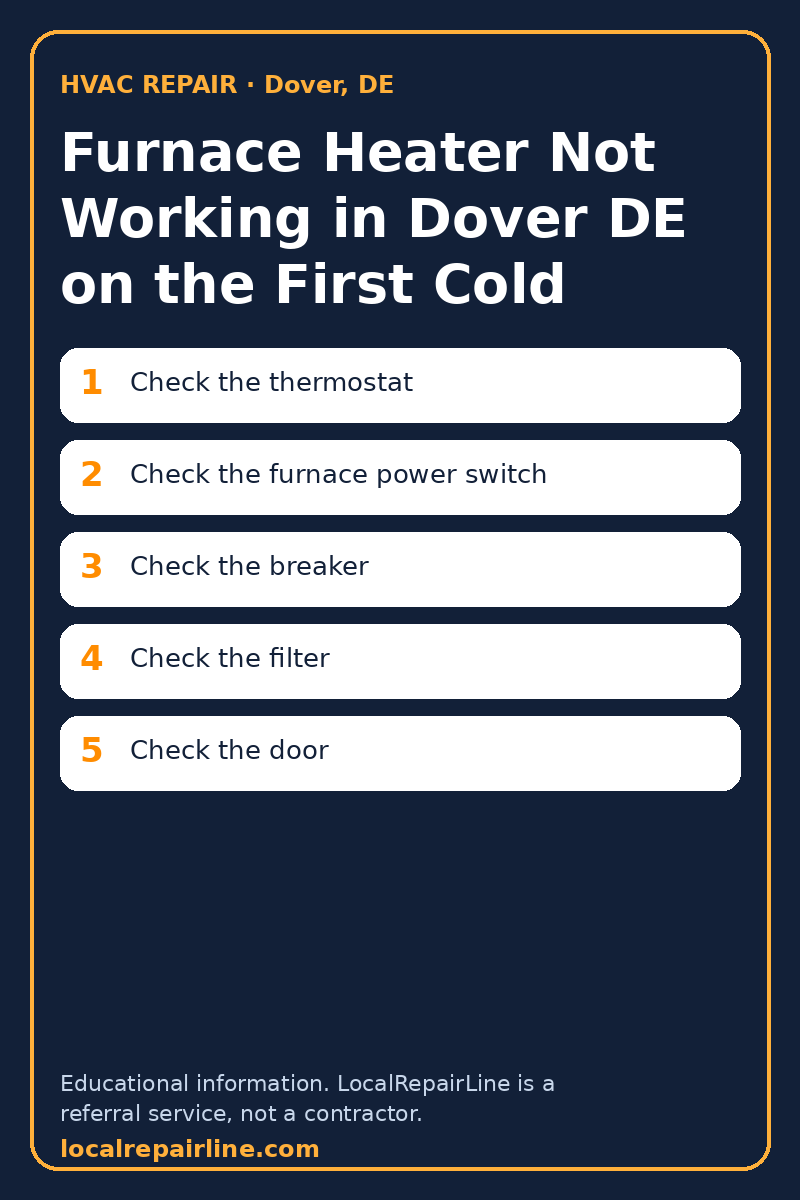
Two-Minute Checks Before You Call Anyone
Before you touch anything, here's the rule: if the thermostat, power switch, breaker and filter all check out and the furnace still won't ignite, keeps shutting off, shows an error code, or you smell gas or burning, stop troubleshooting. That's the point to call a local HVAC pro in Dover, DE, such as LocalRepairLine, instead of guessing. Don't start unscrewing panels to look for the problem.
Work through these in order:
- Check the thermostat. Make sure it's set to "Heat," not "Cool" or "Off," and the target temperature is a few degrees above the room temperature. If the screen is blank, replace the batteries.
- Check the furnace power switch. It often looks like a regular light switch on or near the furnace. Someone may have flipped it off during summer.
- Check the breaker. Look at the panel for a tripped breaker for the furnace. Flip it fully off, then on, once. If it trips again, leave it off.
- Check the filter. Pull it out and hold it up to a light. If you can't see light through it, it's clogged. Replace it with the right size.
- Check the door. Many furnaces won't run unless the blower door is fully seated. Make sure it's closed firmly.
- Look at the vents and returns. Make sure furniture, rugs or closed registers aren't blocking airflow.
A clogged filter deserves special attention after a summer of AC use. A choked filter can cause the furnace to overheat and shut itself off, which looks like a dead furnace.
Pilot light or igniter
Most newer furnaces use an electronic igniter, so there's no flame to relight by hand. If you have an older model with a standing pilot, follow the instructions printed on the furnace itself. Only do it if you smell no gas and feel comfortable doing it. If the pilot won't stay lit after a try or two, stop there.
What the Sounds, Smells and Blinking Lights Are Telling You
Your furnace gives clues. Here's a rough decoder, not a diagnosis:
- Clicking, then nothing: The system is trying to light but the igniter or flame sensor may not be doing its job.
- Starts, runs briefly, then shuts off: Often a dirty flame sensor, a clogged filter, or an overheating limit switch.
- Humming but no heat: Could be a blower or motor issue, or a part that isn't getting the signal to proceed.
- Loud banging or scraping: Something is loose or failing. Turn the system off and call.
- Dusty, burning smell for a short time at startup: Common on the first run, as summer dust burns off. It should fade within a short time.
- A persistent burning, electrical or hot-plastic smell: Turn the furnace off at the switch and call a pro.
- Rotten-egg smell: Treat it as a gas leak (see below).
Many furnaces have a small window or light that blinks a code. The panel door or a sticker inside usually lists what the pattern means. Write down the pattern, because a technician can use it. Don't keep resetting the system over and over to clear it.
How Urgent Is It? Sorting Emergencies From Everything Else
Not every cold-night problem is an emergency, but some are. Here's a simple way to sort it out.
Call right away if:
- You smell gas. Don't flip switches, use a lighter, or search for the source. Get everyone out, then call 911 or your gas utility's emergency line from outside.
- Your carbon monoxide alarm sounds. Move outside into fresh air, and call 911.
- Anyone feels dizzy, nauseated or has a headache while the furnace is running.
- You see scorching, smoke or soot around the furnace, or smell something burning that doesn't fade.
- Water is pooling near the furnace along with an electrical smell or tripped breaker.
Likely less urgent, but still worth a call soon, if:
- The house is cool but not dangerously cold, and everyone is healthy.
- The furnace simply won't start, with no gas smell, no burning, and no alarms.
- You can stay warm with layers and blankets, and if you use a space heater, you follow the precautions in the next section.
The calculation changes if someone in the house is an infant, elderly, ill, or otherwise sensitive to cold, or if a hard cold snap is forecast. In those cases, an earlier call makes more sense. If you don't have working carbon monoxide detectors, treat that as a separate problem to fix soon.
Keeping the House Warm While You Wait for a Technician
A few simple moves can hold heat in for a surprising amount of time.
- Close doors to rooms you don't need and gather in one smaller room.
- Close curtains and blinds at night to cut heat loss through windows.
- Layer clothes, use blankets, and wear socks and a hat to bed.
- Put a towel along the bottom of drafty exterior doors.
- Open the oven for heat? Don't. A gas oven or stove isn't a safe heater and can produce carbon monoxide.
If you use an electric space heater, plug it directly into a wall outlet, not an extension cord. Keep it clear of bedding and curtains, and never leave it running unattended while you sleep. Skip anything meant for outdoor use, such as grills or camp heaters. They're a carbon monoxide risk indoors.
Dover can get cold snaps, and the occasional snow or nor'easter-type storm makes things harder. When you decide how soon to call, think about how cold the house is getting and who is at home with you.
Repair or Replace: How to Weigh the Decision
A cold house makes people say yes to things fast. Try to slow the decision down, even a little.
Costs vary by house, and a technician has to look at the system before anyone can give a real number. Here's what usually drives the decision:
- Age of the furnace. An older unit nearing the end of its typical life makes a big repair harder to justify.
- What failed. A small part like an igniter or sensor is a very different situation from a cracked heat exchanger or failed control board.
- Repair history. If you've been fixing the same system repeatedly, the repairs add up.
- Efficiency and comfort. A newer system may run more efficiently, but the upfront cost is larger.
- Ductwork and installation needs. Costs can change depending on what the house requires.
Ask for the problem explained in plain words, and ask what the repair covers and what could fail next. If a replacement is recommended, it's reasonable to get a second opinion once the house is safely warm. Staying warm safely for now and making a calm decision later often beats a rushed purchase made under pressure.
How to Avoid a Cold-Night Breakdown Next Fall
The fix is simple: don't let the first startup happen on the coldest night.
- Run the furnace for a short stretch on a mild fall afternoon, before you need it.
- Replace the filter before heating season.
- Test your thermostat batteries and settings.
- Keep the area around the furnace clear of boxes and clutter.
- Check your carbon monoxide detectors and replace batteries as needed.
- Consider scheduling a tune-up with a local HVAC pro in Dover, DE in early fall, while the weather is still mild.
A test run in September or October gives you time to fix a problem on your schedule, not in the dark.
FAQ
Why won't my furnace turn on the first time it gets cold?
After months of sitting idle, dust, moisture and aging parts can keep a furnace from starting. Common culprits are a worn igniter, a dirty flame sensor, a clogged filter, or a thermostat that's off or out of batteries. Start with the simple checks, then call a pro if they don't work.
Why is my furnace blowing cold air instead of heat?
First check that the thermostat fan isn't set to "On," which pushes air through even when the burners aren't firing. Cold air can also mean the furnace isn't igniting, or it shut down from overheating, often because of a clogged filter. If a new filter and the right thermostat setting don't fix it, call a technician.
How do I reset my furnace safely?
Turn the thermostat to "Off," then switch the furnace's power switch off, wait a minute or two, and switch it back on. Set the thermostat to "Heat" and give the furnace a few minutes to go through its startup. Try this only once, and never if you smell gas, smell burning,
Need an HVAC repair pro in Dover, DE?
Talk to an independent local contractor who serves your area.
📞 Call (833) 669-0233HVAC repair in Dover, DECall hours: 8am–8pm ET, 7 days