Furnace Igniter Clicking but Not Lighting in Newark DE: Fixes
Furnace igniter clicking but not lighting Newark DE homeowners tend to notice on the first truly cold night: the thermostat calls for heat, you hear clicking, and nothing warms up. It's a stressful sound when the temperature is dropping.
The good news is that "clicking" can point to several different things. Some are simple to check, and some need a technician. This guide helps you tell them apart and avoid paying for the wrong repair.
What That Clicking Sound Actually Means
Most articles treat all clicking as one problem. It isn't. Three different parts can make a click, and each tells you something different.
- Spark igniter click: A rapid tick-tick-tick, like a gas grill starting. You may see a small spark. This is common on furnaces with a spark-lit pilot or direct spark ignition.
- Relay click: A single, sharp click from the control board or a nearby component as it switches something on. It's normal and usually happens right as the cycle starts.
- Gas valve click: A softer click, sometimes with a faint hum, when the valve opens to let gas flow. If you hear this and still get no flame, the problem may be with ignition or flame detection.
Many newer furnaces use a hot surface igniter. That part doesn't click. It glows orange and heats up silently. If your furnace has one and you hear clicking, you're likely hearing a relay or the gas valve, not the igniter.
Need an HVAC repair pro in Newark, DE?
Talk to an independent local contractor who serves your area.
📞 Call (833) 669-0233HVAC repair in Newark, DECall hours: 8am–8pm ET, 7 daysYour call may first be answered by a short screening service that asks what the problem is and where you are. Stay on the line and you will be connected to an independent local pro.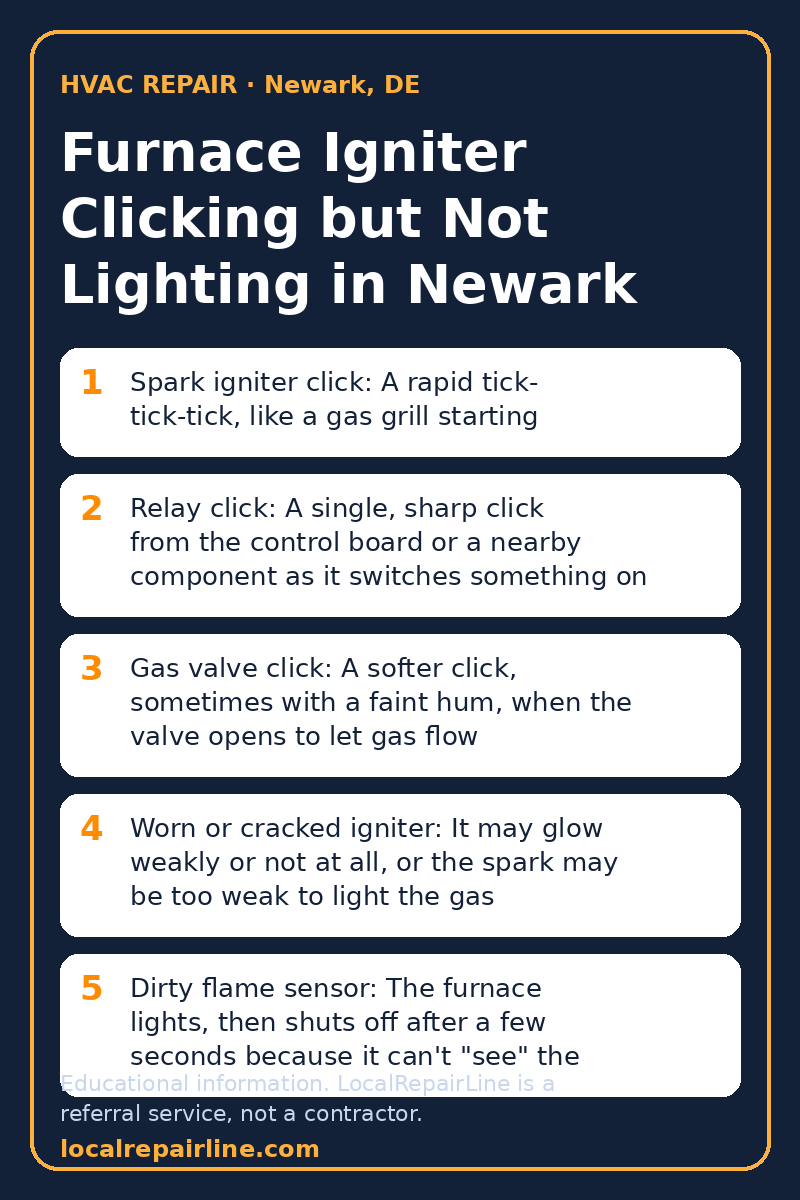
Furnace Igniter Clicking but Not Lighting Newark DE: Why It Happens
A furnace needs three things to stay lit: a working ignition source, gas flow, and a sensor that confirms a flame. If any link fails, the control board shuts things down.
The usual suspects look like this:
- Worn or cracked igniter: It may glow weakly or not at all, or the spark may be too weak to light the gas.
- Dirty flame sensor: The furnace lights, then shuts off after a few seconds because it can't "see" the flame.
- Gas supply problem: A closed valve, a utility interruption, or a faulty gas valve means no fuel reaches the burners.
- Airflow or venting trouble: A blocked intake or exhaust pipe, or a clogged condensate drain on a high-efficiency furnace, can trip safety switches before ignition.
- Control board or wiring fault: Less common, but it can cause repeated failed attempts.
Notice that "never lights" and "lights then quits" are different symptoms. That distinction matters in the next sections.
Safe Checks to Try Before You Call Anyone
Start with the basics. These checks only involve things you can see and reach from outside the burner area, and sometimes one of them turns out to be the whole problem. Stop if any step feels beyond what you're comfortable doing.
- Set the thermostat to Heat and raise the temperature a few degrees above the room. Replace the batteries if it uses them.
- Make sure the furnace power switch (it often looks like a light switch near the unit) is on, and check the breaker.
- Confirm the blower door panel is seated properly. Many furnaces won't run if it isn't.
- Check the air filter. A badly clogged one can cause overheating shutdowns.
- Look at the gas valve near the furnace. The handle should be in line with the pipe when open.
- Check whether another gas appliance, like a stove or water heater, is working. That tells you whether gas is reaching the house.
- Look outside at the vent and intake pipes. After snow or a nor'easter-type storm, drifts or debris can block them.
Read the blinking light
Many furnaces have a small LED visible through a window in the blower door. It blinks in patterns, and a chart on the inside of the door explains each one.
A pattern might suggest a failed ignition, a pressure switch issue, or a flame sensing problem. Write down the pattern. It gives a technician a head start and helps you avoid guessing.
Dirty Flame Sensor vs. Bad Igniter vs. Gas Valve Problems
This is where people sometimes pay for the wrong part. Compare what you observe.
Dirty flame sensor. The burners light, burn for a few seconds, then shut off. The cycle repeats and may end in lockout. Cleaning the sensor, which is a thin metal rod in the burner flame, often solves it. A technician can do this quickly, and some comfortable homeowners do it with power and gas off, but if you're unsure, leave it.
Bad igniter. A hot surface igniter that never glows, or a spark igniter that sparks weakly or not at all, points here. Visible cracks are another sign. Part and labor costs vary by furnace, and how easy the igniter is to reach affects the labor involved.
Gas valve problem. You hear clicks and the igniter works, but no flame appears. A gas valve repair can involve more parts and labor than a sensor cleaning, so confirm the diagnosis first.
Replacing an igniter when the real issue was a dirty sensor is one of the costs people regret. A proper diagnosis first can save you from buying parts you don't need.
Why Newark's First Cold Snap Exposes These Failures
Newark has four distinct seasons. Your furnace may sit idle for months, then be asked to fire up reliably the first time a cold front arrives.
Summers here are hot and humid. That can leave dust and moisture-related buildup on components, including the flame sensor and burner area. A thin film on the sensor is enough to make it misread the flame.
An older igniter may also have been fine in spring and then fail on its first hard start of fall. Igniters are fragile and wear with each heating cycle.
Add winter cold snaps, snow, and the chance of a nor'easter-type storm, and a no-heat furnace becomes both a comfort and a safety issue. That's a good reason to test the furnace on a mild fall day instead of waiting for the first freeze.
What a Repair Visit Involves and How to Avoid Overpaying
A typical visit starts with a technician watching the furnace go through its startup sequence. They check the error code, test the igniter, inspect and clean the flame sensor, and verify gas flow and venting.
Costs vary by house. The main factors are:
- The furnace's age, brand, and how easy it is to reach the part
- Which component failed (a sensor cleaning is usually less involved than a gas valve or control board)
- Labor time and how complicated the diagnosis turns out to be
- Whether other parts are worn and likely to fail soon
To avoid overpaying, ask the technician to show you the failed part or explain the test that pointed to it. Ask whether cleaning or adjustment could solve the problem before parts are replaced.
For an older furnace facing a major repair, ask for a clear comparison of repair versus replacement. There's no single answer, since it depends on age, condition, and what else may be wearing out.
When to Stop and Call a Local HVAC Pro
Stop troubleshooting if you've gone through the safe checks (thermostat on heat, power on, filter clean, gas supply on, no error code you can clear) and the furnace still clicks and never lights. At that point it's time to talk to a local HVAC pro in Newark, DE like LocalRepairLine instead of guessing.
Bring in a pro if any of these apply:
- You smell gas. Leave the house, then contact your gas utility or emergency services from outside. Don't flip switches or use a phone inside.
- You see soot, scorch marks, or yellow, flickering flames.
- A carbon monoxide alarm sounds, or anyone feels dizzy, nauseous, or has a headache.
- The furnace locks out after a few attempts.
Don't keep resetting the unit on a cold night hoping it catches. Repeated attempts can build up unburned gas, and they don't fix a failed part. If the house is getting cold, use safe supplemental heat while you wait, and never use an oven or outdoor-rated heater indoors.
FAQ
Why is my furnace clicking but not lighting?
Clicking means something is trying to start the cycle, but one link in the chain is failing. It could be a weak or cracked igniter, a gas supply problem, a blocked vent, or a control fault. Work through the safe checks first, and note any blinking light pattern to share with a technician.
Can a dirty flame sensor cause clicking and no heat?
Yes, though it usually shows up as the furnace lighting briefly and then shutting off. The sensor can't confirm the flame, so the control board cuts the gas. Cleaning it often helps, but if you're not comfortable doing it, a technician can handle it quickly.
How can I tell a bad igniter from a gas valve problem?
A bad igniter usually shows up as no glow on a hot surface igniter, or a weak or missing spark on a spark igniter. A gas valve problem looks different: the igniter works and you hear clicks, but no flame appears. Because the two can look similar, a technician's test is a reliable way to confirm which part failed.
Is it okay to keep resetting my furnace?
No, you shouldn't. Repeated failed attempts can build up unburned gas, and resetting won't repair a failed part. If the furnace locks out after a few tries, stop and call a local HVAC pro.
Need an HVAC repair pro in Newark, DE?
Talk to an independent local contractor who serves your area.
📞 Call (833) 669-0233HVAC repair in Newark, DECall hours: 8am–8pm ET, 7 days