Furnace Making Loud Banging Noise in Denver, CO: What It Means
Searching "furnace making loud banging noise Denver CO" usually means something just made you jump. Maybe it was a sharp boom when the heat kicked on, or a metal thump from the walls.
Some bangs are harmless. One kind is not, and the difference often comes down to when the noise happens and what it sounds like.
What Kind of Bang Is It? Match the Sound to the Cause
Start by noticing the timing. Does the noise come at startup, while the furnace runs, or when it shuts off?
- A single sharp boom a few seconds after the burners try to light: This points to delayed ignition. Treat it as serious.
- A metallic pop or thump from the ductwork when the heat starts or stops: This is usually metal expanding or contracting.
- A rattle or vibration while the blower runs: Often a loose panel, a loose screw, or a worn blower part.
- Repeated bangs along with shutdowns or a burner flame that looks wrong: Stop and get it checked.
The startup boom deserves the most attention. Duct noise is usually more of a nuisance, while a boom at startup can point to a safety issue worth having checked.
Need an HVAC repair pro in Denver, CO?
Talk to an independent local contractor who serves your area.
📞 Call (833) 669-0233HVAC repair in Denver, COCall hours: 8am–8pm ET, 7 daysYour call may first be answered by a short screening service that asks what the problem is and where you are. Stay on the line and you will be connected to an independent local pro.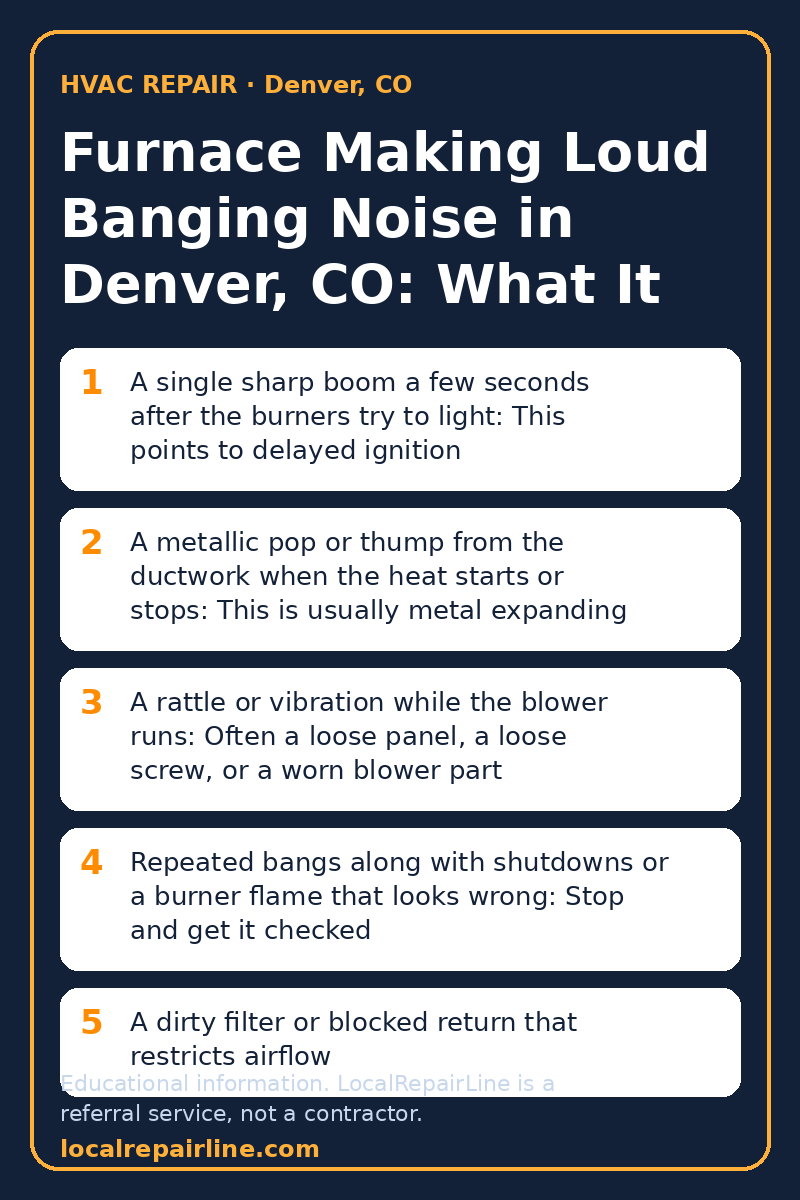
The Boom at Startup: Delayed Ignition and Why It's Serious
A gas furnace is supposed to light the burners almost as soon as gas starts flowing. With delayed ignition, gas flows, but the flame doesn't catch right away. The gas builds up, then lights all at once with a bang.
Common causes include dirty or clogged burners, a weak or failing igniter, and a blocked flame path. Dust and debris are a big part of it. Denver's dry climate means dust settles into furnaces and ducts during long stretches when the heat isn't running.
A small delayed light might only rattle the cabinet. A repeat of it can stress the heat exchanger, the metal part that keeps combustion gases separate from your home's air. A damaged heat exchanger can become a carbon monoxide concern.
If you hear a boom at startup, don't keep restarting the furnace to see if it happens again. Repeatedly resetting a booming furnace can add wear and risk, because each hard ignition puts stress on the parts.
Popping and Thumping Ducts: Usually Harmless, Sometimes Not
Sheet metal ducts expand when warm air flows through and shrink as they cool. That can cause a pop or a thump when the furnace starts or stops. It tends to be a hollow, "oil can" kind of sound, and it comes from the walls, ceiling, or floor rather than from the furnace itself.
Usually it's a nuisance, not a danger. But a few things can make it worse:
- A dirty filter or blocked return that restricts airflow
- Closed or blocked supply vents that raise pressure in the ducts
- Large flat duct sections that flex easily
- Loose duct supports or straps
If the noise gets louder over time, or starts after you closed off several rooms, airflow is a good thing to look at. If you also notice weak heat, uneven rooms, or the furnace shutting itself off, don't assume it's only the ducts.
Furnace Making Loud Banging Noise Denver CO: Why Cold Snaps and Dry Air Make It Worse
Denver winters can swing fast. You might have a mild, sunny stretch where the furnace barely runs, then a cold snap or snowstorm that makes it fire hard for hours.
That pattern is rough on a furnace. Parts that sat idle can be coated with dust. A weak igniter that squeaked by on short mild cycles can fail when the system asks for more heat.
Sunny days in the middle of the heating season add another factor. Many furnaces start and stop often, so the ducts expand and contract again and again. More cycles can mean more popping.
The first cold night of the season is a common time to notice a new noise. If you hear one then, don't brush it off as "it just woke up." Pay attention to whether it's a boom or a duct pop.
Safe Checks You Can Do Before Calling Anyone
These checks are simple and don't involve opening up gas parts. If the noise is a startup boom, skip them and go to the next section.
- Note the timing. Write down whether the bang happens at startup, mid-cycle, or shutdown, and whether it's every cycle or only some.
- Check the air filter. A clogged filter restricts airflow and can make ducts pop. Replace it if it's dirty.
- Open the vents. Make sure supply registers are open and return grilles aren't blocked by furniture or rugs.
- Check the furnace panel. With the thermostat off, make sure the blower door or panel is seated properly. A loose one can rattle or bang.
- Test your carbon monoxide detectors. Confirm they work and have fresh batteries if they need them.
Don't remove burner covers, adjust gas parts, or try to clean burners yourself unless you have the training. Burner cleaning is a job for a technician.
When to Shut It Off and Call a Local Pro
This is the point to stop guessing and talk to a local HVAC pro in Denver, CO, such as Local Repair Line. Turn the furnace off at the thermostat and call a qualified local technician if you notice:
- A sharp boom at startup
- A gas smell
- Soot or black marks around the furnace
- A yellow or flickering burner flame (a healthy flame is usually steady and mostly blue)
- A carbon monoxide alarm
- Repeated shutdowns or lockouts
If you smell gas or a carbon monoxide alarm sounds, get everyone, including pets, outside right away, then call your gas utility or emergency services from outside. Don't flip light switches or try to find the cause first.
For a non-emergency boom, set the thermostat to off. If you know how, you can also close the gas valve to the furnace. In many setups, the handle is closed when it sits crosswise to the pipe. If you're not sure, leave it and let the technician handle it.
Dress warmly, use safe space heating that doesn't involve burning fuel indoors, and wait for the inspection.
What a Pro Will Inspect and What Repairs Typically Involve
A technician will usually start by listening and asking when the noise happens. Then they'll look at the ignition system, burners, flame sensor, gas pressure, venting, and the heat exchanger.
Typical repairs depend on what they find:
- Dirty burners: Cleaning is often enough.
- Weak igniter or flame sensor: These parts can be replaced or cleaned.
- Venting or airflow problems: May need clearing or adjustment.
- Duct noise: Usually involves airflow fixes, added support, or sealing and reshaping sections.
- Cracked heat exchanger: This is the serious one, and it often changes the repair-or-replace decision.
Costs vary by house, furnace age, and how accessible the parts are. A burner cleaning usually involves less work and fewer parts than replacing a major component, so ask the technician to explain what each option involves before you decide.
Repair or Replace? How to Weigh the Cost and the Risk
This decision can go wrong in either direction. Replacing a whole furnace when a burner cleaning would have fixed the boom is one way. Another is to keep patching an old furnace with a damaged heat exchanger until it fails in a cold snap.
Ask the technician plainly what caused the noise, whether the heat exchanger passed inspection, and what else is likely to fail soon. Get the findings explained in plain language before deciding.
Some tradeoffs to weigh:
- Repair makes sense when the cause is a clean-and-adjust issue or a single worn part, and the furnace is otherwise in decent shape.
- Replacement deserves a closer look when the heat exchanger is compromised, repairs keep stacking up, or the furnace is old and unreliable.
- Understanding the tradeoffs helps, because it lets you weigh repair against replacement calmly and with the full picture.
If you get conflicting opinions, a second look from another local technician can be worth it, especially before a major replacement.
FAQ
Is a loud banging noise from my furnace dangerous?
It depends on the sound. A sharp boom at startup can signal delayed ignition and should be treated as serious. A duct pop or thump is usually harmless, but if it comes with a gas smell, soot, odd flames, or a carbon monoxide alarm, shut the furnace off and get help.
Why does my furnace make a loud boom when it turns on?
Gas is likely building up before it lights, then igniting all at once. Dirty burners, a weak igniter, or a blocked flame path are common causes. Turn the furnace off at the thermostat and have a technician check it instead of resetting it repeatedly.
Why do my ducts bang when the heat comes on?
Metal ducts expand as warm air moves through them, and that movement can cause a pop or thump. Restricted airflow from a dirty filter, closed vents, or loose duct supports can make it louder. If the noise grows or comes with weak heat or shutdowns, have a technician take a look.
Need an HVAC repair pro in Denver, CO?
Talk to an independent local contractor who serves your area.
📞 Call (833) 669-0233HVAC repair in Denver, COCall hours: 8am–8pm ET, 7 days