Furnace Stopped Working Denver CO: Fast Fixes and Next Steps
You wake up, see your breath in the hallway, and realize the house is dead quiet. When your furnace stopped working Denver CO winters can make the indoor temperature drop fast, especially when a sudden Arctic cold front blows in off the plains.
Before you assume the entire system is shot, there are a handful of plain mechanical checks you can make right now. Some fixes take two minutes, while others tell you exactly when to stop tinkering and get professional help.
Critical first checks: thermostat settings, power switches, and breakers
Start with the simple things that get bumped or tripped accidentally.
- Check the thermostat screen and mode. Make sure the setting is on Heat, not Cool or Off, and set the temperature at least five degrees above room temperature. If the display is completely blank, pop the cover off and replace the AA or AAA batteries inside.
- Inspect the emergency switch. Most homes have a standard-looking wall light switch mounted right on or near the furnace cabinet, often labeled with a red plate. It gets bumped by brooms or storage boxes in basements all the time, so flip it firmly to On.
- Look at the main electrical panel. Find the breaker labeled Furnace or Heat, which often sits springy in the middle between On and Off when tripped. Push it all the way to Off first, then firmly flip it back to On.
- Fasten the furnace door panel. Modern units have a safety switch behind the main blower door. If that metal access panel is loose or crooked after someone checked a filter, the unit cuts all power immediately.
If none of those bring the blower to life, the problem lies deeper in the unit or the venting.
Need an HVAC repair pro in Denver, CO?
Talk to an independent local contractor who serves your area.
📞 Call (833) 669-0233HVAC repair in Denver, COCall hours: 8am–8pm ET, 7 daysYour call may first be answered by a short screening service that asks what the problem is and where you are. Stay on the line and you will be connected to an independent local pro.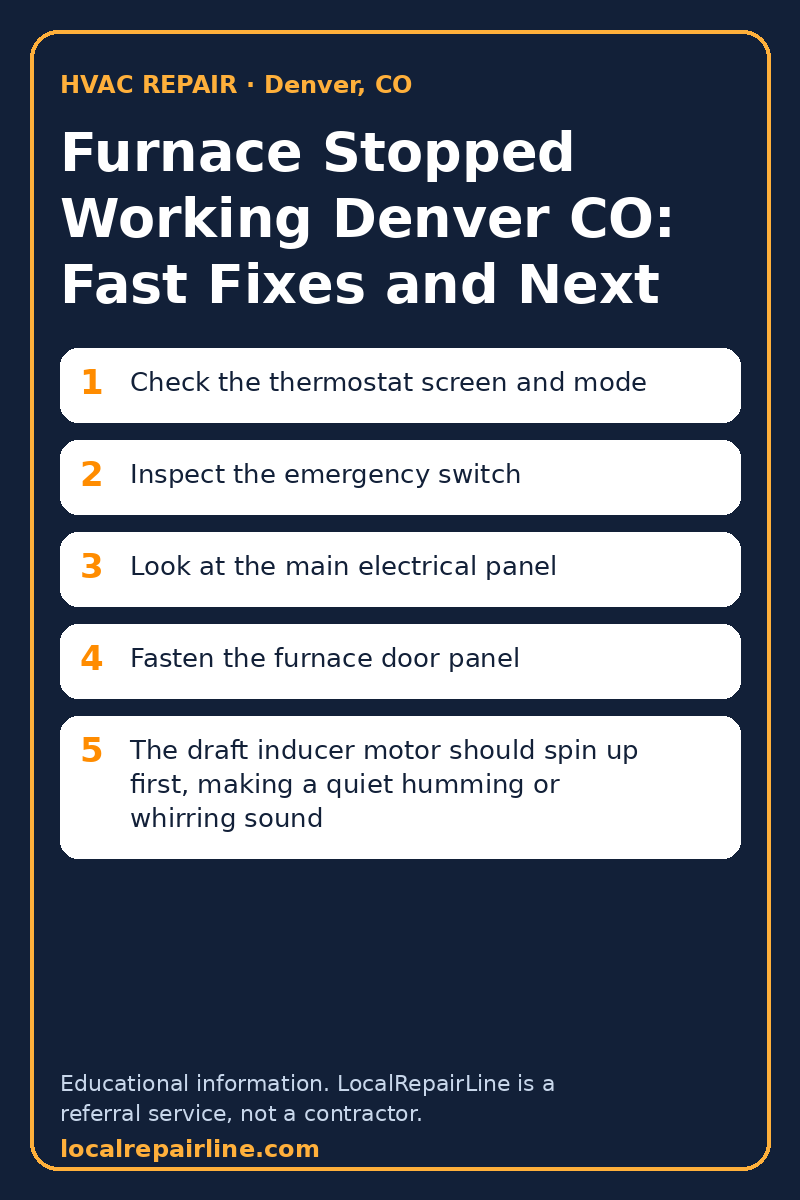
How Colorado air density and dust overheat limit switches
Denver sits a mile above sea level, which changes how heating equipment behaves. Thinner air holds less density, meaning your furnace blower has to move that lighter air across hot metal heat exchangers without letting the metal overheat.
The winter air along the Front Range is notoriously dry, and dry conditions bring heavy indoor dust, pet hair, and particulate. When a furnace filter fills up with that fine dirt, airflow drops to a crawl.
The furnace fires up, the heat exchanger gets scorchingly hot because the thin air can't carry the heat away fast enough, and the high-limit safety switch trips to keep the metal from cracking.
When that limit switch trips, the burners shut down, but the blower fan may keep running endlessly, blowing cold air through your registers.
Slide your furnace filter out and hold it up to a light bulb. If you can't see light through the pleats, that clogged filter is likely your culprit.
Turn the furnace power off at the wall switch, put in a clean filter, and turn the power back on. Many limit switches will reset automatically once the metal cools down completely.
Exterior vent pipe and condensate freezing issues in sub-zero weather
High-efficiency furnaces don't vent out of a brick chimney. Instead, they run white plastic PVC pipes out through the side of your foundation or rim joist.
One pipe draws outside air in, while the other expels exhaust fumes and moisture. Because burning natural gas creates water vapor, these high-efficiency units produce gallons of acidic water every day that drain out through a small plastic tube.
During extreme cold snaps, two things regularly freeze: * The exterior pipe termination: Drifting snow, ice dams, or freezing exhaust steam can form an icicle collar over the pipe openings outside. When the draft inducer fan can't pull in outdoor air or push exhaust out, a sensitive internal pressure switch refuses to let the gas valve open. * The condensate drain line: If your drain pipe runs through an unheated crawlspace, an attached garage, or discharges outside, standing water inside that line can freeze solid. When the water backs up, a safety float switch trips and cuts the power to the ignition system.
Put on a coat and walk around the outside of your house. Clear away snowdrifts or hanging rime ice from around those white PVC pipes. If your drain line is frozen inside an unheated area, gently warming the plastic trap with a hair dryer can sometimes clear the blockage and get the water flowing again.
What to do when your furnace stopped working in Denver CO cold snaps
The sudden barometric pressure swings during regional winter storms put extra strain on safety sensors. High-efficiency furnaces rely on pressure switches to verify that combustion air is flowing properly through the thinner atmosphere.
If the outdoor vents are clear, the filter is fresh, and the power is on, you need to observe the startup sequence:
- The draft inducer motor should spin up first, making a quiet humming or whirring sound.
- The pressure switch closes, confirming proper draft.
- The hot surface igniter glows bright orange, or a spark clicks.
- The gas valve clicks open, and you hear the whoosh of flames catching.
- The flame sensor verifies the fire, and a minute later, the large indoor blower fan starts sending warm air upstairs.
If the furnace starts this dance, clicks, runs for four seconds, and then abruptly shuts off the fire, you're dealing with an ignition or draft failure. Repeated cycling without ignition means the furnace is protecting itself from a dangerous condition.
How to read the diagnostic flashing light codes on your unit
Almost every furnace built in the last twenty years has a small clear sight glass on the lower cabinet door. Peer through that glass before taking any panels off.
You should see an LED light on the control board inside. It might be green, red, or amber, and it will usually be blinking in a distinct pattern: * Steady light or slow pulse: Normal standby or normal call for heat. * Rapid blinking: Often indicates reverse polarity or a grounding issue. * A series of flashes: Two flashes, three flashes, or a pattern of short and long blinks (like Morse code).
Look at the sticker pasted on the inside of the blower door or on the furnace casing. That sticker translates the flashes.
Common codes include pressure switch open, high limit open, or flame rollout. Knowing whether the board is complaining about airflow or gas ignition helps you understand what is actually broken before anyone touches a tool to it.
Repair versus replacement: honest advice without high-pressure sales tactics
When a furnace quits during a freezing week, it is easy to panic and assume you need a brand-new heating system. Heating equipment sales representatives know this, and some will push for a total replacement when a simple part failed.
Small mechanical parts fail naturally over time: * Flame sensors get coated in carbon and can be cleaned with steel wool. * Igniters crack and burn out, much like an incandescent light bulb. * Blower capacitors lose their charge and prevent the motor from starting. * Pressure switches stick due to minor moisture buildup in their tubing.
Replacing a single component like an igniter, capacitor, or switch is a standard repair that costs far less than a full system overhaul. Costs vary by house, parts availability, and the age of the unit, but minor component fixes are generally manageable.
Replacement makes sense if your furnace is past its mid-teens, uses an obsolete motor, and suffers a major failure like a cracked heat exchanger. A cracked heat exchanger leaks exhaust gases into your living space and can't be patched.
If someone tells you the entire furnace must be scrapped for a minor issue, ask them to put the scope and parts in writing before work starts. A trustworthy professional will gladly show you the broken component and explain why it failed.
When to stop troubleshooting and call a heating technician
There is a firm boundary between simple homeowner checks and dangerous tinkering. If you've confirmed the thermostat has fresh batteries, the air filter is spotless, the breaker is set, and the exterior pipes are clear of snow, put the tools away.
This is the exact moment to step back and find a local HVAC professional in Denver, CO at https://localrepairline.com: * The control board LED blinks an ignition lockout code, and the unit refuses to fire after three attempts. * You smell sulfur, rotten eggs, or raw gas anywhere near the equipment. * You hear buzzing, humming, or screeching from the blower motor followed by an electrical burning smell. * The furnace trips the main breaker instantly every single time it turns on.
Dealing with gas lines, 120-volt wiring, and combustion safety controls requires specialized diagnostic meters and combustion analyzers calibrated for higher altitudes. Pushing further on your own risks damaging the control board or creating a carbon monoxide hazard in your home.
FAQ
Why is my furnace blowing cold air instead of heat?
A dirty air filter usually causes this by tripping the high-limit switch, which shuts off the gas burners for safety while leaving the blower fan running to cool the system down. It can also happen if your thermostat fan switch was accidentally switched to On instead of Auto, which forces the fan to circulate room-temperature air even when the burners are off.
How do I reset my furnace after it shuts down?
Locate the power switch on the side of the furnace or the breaker in your main electrical panel, turn it off completely, wait at least sixty seconds, and turn it back on. This clears temporary lockout codes on the control board, but if the underlying problem like a blocked vent or dirty sensor remains, the unit will simply lock itself out again after a few minutes.
Can cold weather freeze high-efficiency furnace exhaust pipes?
Yes, the exhaust from modern high-efficiency units contains heavy moisture that can condense and freeze at the outdoor PVC pipe exit during sustained sub-zero temperatures. If the pipe rim freezes over or snow blocks the opening, the internal pressure switch will shut down the furnace until the obstruction is cleared.
How much does a typical furnace repair cost in Colorado?
Costs vary by house, the age of the unit, and the specific component that failed. A basic service visit to clean a flame sensor or replace an igniter is relatively minor, while replacing a blower motor, draft inducer, or gas valve requires a higher investment in both specialized parts and labor. Always ask the technician to provide a written scope of work detailing the exact parts and labor before they begin.
Need an HVAC repair pro in Denver, CO?
Talk to an independent local contractor who serves your area.
📞 Call (833) 669-0233HVAC repair in Denver, COCall hours: 8am–8pm ET, 7 days