Heat Pump Not Heating in Kalamazoo, MI? What to Check First
If you're searching heat pump not heating Kalamazoo MI, you probably have a vent blowing air that feels cool or barely warm. That's unsettling when the forecast shows snow. The good news is that some of the causes are simple and safe for you to check.
This guide covers what's normal in a Kalamazoo winter, what to check yourself, and when to stop guessing and call someone.
Heat Pump Not Heating Kalamazoo MI: Is It a Cold Snap or a Breakdown?
A heat pump moves heat from outdoor air into your house. It's very good at this in mild weather. When a deep cold snap hits, it has to work much harder.
Air from a heat pump also feels different than air from a furnace. It's usually warm, not hot, and it can feel cool on your skin even when it's heating. Your hand on the vent isn't a great test.
A better test is whether the house is slowly warming toward the thermostat setting. If the temperature inside keeps dropping or sits well below your setting for hours, something is off.
Kalamazoo gets four real seasons, and winter puts heavy demand on any heating system. A system that was fine in October can show its weak spots in January.
Need an HVAC repair pro in Kalamazoo, MI?
Talk to an independent local contractor who serves your area.
📞 Call (833) 669-0233HVAC repair in Kalamazoo, MICall hours: 8am–8pm ET, 7 daysYour call may first be answered by a short screening service that asks what the problem is and where you are. Stay on the line and you will be connected to an independent local pro.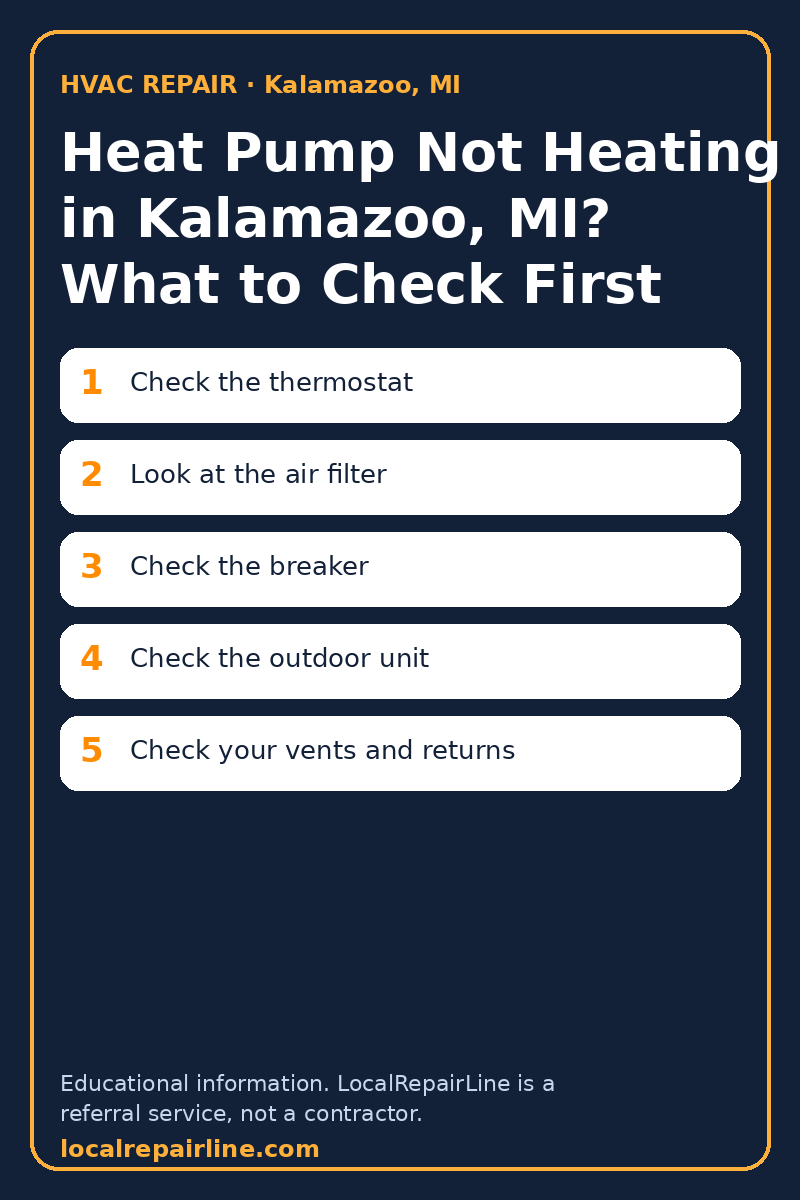
Quick Checks to Make Before You Call Anyone
Start with the basics. These take a few minutes and don't involve opening any panels.
- Check the thermostat. Make sure it's set to Heat, not Cool or Auto-with-a-wrong-setpoint, and that the target temperature is above the room temperature. Replace the batteries if the screen looks dim.
- Look at the air filter. A clogged filter chokes airflow and makes the air feel weak. Swap it if it's dirty.
- Check the breaker. Look at the breakers for both the indoor air handler and the outdoor unit. If one has tripped, reset it once. If it trips again, leave it off.
- Check the outdoor unit. Look for snow, drifts, ice, or leaves packed around it.
- Check your vents and returns. Make sure furniture, rugs, or closed registers aren't blocking airflow.
If the system comes back to life after any of these, you're likely fine. If nothing changes, keep reading before you do anything else.
Normal Defrost Mode vs. a Frozen Outdoor Unit
In cold, damp weather, frost builds up on the outdoor coil. Heat pumps are built to handle this with a defrost cycle. The system briefly reverses, warms the outdoor coil, and melts the frost.
Here's what normal defrost often looks like:
- Steam or vapor rising from the outdoor unit
- The outdoor fan stopping for a few minutes
- Cooler air from your vents during that short stretch
- A change in sound, like a whoosh or a click, when it starts and stops
- Water dripping or running off the unit
Defrost should be short and then the system should go back to normal heating. A frost layer that melts and returns every so often is normal.
A real problem looks different. If the unit is wrapped in thick ice, or the fan is running but the coil is solid ice for hours, defrost isn't working. A sensor, control board, or reversing valve could be to blame. A low refrigerant charge from a leak can also cause heavy icing.
What about auxiliary heat?
Many heat pump systems have backup electric heat strips. During a hard cold snap or defrost, they may kick in. Some thermostats show "Aux" or "Emergency Heat" when this happens.
That's normal in short bursts. But if you see it running constantly, it may mean the heat pump itself isn't keeping up. It also tends to raise your electric bill, so it's worth noticing.
Common Reasons a Heat Pump Blows Cool Air in Winter
Here are the usual suspects, roughly from simple to serious:
- Wrong thermostat setting or dead batteries. Easy to miss, easy to fix.
- Dirty filter or blocked airflow. The system runs, but not enough warm air reaches the rooms.
- Snow or ice around the outdoor unit. The coil can't pull in heat if air can't move through it.
- Failed defrost controls. Ice builds up and the system can't recover on its own.
- Low refrigerant. This usually means a leak. Refrigerant doesn't get "used up," so topping it off without finding the leak only buys time.
- A reversing valve problem. The system may get stuck in cooling mode or mix up its cycles.
- A failing compressor or capacitor. The fan may run but the system makes little heat, or you hear humming or clicking.
- A weak or failed backup heat setup. When it's very cold, a heat pump alone may not cover the load. If the backup strips aren't working, the house falls behind.
- An undersized or aging system. A unit that barely kept up years ago may not handle a real cold snap.
Some of these need a technician with the right tools and training. Refrigerant work in particular isn't a DIY job.
Why Snow, Ice, and Drifting Matter Around Your Outdoor Unit
Being near Lake Michigan means lake-effect snow. It can pile up fast and drift against outdoor equipment, especially along a house wall or fence line.
Late winter and early spring bring another problem. Daytime melting runs down onto the unit, and overnight cold turns it back to ice. That cycle can build ice at the base and around the coil, and it can block drainage.
Here's how to deal with it safely:
- Turn the system off at the thermostat first. Don't run it while you're digging around it.
- Clear snow by hand or with a soft broom. Keep a gap of a couple feet around the unit if you can.
- Don't chip ice with a shovel, hammer, or screwdriver. The coil fins and refrigerant lines are thin and easy to damage, and a puncture means an expensive repair.
- Don't pour hot water on it. It can turn back to ice and make things worse.
- Keep the top clear. Snow or icicles falling from the roof can dent or damage the unit.
If the unit is raised on a stand or bracket, that helps keep it above drifts. If you're not sure how it's mounted or where water drains, a pro can check it during a service visit.
Repair or Replace? How to Weigh Cost, Age, and Reliability
Repair costs vary by house, by the part that failed, and by the age of the system. A thermostat or capacitor issue is a very different bill from a compressor or a refrigerant leak.
Here's the tradeoff to think through. A repair makes sense when the system is fairly young, the problem is isolated, and the unit has otherwise been reliable. Replacement is worth a serious look when the same system keeps breaking.
Patching an aging system winter after winter is worth weighing against replacement. Each repair seems reasonable on its own, but the total adds up, and an older system is more likely to struggle when winter demand is highest.
Questions to ask yourself:
- How old is the system, and how often has it needed repairs?
- Is the repair on a major part, like the compressor?
- Does the house stay uncomfortable even when the system runs fine?
- Are the electric bills climbing because backup heat runs a lot?
If the house never quite warms up in a cold snap, the system may be undersized or the ductwork may be leaking. In that case a repair won't fix the real problem. Ask a pro to explain the options, including how well a replacement would be sized for your house, and compare the choices in writing.
Signs It's Time to Call a Local HVAC Pro
You've done the quick checks. Thermostat on Heat, clean filter, breaker on, snow cleared. If the air is still cool, this is the point to talk to a local HVAC pro in Kalamazoo, MI instead of guessing, and LocalRepairLine is one place to start.
Call when you notice any of these:
- Air stays cool or lukewarm after the basic checks
- The outdoor unit stays iced over for hours or keeps icing up
- The system short-cycles, turning on and off in quick bursts
- You hear grinding, squealing, banging, or loud humming
- A breaker keeps tripping
- Backup heat runs nonstop and the house still won't warm up
- You see oil stains or smell something odd near the unit
If you notice any of the above, turn the system off at the thermostat and call. Running a struggling heat pump can sometimes make a problem worse, so it's smarter to have a technician look at it first. If the house gets uncomfortably cold, use safe temporary heat and keep your pipes in mind.
When you call, mention what you've checked, what the thermostat shows, and what the outdoor unit looks like. That helps the technician come prepared.
FAQ
Why is my heat pump blowing cold air in winter?
It could be something simple, like the thermostat setting, a dirty filter, or a tripped breaker. It could also be a defrost cycle, ice around the outdoor unit, or a bigger issue like low refrigerant or a failing reversing valve. If the basic checks don't help, have a pro take a look.
Is it normal for a heat pump to blow cool air during defrost mode?
Yes, for a short time. During defrost the system temporarily reverses to melt frost off the outdoor coil, so the air from your vents may feel cooler and you may see steam outside. If the cool air lasts a long time or the outdoor unit stays covered in ice, defrost may not be working and it's time to call a pro.
Need an HVAC repair pro in Kalamazoo, MI?
Talk to an independent local contractor who serves your area.
📞 Call (833) 669-0233HVAC repair in Kalamazoo, MICall hours: 8am–8pm ET, 7 days