Heat Pump Not Heating Springfield OH? Fixes Before You Call
A heat pump not heating Springfield OH homeowners count on can be a small thing or a real failure. The tricky part is that a heat pump in winter doesn't act like a furnace. Some behavior that looks like a problem is just normal.
This guide helps you sort the normal from the not-normal. It also covers a few safe checks, and the point where it's smarter to stop and call someone.
Is It Really Broken? Normal Heat Pump Behavior on a Cold Ohio Day
A heat pump moves heat from outdoors into your house. It doesn't make heat by burning fuel. So the air from your vents is often warm but not hot, and it can feel cooler than what you remember from a gas furnace.
Springfield winters are cold and snowy, with sudden snaps after a mild stretch. When the temperature drops, the system runs longer and the air can feel milder. That alone doesn't mean it's failing.
Here's what is usually normal:
- Longer run times. On a cold day, the system may run nearly nonstop to hold your setting.
- Lukewarm-feeling air. Warm, steady air from the vents is fine. Air that feels room-temperature or cool is not.
- Steam or mist at the outdoor unit. This often happens during a defrost cycle.
- A brief change in sound. The unit may whoosh, hiss, or pause for a few minutes while it defrosts.
- Cool air for a short time. During defrost, the indoor air can turn cooler for a few minutes.
What isn't normal: cool air that goes on for long stretches, a house that keeps losing ground, or an outdoor unit that stays buried in ice.
Need an HVAC repair pro in Springfield, OH?
Talk to an independent local contractor who serves your area.
📞 Call (833) 669-0233HVAC repair in Springfield, OHCall hours: 8am–8pm ET, 7 daysYour call may first be answered by a short screening service that asks what the problem is and where you are. Stay on the line and you will be connected to an independent local pro.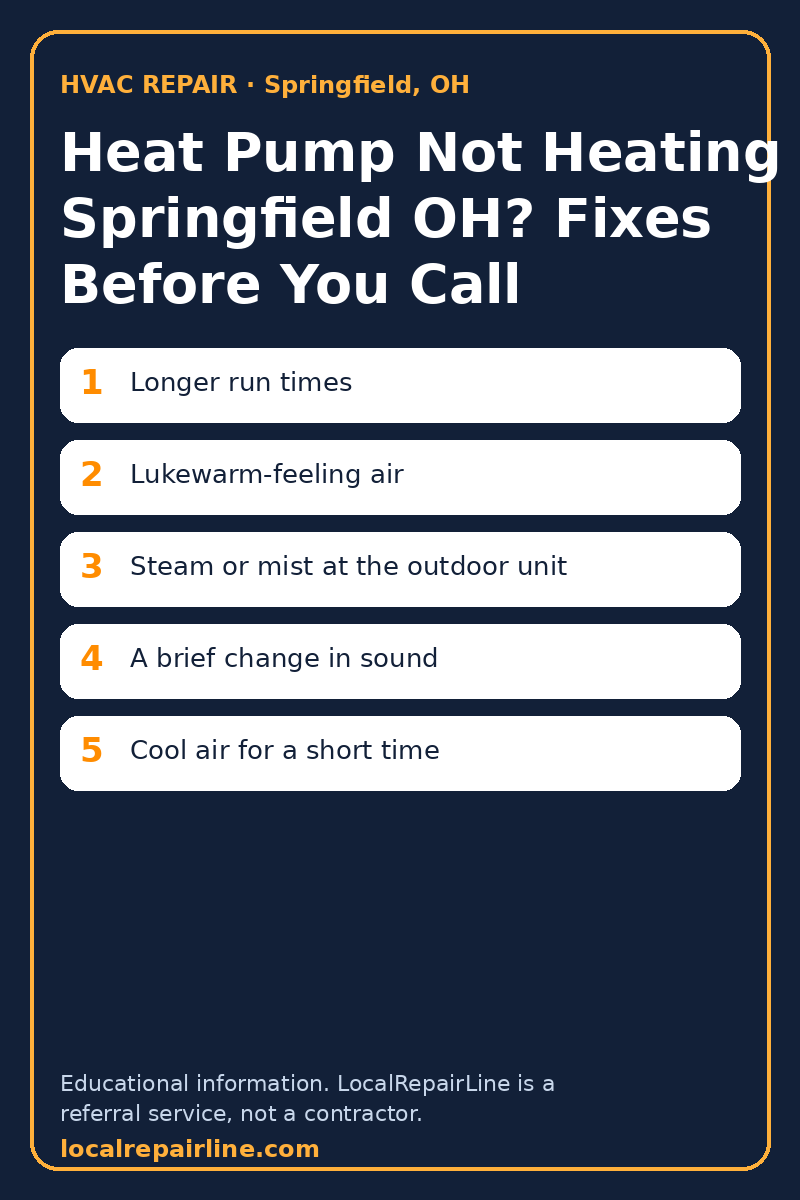
Quick Checks to Run Before You Call Anyone
Start with the simple stuff. These checks stay on the outside of the equipment, so you won't need to remove any covers or panels from the heat pump.
- Check the thermostat mode. Make sure it's set to Heat, not Cool or Off. Then confirm the set temperature is above the current room temperature.
- Look at the display for "Emergency Heat" or "Aux." If it's showing, note it. More on that below.
- Check the air filter. A clogged filter chokes airflow and makes the air feel weak. Replace it if it's dirty.
- Look at your breaker panel. If a breaker for the indoor or outdoor unit has tripped, reset it once. If it trips again, leave it off and call a pro.
- Clear the outdoor unit. Gently remove snow, leaves, or debris from around it. Keep a clear space on all sides so air can move.
- Open the vents and registers. Make sure supply vents aren't blocked by rugs, furniture, or closed dampers.
If you've done all six and the house still isn't warming, you've reached the edge of safe DIY. Stop there rather than poking around inside the equipment.
Ice on the Outdoor Unit: Normal Frost vs. a Defrost Problem
Cold, damp air is hard on an outdoor unit. A light coat of frost in freezing weather is common. The system is built to melt it off with a defrost cycle.
What normal looks like
You may see a thin layer of frost, then watch it melt away over several minutes with some steam rising off the unit. The frost comes back later and clears again. That's the system doing its job.
What points to a problem
Pay attention if the coil is covered in thick ice, or the unit looks like a block of ice. Same goes for ice that stays after the unit has run through a few defrost cycles. A fan that isn't turning is another warning sign.
A frozen unit can mean a failed defrost control, a sensor issue, low refrigerant, or poor airflow. None of those are DIY fixes.
Don't chip at the ice with a hammer, screwdriver, or shovel. The coil fins and refrigerant lines are easy to damage. Clearing loose snow from around the unit is fine, but leave the ice alone.
After an ice or snow event, check that nothing is piled against the unit, and that meltwater can drain away rather than refreeze underneath it.
Common Reasons a Heat Pump Blows Cool Air
If the air stays cool and the outdoor unit isn't just in a normal defrost, a few causes show up often:
- Dirty filter or restricted airflow. Weak airflow makes the system struggle and can lead to freezing.
- Low refrigerant. Refrigerant doesn't get "used up." Low levels usually mean a leak, which needs a pro to find and fix.
- A failing reversing valve. This part switches the system between heating and cooling. If it sticks, you may get cool air in heat mode.
- Defrost control or sensor trouble. The unit can't clear frost properly, so it ices over.
- Compressor or capacitor problems. The fan might run, but the compressor isn't doing the work.
- Thermostat or wiring issues. The system may not be getting the right signal.
A gradual problem can hide for months. Swings between mild and cold days in fall and early spring mean you may not notice a weak system until the first real cold stretch. That's often when a long-ignored fault finally shows.
Emergency Heat and Your Power Bill: What Springfield Homeowners Should Know
Most heat pumps have backup electric heat strips. They kick in as "auxiliary" heat when it's very cold or the system needs help. "Emergency heat" is a setting that forces the strips on and shuts off the heat pump itself.
Strips can make a house feel warm, which is why people leave the setting on and call it good. The trouble is that electric strips generally cost much more to run than a working heat pump. A cold snap with the system stuck on backup can push up your power bill noticeably, and costs vary by house.
It also hides the real problem. The house feels fine, so nobody fixes the heat pump. Meanwhile the underlying fault can get worse.
How to tell it's switched to backup
- The thermostat shows "Aux," "Emergency," or a similar light.
- The air from the vents feels warmer than usual, but your electric bill climbs.
- The outdoor unit isn't running while the indoor unit is blowing warm air.
- You smell a brief dusty or burning scent when strips first turn on. That can be normal after a long off period, but it shouldn't linger.
Emergency heat is meant for short-term use, like waiting a day or two for a repair. It's not a fix. Using it for weeks during an Ohio cold snap is an expensive way to cover up a problem.
Repair or Replace? What to Weigh Before Spending Money
Once a pro diagnoses the problem, you'll face a choice. A few things help you think it through.
Repair usually makes sense when: - The problem is a smaller part, like a capacitor, sensor, or control board. - The system is fairly new and has been reliable. - Your bills were steady until this issue showed up.
Replacement deserves a closer look when: - The system is old and has needed repairs more than once. - The repair involves a major part like the compressor. - A refrigerant leak keeps coming back. - Your heating bills have crept up year after year.
Costs vary by house and by system, so get a clear written breakdown before deciding. Ask what's failing, what the repair covers, and what it would mean if another part goes soon after. A repair that buys you only a short stretch of life may not be worth much.
When a Heat Pump Not Heating Springfield OH Means Calling a Local HVAC Pro
You've checked the thermostat, filter, and breaker. You've cleared snow and debris from around the outdoor unit. If the house still isn't warming, or the unit stays iced over after a defrost cycle, this is the point to talk to a local HVAC pro in Springfield, OH, such as the LocalRepairLine team, instead of guessing.
Keeping the system running in that state won't fix anything, so ask the tech whether it's okay to leave it on until they arrive. It can also rack up runaway costs if the backup strips are doing the work.
Call sooner if you notice any of these:
- Breakers that keep tripping
- Loud grinding, banging, or squealing
- A burning smell that doesn't fade
- Oily residue near the outdoor unit or refrigerant lines
- A thick shell of ice that won't clear
- Emergency heat running for more than a day or two
When you call, share what you've already tried and what the thermostat shows. Mention whether it says "Aux" or "Emergency." That helps the tech narrow things down faster.
FAQ
Why is my heat pump blowing cold air in the winter?
It could be a defrost cycle, which causes cool air for a few minutes. It could also be a clogged filter, a thermostat set wrong, or a real fault like low refrigerant or a stuck reversing valve. If the air stays cool beyond a short defrost, it's time to have a pro take a look.
Is it normal for my heat pump to have ice on it?
A light layer of frost that melts off during a defrost cycle is normal in cold, damp weather. Thick ice that stays on the unit, or a fan that won't turn, is not. Don't chip the ice away yourself, since you can damage the coil.
Should I use emergency heat when my heat pump isn't heating?
Only briefly, as a short-term bridge while you wait for a repair. Emergency heat uses electric strips, which can push your power bill up fast, and it can mask a problem that's getting worse. If you've been on it for more than a day or two, call a pro.
How cold is too cold for a heat pump to work?
Heat pumps work in cold weather, but they get less efficient as the temperature falls. That's why backup heat strips often join in on the coldest days. The exact point varies by model, age, and how well your house holds heat, so if your system struggles during an ordinary Ohio cold spell, have a pro check it.
Need an HVAC repair pro in Springfield, OH?
Talk to an independent local contractor who serves your area.
📞 Call (833) 669-0233HVAC repair in Springfield, OHCall hours: 8am–8pm ET, 7 days