Emergency Furnace Repair Fort Wayne IN: What to Do Tonight
Searching for emergency furnace repair Fort Wayne IN usually means the house is getting cold and you want answers fast. This guide helps you sort out what's dangerous, what you can check yourself, and what can wait until morning.
A dead furnace in a Northeast Indiana winter is stressful. A calm, ordered plan helps you make safer choices and avoid rushed decisions.
How to Tell If Your Furnace Problem Is an Emergency
Not every no-heat night is a true emergency. Some problems are dangerous at any hour, and others are just uncomfortable.
Treat it as urgent if you notice:
- A gas smell, often described as rotten eggs
- A carbon monoxide alarm going off
- Loud banging, popping, or grinding from the furnace
- A burning smell, smoke, or soot and scorch marks around the unit
- Water pooling around the unit along with no heat
- A below-zero forecast, or a home with young children, older adults, or anyone medically fragile
It can likely wait until morning if:
- The house is still holding a safe temperature
- The weather isn't extreme
- The furnace simply won't start, with none of the warning signs above
Even then, don't ignore it. Calling in the morning is a better move than hoping it fixes itself.
Need an HVAC repair pro in Fort Wayne, IN?
Talk to an independent local contractor who serves your area.
📞 Call (833) 669-0233HVAC repair in Fort Wayne, INCall hours: 8am–8pm ET, 7 daysYour call may first be answered by a short screening service that asks what the problem is and where you are. Stay on the line and you will be connected to an independent local pro.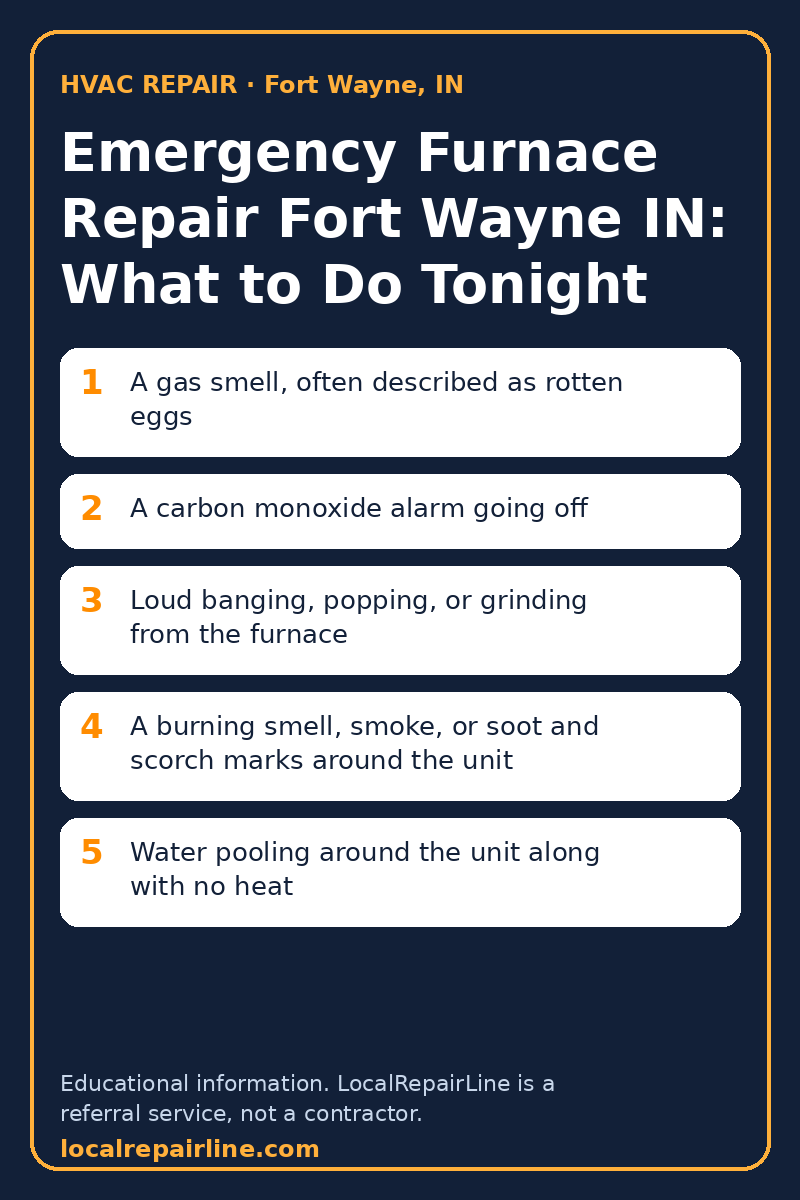
Safety First: Gas Smells, Carbon Monoxide, and When to Leave the House
If you smell gas, don't hunt for the source. Don't flip light switches, use a lighter, or unplug anything.
Get everyone, pets included, out of the house. Then call your gas utility and emergency services from outside or from a neighbor's home.
A carbon monoxide alarm is just as serious. Carbon monoxide is odorless, and symptoms can feel like the flu: headache, dizziness, nausea, confusion.
If the alarm sounds, or anyone feels sick, go outside into fresh air and call emergency services. Don't go back in until responders say it's safe. Don't silence the alarm and assume it's a glitch.
Quick Checks Before You Call: Thermostat, Filter, Pilot, and Breaker
If there's no gas smell and no alarm, a few simple checks can sometimes get the heat back on. They take about ten minutes, and they give you useful details if you do need to call someone.
Work through them in this order:
- Check the thermostat. Make sure it's set to "heat," not "cool" or "off," and set the temperature a few degrees above the current room temperature. If the screen is blank or dim, replace the batteries.
- Check the furnace power switch. Most furnaces have a switch that looks like an ordinary light switch on or near the unit. It's easy to flip off by accident, especially in a basement or utility closet.
- Check the breaker panel. Look for a tripped breaker labeled for the furnace or "HVAC." Reset it once. If it trips again right away, leave it off and call for help.
- Check the air filter. A clogged filter restricts airflow and can cause the furnace to overheat and shut itself down. If it's gray and packed with dust, swap in a clean one that matches the size printed on the old filter's frame.
- Check the pilot light or ignition. Some older furnaces have a standing pilot light, while newer ones use electronic ignition. If yours has a pilot that's out, follow the relighting instructions printed on the unit, and stop if you smell gas at any point.
- Check the gas valve. The handle should line up with the pipe when open. If it sits crosswise, the gas is off.
Other Things Worth a Look
A few Northeast Indiana winter problems are easy to spot from the outside.
- Blocked vents. Many newer furnaces vent through plastic pipes on the side of the house. Drifting snow or ice can block them, and the furnace may shut down as a safety response.
- Clogged condensate drain. High-efficiency furnaces make water as they run. If the drain line backs up or ices over, the unit can lock out.
- Closed or blocked registers. Furniture or rugs over vents can make some rooms feel cold even when the furnace is working.
If you clear a vent or replace a filter and the furnace restarts, keep an eye on it for the next hour. If it shuts off again, something else is going on.
What Not to Do
Don't open the furnace's inner panels or poke around the burners. Don't bypass safety switches, and don't keep resetting the unit over and over. Those safety features are there for a reason, and repeated resets can hide a real problem.
How to Handle Emergency Furnace Repair Fort Wayne IN Calls
If the checks don't work, or you spotted one of the urgent signs, it's time to call a heating company, and you can request local help here when you're ready. A little preparation makes the call faster and the visit more useful.
Have this information ready:
- Furnace brand and age, if you know them (often printed on a label inside the door)
- What the furnace did before it stopped, such as strange noises or smells
- Which checks you already tried
- Any error codes or blinking lights on the control board, if you can see them without opening anything
Ask a few plain questions before you agree to a visit. Does the company charge extra for evening, weekend, or holiday calls? Is there a separate fee just to diagnose the problem? Will you get a clear price before any repair starts?
Costs vary by house. After-hours calls often cost more than daytime visits, and the final bill depends on what failed, how old the furnace is, and how hard it is to reach the part.
Repair, Wait, or Replace?
Some fixes are small, like a worn igniter or a failed sensor. Others, like a cracked heat exchanger or a failed blower motor on an old unit, can raise a bigger question about replacement.
Here's the tradeoff. An emergency night is a stressful time to make a big purchase decision.
If the tech recommends replacing the furnace, you can ask whether a temporary fix or a short-term heating plan will hold until morning. That gives you time to compare options calmly.
Staying Warm and Safe While You Wait
Repair help may not arrive right away, especially during a cold snap when many homes lose heat at once. A few smart steps can buy you time.
- Close the doors to unused rooms and gather everyone in one space.
- Cover windows with blankets or heavy curtains, and block door gaps with towels.
- Dress in layers, and use hats and warm socks. Heavy blankets help too.
- Keep your pipes in mind. Open cabinet doors under sinks on exterior walls, and let a faucet drip if temperatures are dropping hard.
If you use a space heater, plug it directly into a wall outlet, not an extension cord. Keep it clear of bedding, curtains, and furniture, and never leave it running while everyone is asleep.
Never heat the house with a gas oven or stovetop. Don't run a grill, camp stove, or generator indoors or in an attached garage. All of these can produce carbon monoxide.
If the house is getting dangerously cold and no one can reach you, consider staying with friends or family for the night. Staying put isn't worth the risk if someone in the home is vulnerable.
Avoiding the Next No-Heat Night
Furnaces work hardest in the coldest weeks, and worn parts can fail under that strain. A little upkeep before winter can reduce the odds.
Change the filter on a regular schedule, and check it more often during heavy-use months. Keep the area around the furnace clear of boxes, paint cans, and anything flammable. After snowfall, clear the vent and intake pipes outside.
Test your carbon monoxide and smoke alarms, and replace batteries as needed. Schedule a yearly tune-up in the fall, before the first hard cold. It won't prevent every failure, but it often catches worn parts while they're still a simple fix.
FAQ
Should I call for emergency help if my furnace stops working at night?
Call right away if you smell gas, a carbon monoxide alarm sounds, or you see smoke or scorch marks. If you smell gas or the alarm is going off, leave the house first and call from outside. If none of those signs are present and the house is holding a safe temperature, the quick checks above and a morning call are often enough.
What can I check myself before calling a repair company?
Start with the thermostat settings and batteries, the furnace power switch, the breaker, and the air filter. Then look at the pilot light or ignition, the gas valve, and any outdoor vent pipes blocked by snow or ice. Don't open inner panels or work around the burners.
Will an after-hours furnace repair cost more?
Often it does, but costs vary by house and by company. Ask whether there's an extra charge for evenings, weekends, or holidays, and whether there's a separate diagnostic fee. Also ask for a clear price before any repair begins.
How can I keep my home safe while I wait for repairs?
Close off unused rooms, cover windows, and layer up to hold in warmth. If you use a space heater, plug it straight into the wall and keep it away from anything flammable. Never use a gas oven, grill, camp stove, or generator indoors, since they can produce carbon monoxide.
Need an HVAC repair pro in Fort Wayne, IN?
Talk to an independent local contractor who serves your area.
📞 Call (833) 669-0233HVAC repair in Fort Wayne, INCall hours: 8am–8pm ET, 7 days