Sewer Line Repair Cost in Fort Wayne, IN: What to Expect
A sewer line problem rarely announces itself politely. One day a drain is slow, and a few days later your basement floor drain is gurgling.
If you're searching for sewer line repair cost Fort Wayne IN homeowners actually face, you'll mostly find one national range. This guide explains what moves the price up or down here, so you can ask better questions before anyone starts digging.
Sewer Line Repair Cost Fort Wayne IN: The Short Version
Costs vary by house, and no honest article can predict your exact bill without a look inside the pipe. What you can know is the main options, from least digging to most:
- Drain cleaning or root cutting: clears the blockage, but it treats a symptom. It may need repeating.
- Spot repair: replacing one damaged section. The cost depends on how deep and how hard to reach.
- Trenchless lining or pipe bursting: much less digging. The cost depends on the pipe's condition and length.
- Full replacement by open trench: the most digging, especially with a long run, deep pipe, or lots to restore afterward.
The method is the biggest swing factor. Pipe depth, length, and what sits on top of the pipe come next.
Need a plumbing repair pro in Fort Wayne, IN?
Talk to an independent local contractor who serves your area.
📞 Call (833) 350-0420Plumbing repair in Fort Wayne, INCall hours: 8am–8pm ET, 7 daysYour call may first be answered by a short screening service that asks what the problem is and where you are. Stay on the line and you will be connected to an independent local pro.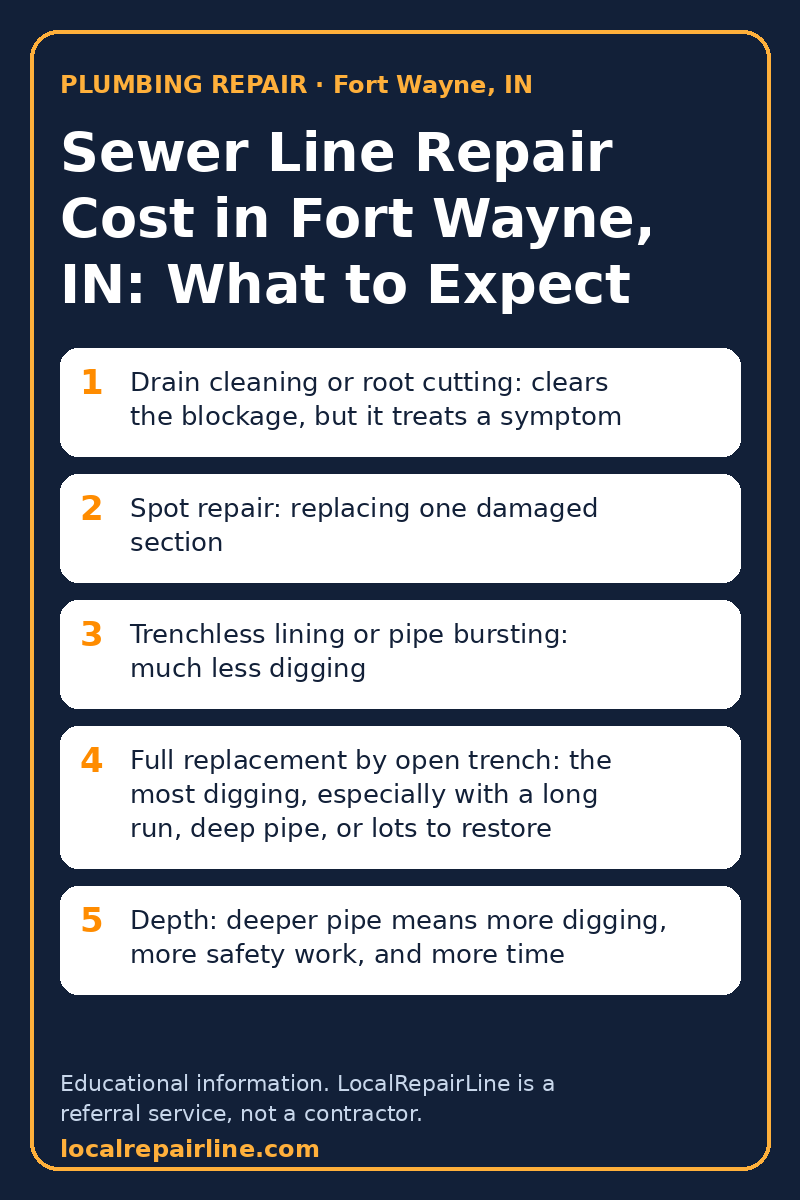
Repair vs. Replacement: How the Method Changes Your Price
Plumbers generally sort sewer fixes into three buckets. Which one fits depends on what the camera shows.
Spot repair
If the pipe is mostly sound with one cracked or shifted section, a plumber can dig down and swap just that piece. This is often the least disruptive real fix. The catch is that the rest of an old pipe may fail later, so ask what the camera shows on both sides of the damage.
Trenchless lining or pipe bursting
Lining places a resin liner inside the old pipe. Pipe bursting pulls a new pipe through the old path while breaking the old one apart. Both need only small access holes instead of a long trench.
Lining generally works when the pipe is still roughly in line and not collapsed. A badly crushed or sagging pipe often rules it out.
Full open-trench replacement
When a pipe has collapsed, separated, or sags enough to hold water, digging it out and replacing it may be the only lasting answer. It is the most disruptive option, and it makes a mess of the yard. Sometimes it's still the right call.
You could end up paying for a full dig when lining would have worked. The reverse can happen too, when a liner goes into a pipe that needed replacing. A clear camera picture helps you avoid both.
What Drives the Cost Up: Depth, Pipe Material, Roots, and Access
Two houses on the same street can need very different work. These are the usual reasons:
- Depth: deeper pipe means more digging, more safety work, and more time.
- Length of the damaged run: a short spot repair costs less than replacing the whole line to the street.
- Pipe material: clay, cast iron, and older fiber-conduit pipe each fail in different ways. Some take liners better than others.
- Roots: light root intrusion might be cleared. Roots that have split the pipe call for a real repair.
- Access: a pipe under a driveway, patio, porch, or mature tree costs more to reach than one under open lawn.
- Where the break is: inside the foundation, under a slab, or near the street each brings its own complications.
Ask your plumber to point out on the camera footage which of these apply to you. That makes the written breakdown easier to understand.
Why Fort Wayne Winters, Wet Springs, and Older Pipes Matter
Fort Wayne has four real seasons, and buried pipes feel all of them.
Cold winters mean the ground frosts and thaws again and again. That shifting soil can stress joints, nudge pipes out of line, and widen small cracks. Frost can also make digging harder and slower in the coldest stretches. Winter work may involve extra time or temporary measures, so ask how weather affects scheduling.
Spring brings heavy rain and thunderstorms in northeastern Indiana. Saturated soil can press on weak pipes and expose gaps. When the ground is that wet, a crack can let groundwater in and make a line work harder than it should. A trench in soggy ground can also be messier and costlier to restore.
Summer is warm and humid, and that fuels tree and shrub roots. Roots go looking for moisture, and a small joint gap in a sewer pipe is an invitation. A drain that slows in late summer may be a root problem getting started.
Then there's age. Depending on when your house was built, the line may be clay, cast iron, or a fiber-conduit material. Older materials tend to crack, corrode, or deform, which is why a camera look matters before choosing a method.
Hidden Costs Homeowners Regret: Camera Inspections, Permits, and Restoration
The repair itself is only part of the final number. These are the extras people often forget.
Camera inspection
A camera inspection shows the pipe's condition, the location of the damage, and whether lining is even possible. Skipping it to save money is risky, because the method and price are guesses without it. Ask whether the inspection fee is credited toward the repair if you hire that company, and ask for a copy of the video.
Permits
Permit rules can differ from place to place, so ask your plumber and your local city or county office whether your repair needs one. If one is needed, ask whether the permit is built into the written breakdown or billed separately.
Yard, driveway, and landscaping restoration
Open-trench work can mean torn-up lawn, shrubs, sidewalk, or driveway. Make sure the written breakdown spells out what is restored and what isn't. Some plans cover only backfilling the hole, leaving grass seed, concrete, and plantings to you.
The portion near the street
The part of the line close to the street or main may be handled differently than the part on your property. Before you assume anything, ask your plumber and your local sewer utility who handles that section.
Warning Signs Your Sewer Line Is Failing
A failing sewer line usually gives hints before a full backup. Watch for these:
- Several drains slowing or backing up at the same time
- Gurgling toilets or drains when water runs elsewhere in the house
- Sewage smell indoors or in the yard
- Soggy, sunken, or unusually green patches over the line
- A drain that clogs again soon after being cleared
- Floor drain backups, especially after heavy rain
One slow sink is often just a local clog. A pattern across the house points toward the main line.
When to call a Fort Wayne plumber
If more than one drain backs up at once, sewage smells or wet spots show up in the yard, or a drain keeps clogging after you've cleared it, stop guessing. This is the point to talk to a local plumbing pro in Fort Wayne, IN, such as LocalRepairLine.
A camera inspection is the only way to learn the real repair method and price. Without it, any number you hear is a rough guess. If sewage is backing up indoors, it's reasonable to hold off on using water in the house and to keep kids and pets out of that area until a plumber has taken a look.
How to Get a Clear Written Breakdown and Compare Options
Use this short checklist when you start comparing plumbers:
- Get the camera video and ask the plumber to show you the damage and explain it.
- Ask which methods are possible for your pipe, and why one is recommended over the others.
- Request an itemized written breakdown covering excavation or access, materials, permit, inspection, and cleanup.
- Confirm what restoration is included for lawn, concrete, and landscaping.
- Ask about weather and timing, especially during frost or a wet spring.
- Get at least two written breakdowns and compare the scope, not just the final number.
If one written breakdown is far lower than another, check what's missing. It may leave out restoration, a permit, or
Need a plumbing repair pro in Fort Wayne, IN?
Talk to an independent local contractor who serves your area.
📞 Call (833) 350-0420Plumbing repair in Fort Wayne, INCall hours: 8am–8pm ET, 7 days