Water Heater Not Working? Repair Steps for Lansing, MI
You step into the shower on a January morning and the water never warms up. If you're searching for water heater not working repair Lansing MI help, the good news is that a few safe checks can sort out the easy problems fast. The rest of this guide covers what those checks are, what usually goes wrong, and when it's time to bring in a pro.
Signs Your Water Heater Has Stopped Working Properly
Sometimes the heater quits outright. Other times it fades slowly, and you only notice once the cold weather arrives.
Watch for these:
- No hot water at all
- Water that starts warm and turns cold quickly
- Water that's only lukewarm, even after waiting
- Rumbling, popping, or banging noises from the tank
- Rusty or cloudy hot water
- Moisture or puddles near the base of the tank
- A pilot flame that keeps going out (gas models)
One symptom alone doesn't tell you much. A few together usually point to a specific cause.
Need a plumbing repair pro in Lansing, MI?
Talk to an independent local contractor who serves your area.
📞 Call (833) 350-0420Plumbing repair in Lansing, MICall hours: 8am–8pm ET, 7 daysYour call may first be answered by a short screening service that asks what the problem is and where you are. Stay on the line and you will be connected to an independent local pro.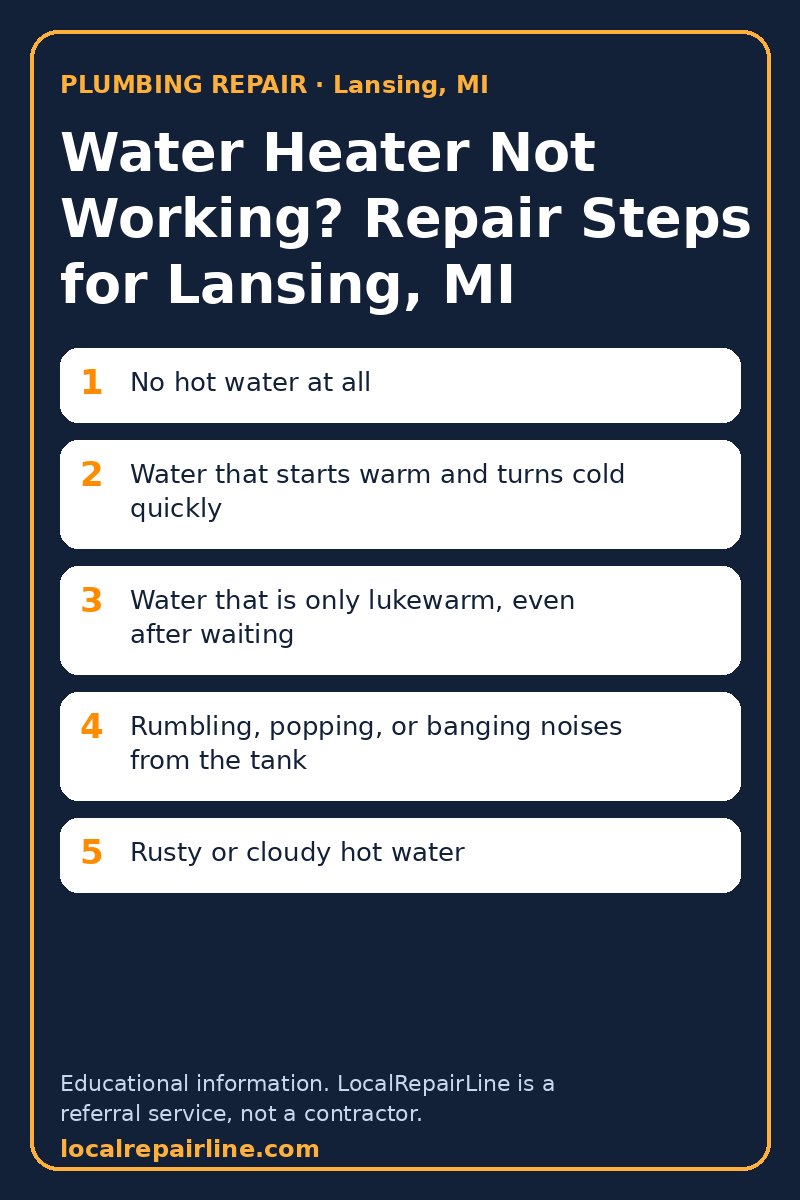
Quick Safe Checks Before You Call Anyone (Gas vs. Electric)
Start with the simple stuff. These checks take a few minutes and need no tools.
- Confirm what type of heater you have. A gas heater has a burner and a vent pipe on top, while an electric one has heavy wiring going in.
- Check the thermostat dial or display. Someone may have bumped it down, so set it to the level the label recommends.
- Look at the power or gas supply, depending on the type (details below).
- Wait a bit after any reset. A full tank takes time to heat, and checking too soon can fool you.
- Look around the tank for any water, rust, or scorch marks before you touch anything.
If you have an electric heater
Check your breaker panel first. A tripped breaker is a common reason for no hot water at all. Flip it fully off, then back on once.
Many electric tanks also have a small reset button on the thermostat behind an access panel. Leave that panel closed unless you're comfortable working around live wiring. If the breaker trips again right away, stop and call a plumber.
If you have a gas heater
Make sure the gas valve at the heater is open and the pilot is lit. Many tanks have a small window or indicator, plus instructions printed on the label. Follow those exactly.
If the pilot won't stay lit after a careful try or two, don't keep trying. A failing part such as a thermocouple is a common cause, and it's a job for a pro.
If you smell gas at any point, skip all of this. Leave the house, then call your gas utility or 911 from outside.
Common Water Heater Problems and What Causes Them
Once the basics check out, the cause is usually one of a handful of things. Here's what each one looks like.
A failed heating element or thermostat (electric). Elements wear out over time. You'll often get lukewarm water or hot water that runs out fast. This is one of the more repairable problems, though costs vary by house and by model.
A faulty thermocouple or burner issue (gas). The pilot won't stay lit, or the burner doesn't fire. Sometimes a good cleaning fixes it, and sometimes a part has to be swapped.
Sediment buildup. Minerals settle at the bottom of the tank over the years. That layer makes the heater work harder, and it's often behind the rumbling or popping sounds.
A worn anode rod. This rod sits inside the tank and takes the rust hit so the steel doesn't have to. Once it's used up, the tank itself starts to corrode.
A bad dip tube. This part sends cold water to the bottom of the tank. When it breaks down, cold water mixes in near the top and your hot water turns lukewarm.
A leaking tank. This is different from a leaky fitting. If the tank itself is leaking, repair usually isn't an option.
Why Lansing Winters Make Water Heater Problems Worse
Lansing winters are cold and snowy, and the water coming into your house is very cold that time of year. Your heater has to raise that water a long way, and it works harder to do it.
That extra demand exposes weak spots. A tired element, a sediment-coated tank bottom, or a part on its way out can limp along in mild weather. Then the cold shows up and suddenly there's no hot water.
Lansing's seasons swing hard, too. Sharp temperature changes in fall and spring are often when people first notice something is off, because that's when they start paying attention to heating and hot water.
Summer can hide problems as well. Warm, humid air can mask a slow tank leak or rusty fittings, since moisture on or near the tank doesn't stand out. Then the cold season puts the whole system under more demand, and the problem surfaces.
A little upkeep helps. Flushing sediment from the tank and having the anode rod checked can slow wear, and fall is a sensible time to do it, before the heavy winter demand starts. If you've never done it, ask a plumber to show you what's involved.
Repair or Replace? Weighing Cost, Age and Risk
This is a decision worth slowing down on. A repair makes sense on a tank that's still in decent shape, and not so much on one near the end of its life.
Age matters most. Tank heaters wear out over time, and how long yours lasts depends on water quality, upkeep, and how hard it works. If yours is old, or you can't tell how old it is, a repair may just buy you a short delay.
Think about it this way:
- Repair tends to make sense when the heater is fairly young and the problem is a single part, like an element, thermostat, or thermocouple.
- Replacement tends to make sense when the tank is old, the tank itself is leaking, or you've had several repairs in a short stretch.
- Replacement is usually the answer when rust has set in on the tank or fittings, since corrosion tends to spread.
Ask a plumber for the repair cost and the replacement cost side by side. If the repair is a large share of a new unit's price on an old tank, replacing usually wins. Costs vary by house, tank size, fuel type, and how easy the heater is to reach.
Warning Signs That Mean Shut It Off and Call a Plumber
Some problems are past the point of DIY. If you've run the safe checks and still have no hot water, it's time to talk to a local plumbing pro in Lansing, MI like the LocalRepairLine team instead of guessing.
If you notice any of these, it's time to put the troubleshooting aside and bring in a plumber:
- Water pooling around the tank
- A gas smell near the heater
- Loud rumbling or banging that keeps getting worse
- Rusty water coming from the hot tap
- A pressure relief valve that's dripping, hissing, or discharging water
- Scorch marks, or a hot, burning smell near the unit
A gas smell is an emergency. Get everyone outside first, and don't flip switches or use a phone indoors.
For a leak, shut off the power or gas to the heater and close the cold water supply valve on top of the tank if you can reach it safely. Then call.
The pressure relief valve is a safety device. Don't cap it, plug it, or tinker with it. If it's discharging, something is wrong inside the system, and that needs a professional look.
Water Heater Not Working Repair Lansing MI: What a Plumber Visit Looks Like
A plumber will usually start by asking what you've noticed and when it began. Tell them what you already checked, such as the breaker, thermostat setting, or pilot.
Then they'll look at the heater's age, the fuel and venting setup, the supply connections, and signs of leaks or rust. They may test elements or burner parts, check the thermostat, and look at the pressure relief valve.
After that, they should explain what failed and give you options. Ask for repair and replacement choices, and what each one involves. A plain explanation of why the tank failed is a good sign you're getting straight advice.
Have the heater's label handy if you can, since it lists the model and often the age. Clear the area around the tank so they can get to it easily.
FAQ
Why is my water heater not producing hot water?
The most common causes are a tripped breaker, a pilot light that went out, a thermostat set too low, or a failed heating element or burner part. Sediment buildup and a damaged dip tube can also leave you with lukewarm water. If the safe checks don't bring hot water back, a plumber can pin down the cause.
How much does it cost to repair a water heater?
It depends on what failed, the type of heater, and how easy it is to reach. A small part swap and a full tank replacement are different jobs, so the price can differ quite a bit between them. Costs vary by house, so ask for a clear explanation of the problem and options before you agree to work.
Is it worth repairing a water heater?
Often it is, if the heater is fairly young and the problem is a single part like an element, thermostat, or thermocouple. It's usually not worth it on an old tank, a leaking tank, or one with rust or several recent repairs. Ask for the repair and replacement costs side by side, and keep in mind that costs vary by house.
Need a plumbing repair pro in Lansing, MI?
Talk to an independent local contractor who serves your area.
📞 Call (833) 350-0420Plumbing repair in Lansing, MICall hours: 8am–8pm ET, 7 days