AC Not Cooling in Kettering, OH? What to Check Before You Call
Typing "ac not cooling Kettering OH" into your phone usually means the system is running, the house is warm, and you're getting more annoyed by the hour. Some causes are simple enough to check yourself. Others are a reason to shut the system off and bring in a pro.
This guide walks through both, so you know which is which before you spend money or hurt your equipment.
Is It Really Not Cooling? Signs Your Kettering AC Is Struggling
Southwest Ohio has four real seasons. Your AC may sit idle for months, then get asked to run hard the first time a muggy week hits. That jump is when weak spots show up.
Here are the common signs of a struggling system:
- Air from the vents feels warm or only slightly cool.
- The system runs for long stretches and the house never reaches the thermostat setting.
- Airflow from the vents feels weak.
- The air feels clammy even if the temperature looks close to normal.
- You see ice on the indoor unit or the thicker copper line.
- The outdoor unit hums or buzzes but the fan isn't spinning.
Notice which of these you have. The pattern points toward the cause, and the table later in this article shows how.
Need an HVAC repair pro in Dayton, OH?
Talk to an independent local contractor who serves your area.
📞 Call (833) 669-0233HVAC repair in Dayton, OHCall hours: 8am–8pm ET, 7 daysYour call may first be answered by a short screening service that asks what the problem is and where you are. Stay on the line and you will be connected to an independent local pro.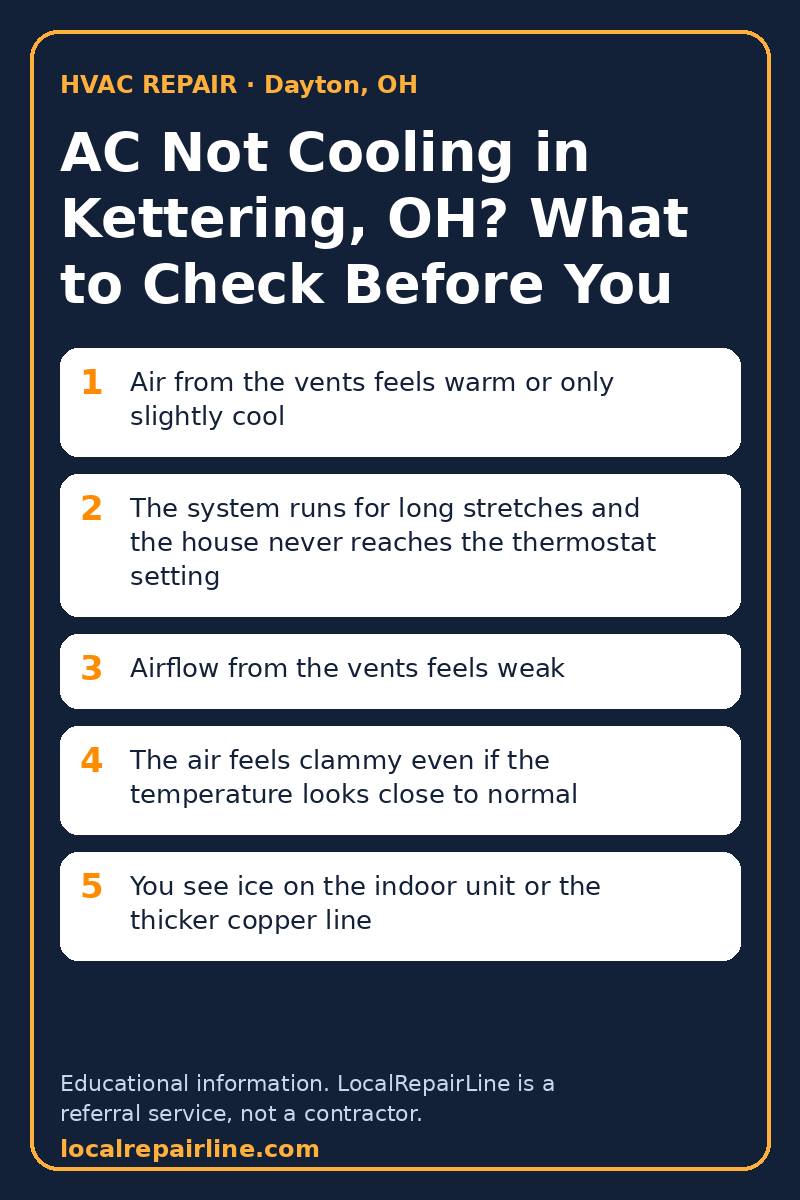
Quick Checks for an AC Not Cooling Kettering OH Homeowners Often Try First
Start with the simple stuff. These checks take a few minutes and need no tools beyond a screwdriver, if that.
- Check the thermostat. Make sure it's set to "cool," the temperature is set below the current room temperature, and the fan is on "auto." If it has batteries, replace them.
- Check the air filter. Slide it out and hold it up to a light. If you can't see light through it, swap it for a clean one in the right size.
- Check the breaker. Look at the panel for a tripped breaker labeled for the AC or air handler. Flip it fully off, then on, once.
- Check the vents and returns. Make sure furniture, rugs, or closed registers aren't blocking airflow.
- Look at the outdoor unit. Clear leaves, grass clippings, or debris from around it. Leave the panels on and don't poke at anything inside.
If the breaker trips again right after you reset it, stop there. Repeated resets can make a small electrical problem bigger.
Warm Air vs. Weak Airflow vs. Humid and Clammy: What Each Symptom Points To
Not every "not cooling" problem is the same problem. This table matches common symptoms to likely causes and who should handle them.
| What you notice | Likely cause | DIY or pro? |
|---|---|---|
| Weak airflow at every vent | Clogged filter, blocked return, or struggling blower | Filter is DIY; blower is a pro job |
| Warm air, outdoor unit silent | Tripped breaker, failed capacitor, or surge damage | Reset once; otherwise pro |
| Warm air, outdoor unit running | Dirty condenser, low refrigerant, or failing compressor | Rinse debris from outside; the rest is a pro job |
| Ice on coil or copper line | Restricted airflow or a refrigerant problem | Thaw it safely; then pro if it returns |
| Cool air but clammy house | Oversized or short-cycling system, dirty coil, or airflow issues | Pro evaluation |
| One room much warmer than others | Duct leaks, closed or blocked registers, or balance issues | Check registers; duct work is a pro job |
Why humidity matters here
Dayton-area summers are warm and muggy. An AC has two jobs: lowering temperature and pulling moisture out of the air.
If it does the first job but not the second, the house feels sticky even when the thermostat says 74. A dirty coil, poor airflow, or a system that shuts off too quickly can all cause this. Turning the thermostat down further usually just wastes energy.
Frozen Coil, Dirty Condenser, and Low Refrigerant: Common Causes in Ohio Summers
Long run times in humid weather expose a few usual suspects.
A frozen indoor coil
Ice usually points to either too little airflow across the coil or a refrigerant problem. A clogged filter is the most common simple cause, but not the only one.
Don't run the system "to see if it clears up." Running a frozen coil can put extra strain on the system, including the compressor. Turn the thermostat to "off," set the fan to "on" so air moves across the coil, and let the ice melt. Expect that to take a few hours. Put towels down near the indoor unit in case of dripping.
If the ice comes back after a clean filter and a full thaw, call a pro.
A dirty outdoor condenser
The outdoor unit dumps heat from your house. If cottonwood fluff, grass clippings, or dirt coat the fins, it can't release heat well and the system struggles on hot days.
You can gently clear loose debris from around the unit and rinse the fins from the outside with a garden hose on a low setting. Turn the power off at the disconnect first, and don't use a pressure washer, which can bend the fins.
Low refrigerant
Refrigerant doesn't get "used up" like fuel. If the level is low, there's a leak somewhere.
Adding more without finding and fixing the leak only treats the symptom. The top-off may not last, because the leak is still there and the system can run low again. Ask any tech who suggests adding refrigerant where the leak is and whether it can be repaired.
Storm and Power Surge Damage: Why the Outdoor Unit May Quit After a Thunderstorm
Spring and summer thunderstorms are common in southwest Ohio. Storms and outages can trip breakers, blow fuses, or damage parts in the outdoor unit, like the capacitor, contactor, or control board.
A typical story is that the AC worked fine before the storm and doesn't cool after it. The indoor fan may still blow air while the outdoor unit stays silent.
If you suspect storm damage:
- Check the breaker and reset it once.
- Check that the thermostat didn't lose its settings or go blank.
- Don't open the outdoor unit. Capacitors can hold a charge even with the power off.
- Call a pro if the unit doesn't start, or if you smell burning.
Ask whether a whole-system surge protector makes sense for your home. The need and the cost vary by house and equipment.
Repair or Replace? Cost Factors and Questions to Ask a Local Pro
Repair costs vary by house, the part that failed, and how accessible the equipment is. The decision to repair or replace depends on more than one price.
Things to weigh:
- Age of the system. Older equipment is more likely to have more than one problem coming.
- Type of failure. A capacitor is a small repair. A failed compressor or a leaking coil is a bigger decision.
- Repeat visits. If you've had the same problem more than once, the repair isn't fixing the cause.
- Ductwork. In many mature homes, ducts may be leaky, undersized, or poorly insulated. New equipment won't perform well on bad ducts.
Some choices can add cost without solving the problem. Examples are running an iced-over system, repeating refrigerant top-offs without a leak repair, and replacing equipment without checking the ducts or sizing.
Questions worth asking before you approve work:
- What exactly failed, and how did you confirm it?
- Is this a repair that will last, or a temporary fix?
- If refrigerant is low, where is the leak?
- What happens if I wait on this repair?
- Can you give me the repair and replacement options in writing?
A good pro will explain the answers in plain language.
When to Stop Troubleshooting and Call an HVAC Technician
You've checked the thermostat, the filter, and the breaker. If the AC still blows warm air, you've done what's reasonable on your own. Guessing beyond this point is unlikely to help, and a pro can safely check the parts you can't reach.
This is the point to turn the AC off and talk to a local HVAC pro in Kettering, OH, such as the LocalRepairLine team, instead of guessing. Call if you see any of the following:
- Ice on the indoor coil or refrigerant line that returns after thawing
- Grinding, buzzing, or clicking from the outdoor unit
- A breaker that trips again after one reset
- Warm air even with a clean filter and clear outdoor unit
- A burning smell, or any sign of water near electrical parts
Tell the technician what you checked and what you saw. That saves time and helps them find the problem faster.
FAQ
Why is my AC running but the house isn't cooling down?
Common causes include a clogged filter, a dirty outdoor unit, a frozen coil, low refrigerant, or leaky ducts. On very hot, humid days, an older or undersized system may also struggle to keep up. Start with the thermostat, filter, and breaker. If those look fine, a pro can check the refrigerant, electrical parts, and airflow.
Need an HVAC repair pro in Dayton, OH?
Talk to an independent local contractor who serves your area.
📞 Call (833) 669-0233HVAC repair in Dayton, OHCall hours: 8am–8pm ET, 7 days