Furnace Repair in Kettering, OH: What to Check Before You Call
It's a cold night, the house feels off, and the vents are blowing lukewarm air or nothing at all. If you're searching for furnace repair Kettering OH, you likely want a clear idea of what's wrong and what your next step should be.
This guide walks through the signs of trouble, the checks you can safely do yourself, what affects repair costs in plain terms, and when it's time to stop patching and think about replacing.
Signs Your Furnace Needs Repair Right Now
Some furnace problems creep in. Others show up on the coldest morning of the year.
Watch for these:
- Air from the vents is cool or barely warm while the furnace runs.
- The furnace turns on and off every few minutes.
- You hear banging, squealing, rattling or grinding.
- Some rooms stay cold while others are fine.
- The furnace won't start, or starts and shuts down again.
- Your heating bills creep up with no change in how you live.
- You smell something burning or notice a gas odor.
Kettering has four real seasons, and winters in the Dayton area bring snow, ice and hard cold. A furnace that struggles in the fall is worth looking at early, since winter asks the most of it.
Need an HVAC repair pro in Dayton, OH?
Talk to an independent local contractor who serves your area.
📞 Call (833) 669-0233HVAC repair in Dayton, OHCall hours: 8am–8pm ET, 7 daysYour call may first be answered by a short screening service that asks what the problem is and where you are. Stay on the line and you will be connected to an independent local pro.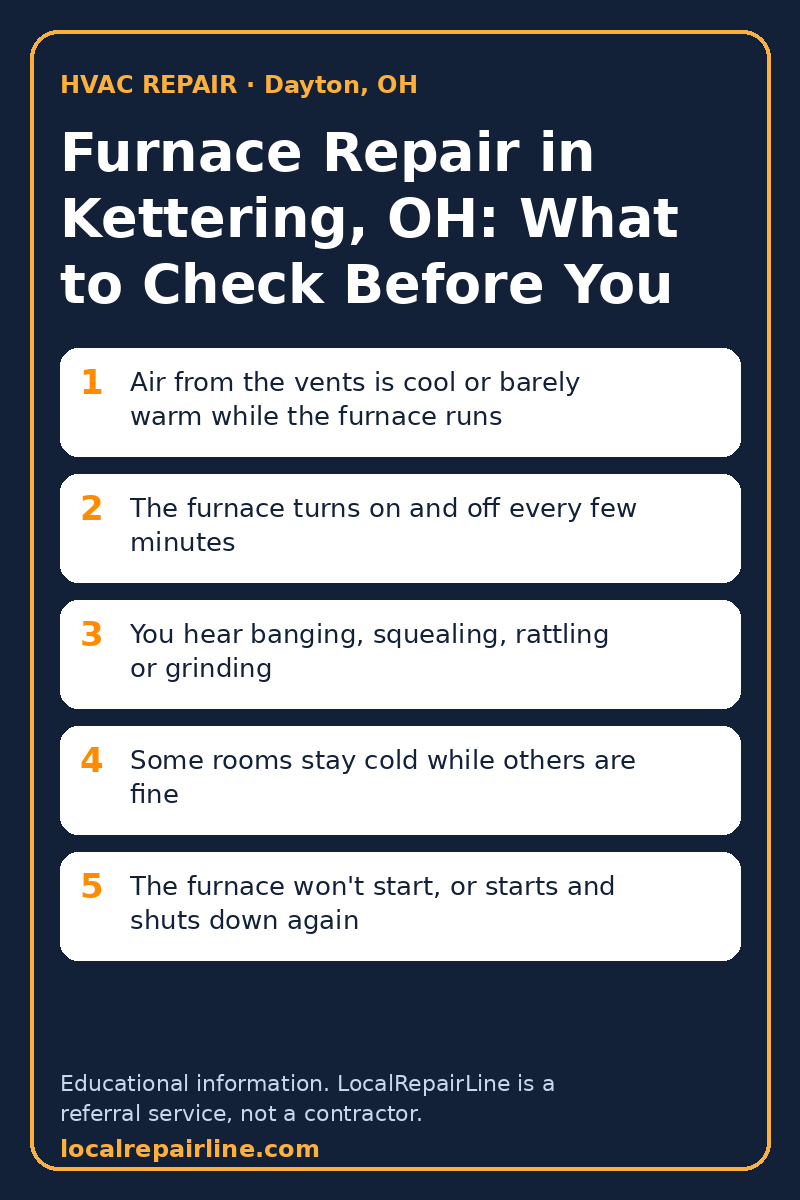
Quick Safety Checks Kettering Homeowners Can Do Before Calling
Plenty of "no heat" calls come down to something simple. These checks take a few minutes and need no tools.
- Check the thermostat. Make sure it's set to "heat" and the target is a few degrees above the room temperature. Replace the batteries if it has them.
- Check the air filter. A clogged filter chokes airflow and can make the furnace overheat and shut down. Swap in a clean one if it looks gray and packed.
- Check the power. Look at the breaker for the furnace and the wall switch near it. Flip the switch on if it was bumped off.
- Check the gas valve. If you know where it is, confirm the handle runs parallel to the pipe, which means open. Don't force anything.
- Check outdoor vents. If your furnace has white plastic intake and exhaust pipes outside, clear away snow, ice or leaves blocking them.
- Try one reset. Turn the power off for a minute, turn it back on, and see if it starts. Do this once only.
Don't open the burner area, poke at wiring, or repeatedly reset a furnace that keeps shutting off.
When DIY Stops
If you've checked the thermostat, filter and breaker and the furnace still won't heat, this is the point to talk to a local HVAC pro in Kettering, OH, such as the LocalRepairLine team, instead of guessing. The same goes if you notice a gas smell, a burning smell, repeated lockouts or banging noises. A qualified technician can test the parts you can't safely reach and find the real cause.
If you smell gas, leave the house first and call the gas company or emergency services from outside. Don't flip switches or use a lighter on your way out.
Common Furnace Problems in Ohio Winters and What Causes Them
Southwest Ohio swings between warm and cold days in spring and fall. That makes a furnace start and stop again and again, which wears out parts that only get used a little. Then winter brings long stretches of steady, heavy running.
Here are the usual suspects.
Dirty filter or restricted airflow
This one is simple to prevent with regular filter checks. Poor airflow also shows up when vents are blocked by furniture or ducts leak, which is more likely in older homes with aging ductwork.
Failed igniter or dirty flame sensor
If the furnace tries to light and then shuts off, one of these two parts is often the reason. A dirty flame sensor can't "see" the flame, so the control shuts the gas off as a safety step.
Worn blower motor or capacitor
A furnace can heat the air but struggle to move it. You may hear squealing or grinding, or feel weak airflow at the vents.
Control board or wiring trouble
Modern furnaces rely on a circuit board to run the startup sequence. When it fails, you can see odd behavior like random shutdowns or lockouts.
Short-cycling
A furnace that turns on and off constantly is often overheating from poor airflow, or reacting to a bad sensor or an oversized unit. Mild-weather days make it more noticeable because the system barely settles into a run.
What Affects Furnace Repair Costs
Costs vary by house, furnace type and the part that failed, so treat the following as general guidance rather than numbers for your home.
- Smaller repairs: Cleaning a flame sensor, replacing a thermostat, or swapping a simple switch tend to be quicker jobs with parts that are easy to reach.
- Mid-level repairs: Igniters, capacitors, inducer parts and gas valves can take more time, mainly because of the part itself and the work needed to reach it.
- Larger repairs: Blower motors and control boards are more involved jobs, especially on newer, high-efficiency models with proprietary parts.
- Major failures: A cracked heat exchanger is a serious problem, so ask the technician to walk you through both repair and replacement before you decide.
What drives the price: the age and brand of the furnace, how easy the part is to get, how hard the unit is to reach, and whether the visit happens during a busy cold snap. Ask for the diagnosis and the repair price in writing before work starts, and ask what the repair covers if something else fails soon after.
Repair or Replace? How to Decide With an Older Furnace
One trap to avoid is paying for repair after repair on a worn-out furnace in the middle of winter. Each fix feels small, but they add up, and the next breakdown still arrives on a cold night.
Here's a rule of thumb. The older the furnace and the bigger the repair, the more it makes sense to ask your technician about replacement. If it's younger and the problem is a single small part, repair is often reasonable.
Lean toward replacement if:
- You've had more than one repair in a single season.
- The furnace is noisy, uneven and costly to run.
- A technician finds a cracked heat exchanger.
- Parts are hard to find because the model is old.
Lean toward repair if the unit is relatively young, has been well maintained, and the problem is a single, clearly identified part.
If your furnace is getting old, it helps to look at replacement options while nothing is broken. Planning a replacement in early fall, before the first hard cold, gives you time to compare options instead of taking whatever is available in a crisis. Also have the ductwork looked at, since a new furnace connected to leaky old ducts won't perform as well as it should.
Carbon Monoxide and Other Warning Signs You Should Never Ignore
Some signs mean stop, not troubleshoot.
- A gas smell, which is often described as rotten eggs.
- Soot, scorch marks or a yellow, flickering burner flame.
- Headaches, dizziness or nausea that ease when you leave the house.
- A carbon monoxide alarm going off.
- Water pooling around the furnace, or a burning odor that doesn't fade.
Carbon monoxide has no smell and can't be seen, so working detectors on each level of your home and near bedrooms are essential. Test them and replace batteries on a schedule. If an alarm sounds, get everyone outside and call emergency services from there. Don't go back in until it's been cleared.
How to Choose Furnace Repair Kettering OH Homeowners Can Rely On
Pick your contact before you need one. Choosing calmly ahead of time lets you compare a few options without rushing.
Here's what to look for:
- Proper credentials and proof of coverage, which you can ask to see.
- A written breakdown that explains the cause and the fix.
- Clear communication about the cost and the repair choices, including replacement if the unit is worn out.
- A technician who explains the problem without pressuring you.
- Experience with the furnace type you have, whether standard or high-efficiency.
Ask whether they do a safety check on the heat exchanger and venting during repairs. And be wary of anyone who pushes a full replacement before explaining what failed and why a repair won't hold.
FAQ
Why is my furnace running but blowing cold air?
Often it's a dirty filter, a thermostat set to "fan" instead of "heat," or a flame sensor or igniter problem that shuts the burner off. Check those basics first. If the air stays cool, a technician should take a look.
Is it worth repairing an older furnace?
It depends on age, condition and the repair itself. A small fix on a well-kept unit usually makes sense, while a major repair on a worn-out furnace often doesn't.
Need an HVAC repair pro in Dayton, OH?
Talk to an independent local contractor who serves your area.
📞 Call (833) 669-0233HVAC repair in Dayton, OHCall hours: 8am–8pm ET, 7 days