Burst Pipe Plumber in Cleveland, OH: What to Do First
Water is spreading, or you just heard a hiss in the wall, and you need a burst pipe plumber Cleveland OH homeowners can hire to find and fix the break. Before you pick up the phone, take a minute to stop the water. The steps below also help you limit damage and gather details that are useful to a plumber and for any insurance conversation you may have.
Cleveland winters add a twist. A pipe often splits during the deep cold, but the real flooding can start when things warm up and water begins to move again.
Signs You Have a Burst Pipe (Even If You Can't See Water)
Some breaks are obvious. Others hide behind drywall, under a floor, or in a crawl space. Watch for these clues:
- Water pressure that suddenly drops, or a faucet that sputters or runs only a trickle
- A stained or sagging ceiling, or paint that bubbles on a wall
- A musty smell that wasn't there yesterday
- The sound of running water when every fixture is off
- A water meter that keeps moving when nothing is in use
- Warped floorboards, damp carpet, or a wet spot on the basement floor
- Frost or a visible bulge on a pipe in a garage, crawl space, or exterior wall
During a cold snap, no water at a faucet can mean the line is frozen. A frozen line may already be cracked, even if nothing is dripping yet.
Need a plumbing repair pro in Cleveland, OH?
Talk to an independent local contractor who serves your area.
📞 Call (833) 350-0420Plumbing repair in Cleveland, OHCall hours: 8am–8pm ET, 7 daysYour call may first be answered by a short screening service that asks what the problem is and where you are. Stay on the line and you will be connected to an independent local pro.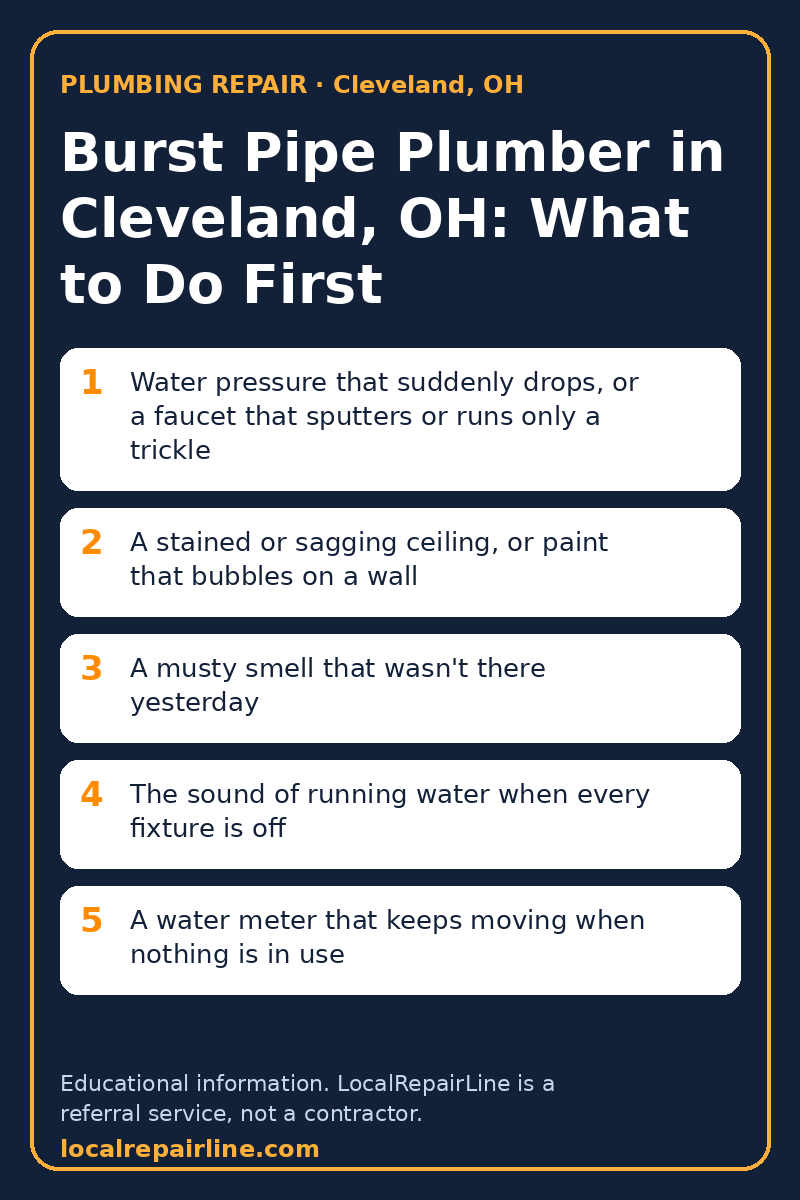
Shut Off the Water and Protect Your Home: The First 10 Minutes
Take these steps in order, and keep your own safety first. Here's a short checklist:
- Shut off the main water valve. It's usually where the water line enters the house, often in a basement, utility area, or near the water heater. Turn it clockwise until it stops.
- Open a faucet or two. Start with one in the basement or on the ground floor to help drain what's left in the pipes.
- Turn off the water heater (power or gas setting) if the break is on the hot side or the tank may drain.
- Stay away from electrical hazards. If water is near outlets, panels, or appliances, shut off power to that area only if you can reach the panel without stepping in water. Otherwise, stay out and call for help.
- Move belongings out of the wet zone. Rugs, boxes, and furniture soak up water fast.
- Mop, towel, or wet-vac standing water once it's safe to do so.
If you can't find the main valve, or it won't turn, don't force it with a tool that could snap it. That's a good time to call a plumber.
When to stop guessing and call a local plumber
Once the water is off, you might see one of these:
- A wall that's still wet or a ceiling that's still stained
- A pipe that won't stay sealed after a temporary wrap
- No idea where the break actually is
This is the point to talk to a local plumbing pro in Cleveland, OH, such as the LocalRepairLine team, instead of guessing. Water that has soaked into drywall, insulation, or flooring keeps doing damage even when the supply is off. A plumber needs to find and repair the break before you turn the water back on. If you turn it on to "test" and the break is still open, you could flood the house all over again.
Why Pipes Burst During Cleveland Cold Snaps and Thaws
Cleveland sits on Lake Erie, and lake-effect snow is a regular part of winter. When a sharp cold snap hits Northeast Ohio, pipes in exterior walls, crawl spaces, and garages are the most exposed.
Here's what happens. Water inside a pipe turns to ice and expands. The pressure builds and a section splits, often at a weak point or near a fitting.
The ice plug usually keeps the water from pouring out at first. You may not notice anything wrong. Then temperatures climb, the ice melts, and water flows through the crack. That's when the ceiling starts to drip or the basement gets wet.
Late winter and early spring make it worse. Cold nights and milder days mean pipes go through repeated cold-and-thaw stress. A small crack that held for a week can open up on the first warm afternoon.
During the thaw window
If you suspect a pipe froze, don't wait for it to melt on its own. Here's what to do:
- Keep the main valve closed if you already suspect a split.
- Check the usual trouble spots for damp insulation, drips, or bulging pipe.
- Look at fittings and joints as well as straight runs. A split pipe often shows a long crack or swelling. A failed fitting tends to leak right at the joint.
- Keep heat on in the house and open cabinet doors under sinks on exterior walls.
Don't use an open flame to thaw a line. Ask a plumber about thawing the line and checking it for damage at the same time.
What to Photograph and Document Before Cleanup Starts
Once everyone is safe and the water is off, grab your phone before you start tearing out wet material. Photos and notes can be useful if you decide to file an insurance claim, and they give your plumber a clearer picture.
Capture:
- Wide shots of each affected room, then close-ups of damage
- The pipe itself, the split, and any frost or bulge
- Wet walls, ceilings, floors, and stained areas
- Damaged belongings, with brand and model labels visible when you can
- The water meter and the main valve in the closed position
Write down the date and time you noticed the problem, when you shut off the water, and what you did next. Keep any receipts for towels, fans, or temporary supplies.
Don't throw out damaged materials until you've photographed them, and if you plan to file a claim, check your policy or ask your insurer what you should keep. You can still take reasonable steps to stop more damage, such as removing standing water.
Temporary Fix vs. Real Repair: What a Plumber Actually Does
A pipe clamp, rubber patch, or repair tape can slow a leak. That can be useful while you wait for help. But it's a stopgap.
On older plumbing, quick patches often fail. Pipes that have aged or been through many cold-and-thaw cycles can be brittle or corroded near the damaged spot. A clamp may hold for a bit, then the next section gives way, and now you have a second leak.
A real repair usually involves:
- Finding the full extent of the damage, not just the spot that's leaking
- Cutting out the damaged section of pipe
- Replacing it with new pipe and proper fittings
- Checking nearby joints and runs for cracks or weak spots
- Slowly turning the water back on and testing for leaks
- Recommending insulation or rerouting if the pipe is in a cold spot
If the damaged pipe is behind a wall or under a floor, a plumber may need to open that area to reach it. Ask what will be opened, and what will need patching afterward by you or another trade.
What Affects Burst Pipe Repair Cost and Where Homeowners Regret Cutting Corners
Costs vary by house. There's no honest single answer, because the job depends on a handful of factors:
- Pipe location: An exposed pipe in a basement is simpler than one inside a finished wall or under a slab.
- Pipe material: Copper, PEX, galvanized steel, and older materials all repair differently.
- Access: More demolition and patching usually means more time and more cost.
- Extent of damage: One split is different from several cracks along the same line.
- Timing: Pricing can depend on when the work is done, so ask how it's calculated.
- Water damage: Drying out, drywall, flooring, and mold concerns are often separate from the plumbing repair.
Three shortcuts can turn a pipe repair into a bigger problem. One is leaving a wet wall closed up to save on repair work. Another is relying on a clamp on old pipe. The third is choosing a plumber purely on who sounds quickest, without asking what's included.
Ask for a clear scope of work in writing, including what the job covers and what it doesn't.
How to Choose a Burst Pipe Plumber Cleveland OH Homeowners Can Rely On
When water is already flowing, it's tempting to call the first name you find. A few quick checks can still help.
- Ask if they handle emergency burst pipes and how soon someone can realistically arrive.
- Ask for proof they're authorized to do plumbing work in your area, and don't be shy about requesting it.
- Ask what they'll do first: locate the break, confirm the damage, and explain the options before starting.
- Ask whether they'll look at the rest of the line, not just the leak.
- Get the scope and price basis in writing before work begins, if the situation allows.
- Be cautious of pressure. If someone insists you replace everything without explaining why, ask them to show you the problem.
Tell the plumber what you've done: when you shut off the water, what you saw, and where you think the water is coming from. Share your photos. It saves time and helps them find the break.
FAQ
What should I do first when a pipe bursts in my house?
Shut off the main water valve right away, then open a low faucet to drain the lines. Turn off the water heater, keep clear of electrical hazards, and move belongings out of the wet area. After that, take photos and call a plumber if water is still in the walls or you can't find the break.
How much does it cost to repair a burst pipe in Cleveland, OH?
Costs vary by house. The main factors are where the pipe is, what it's made of, how much wall or floor has to be opened, and how much water damage needs drying out. Ask for a written scope so you know what the work covers and what it leaves out.
Need a plumbing repair pro in Cleveland, OH?
Talk to an independent local contractor who serves your area.
📞 Call (833) 350-0420Plumbing repair in Cleveland, OHCall hours: 8am–8pm ET, 7 days