Sewer Line Repair Cost in Cincinnati, OH: What to Expect
If you're trying to pin down sewer line repair cost Cincinnati OH homeowners face, here's the honest answer: it swings a lot. A small fix on one section of pipe and a full replacement from house to street are very different jobs.
This guide explains what moves the price, where people get surprised, and how to avoid digging up more yard than you need to. Costs vary by house, so treat everything below as a way to understand a written breakdown, not predict your bill.
Sewer Line Repair Cost Cincinnati OH: What You'll Typically Pay
Repairs generally fall into three types. A localized spot repair fixes one section. Lining the pipe from the inside covers more of the run without digging it up. Full replacement involves the most work, especially if it means heavy digging.
Most of the bill comes from a handful of factors:
- Pipe length: the distance from your house to the connection at the street.
- Pipe depth: deeper pipe means more excavation and more labor.
- Pipe material: clay, cast iron, and older fiber-type pipe fail in different ways.
- What's on top: lawn is easier to restore than a driveway, patio, or sidewalk.
- Access: tight side yards, mature trees, and fences slow the work.
- Damage extent: one crack, or the whole run in rough shape.
A short, shallow run under grass sits at the friendly end. A long, deep run under concrete sits at the other.
Need a plumbing repair pro in Cincinnati, OH?
Talk to an independent local contractor who serves your area.
📞 Call (833) 350-0420Plumbing repair in Cincinnati, OHCall hours: 8am–8pm ET, 7 daysYour call may first be answered by a short screening service that asks what the problem is and where you are. Stay on the line and you will be connected to an independent local pro.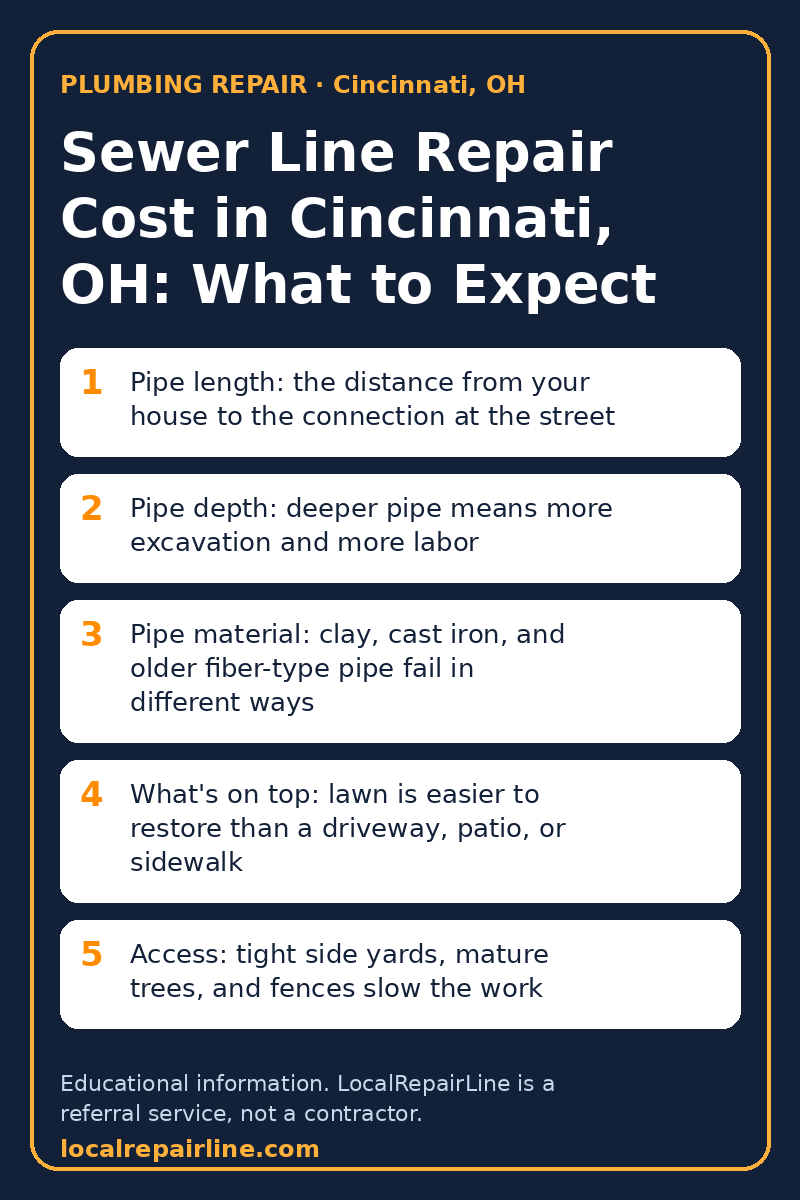
Spot Repair, Lining, or Full Replacement: How the Price Changes
Spot repair
If a camera shows one broken joint or a single cracked section, a plumber may dig down and replace just that piece. It can be a practical route when the rest of the pipe is sound.
The catch is that old pipe tends to fail in more than one place. Fixing one spot can leave you with another problem a few feet away.
Pipe lining
Lining pushes a resin-coated sleeve through the existing pipe and hardens it into a new pipe inside the old one. It works well for cracks, small gaps, and root intrusion at joints.
It doesn't suit every pipe. Badly collapsed, bellied, or separated sections often can't be lined without being fixed first.
Full replacement
When the pipe is crushed, severely offset, or failing along most of its length, replacement is usually the sensible call. The upfront job is bigger, but you're not paying for repeated patches.
Ask your plumber to explain why one option beats the others for your pipe. A good answer points to what the camera showed.
Trenchless vs. Traditional Digging: Cost and Yard Impact
Trenchless methods use small access holes instead of one long trench. Your lawn, landscaping, and driveway mostly stay put.
Is trenchless always cheaper? Not necessarily. The repair itself can cost as much as digging, or more. The savings often show up elsewhere, in less restoration, fewer ruined shrubs, and less disruption.
Here's how the tradeoffs usually shake out:
- Traditional digging: often lower equipment cost, but you pay for excavation, backfill, and putting the yard back together.
- Trenchless: often higher repair cost, but far smaller restoration bills.
- Hard-to-dig spots: under a driveway, porch, or big tree, trenchless often wins on total cost.
- Open lawn with shallow pipe: digging can come out ahead.
The pipe's condition decides what's possible. Your preference matters less than what the camera shows.
Why a Camera Inspection Should Come First
This step gives the written plan something solid to stand on. Without a camera, any number is mostly a guess, and a guess can swing in either direction.
A camera run shows the pipe's material, the location of breaks, root intrusion, sags where water pools, and how far the damage extends. That tells you whether you need a small fix or a major one.
Without it, you might pay for a full replacement you didn't need. Or you might pay for a spot repair and find out later the pipe is failing elsewhere.
Warning signs worth acting on
If you notice any of these, it's time to get the line looked at:
- Repeated backups, especially in a basement or ground-floor drain
- Gurgling sounds from toilets or tubs when water runs elsewhere
- Soggy, sunken, or unusually green patches in the yard
- Sewage odors indoors or near the yard
- Slow drains in several fixtures at once
Any one of these can have a simple cause. A cluster of them, or the same problem returning after clearing a clog, points to something in the line itself.
This is the point to talk to a local plumbing pro in Cincinnati, OH instead of guessing, such as the LocalRepairLine team. Only a camera inspection can show whether you're facing a small repair or a full replacement. Once you know that, ask for a written, itemized breakdown.
Hidden Costs: Permits, Restoration, and Surprise Add-Ons
A single total on a page can hide a lot. The line items that catch people off guard are usually the ones around the pipe, not the pipe itself.
Ask whether the written breakdown includes:
- The camera inspection, or whether it's billed separately and credited later
- Any permits or inspection fees your plumber says apply to the job
- Excavation and hauling away soil or old pipe
- Restoration of grass, landscaping, driveway, or sidewalk
- Work in the connection at the street, if that's needed
- Written terms for who to contact and what happens if a problem shows up after the work
Restoration deserves extra attention. "Backfilled" is not the same as "lawn restored." Some plans leave you with a dirt trench and a rake.
Concrete is another common surprise. If the pipe runs under a driveway or walkway, cutting and replacing it can add a big chunk to the bill.
Whether the job needs a permit can vary, so it's worth confirming up front. Ask your plumber which permits apply and who pulls them, rather than assuming it's covered.
How Cincinnati's Older Homes and Weather Affect Your Sewer Line
Older homes often have older pipe. Clay and cast iron can last a long time, but both wear out. Clay joints let roots in, and cast iron can corrode and flake from the inside.
Cincinnati's weather doesn't help. Winters bring repeated cold snaps and thaws, and that shifting ground can stress buried pipe, loosen joints, and widen small cracks.
Spring storms can saturate the soil and send extra water through the system. A line with a weak spot may show it then, with slow drains or a backup.
Summer thunderstorms can drop a lot of rain in a short time. Roots also grow hard in the heat and humidity, and they go looking for moisture in any joint that leaks.
Timing matters for the work, too. Digging in saturated spring soil gets messy, and frozen or very wet ground can slow a job and complicate restoration. If you're wondering about your pipe's condition, a camera inspection during a calmer stretch lets you weigh your options at your own pace.
How to Compare Written Breakdowns and Know When to Call a Pro
Compare a couple of written breakdowns when you can, and make sure each is based on a camera inspection. Otherwise you're comparing guesses.
Before you approve a dig or a trenchless job, work through this short checklist:
- Did the plumber show you the camera footage and point out the problem?
- Is the written breakdown itemized, including permits and restoration?
- Why this method, and what would the alternative cost in yard damage?
- What's the plan if the pipe turns out worse than expected once it's open?
- What happens if a problem shows up after the work, and who do you call?
Be cautious of one that comes in much lower than the rest. It may leave out restoration, permits, or part of the pipe.
If you're seeing backups, gurgling, or soggy spots, you'll want answers before you commit to any repair. Call a local plumbing pro for a camera inspection and get the results in writing.
FAQ
How much does it cost to replace a sewer line in Cincinnati?
It depends on pipe length, depth, material, and what's above it. A short run under open lawn costs much less than a long, deep run under a driveway or sidewalk. Costs vary by house, so the reliable way to get a real number is a camera inspection followed by an itemized written breakdown.
Does homeowners insurance cover sewer line repair?
It depends on your policy, and the answer can differ for the pipe itself versus damage from a backup. Coverage varies a lot, so check yours for how it treats pipe wear, root damage, and sewer backup. Read your policy or ask your agent what it covers before work starts, and ask before you approve a repair if you plan to file a claim.
Is trenchless sewer repair cheaper than digging?
Sometimes, but not always. The trenchless repair itself can cost as much as digging, or more, while the savings come from less yard and hardscape restoration. It tends to make the most financial sense when the pipe runs under a driveway, patio, or mature landscaping.
How
Need a plumbing repair pro in Cincinnati, OH?
Talk to an independent local contractor who serves your area.
📞 Call (833) 350-0420Plumbing repair in Cincinnati, OHCall hours: 8am–8pm ET, 7 days