Sewer Line Repair Cost in Cleveland, OH: What to Expect
If you're searching for sewer line repair cost Cleveland OH homeowners actually face, you probably have a backup, a slow drain, or a camera report in hand. The honest answer is that costs vary by house, and the spread can be wide. Pipe material, depth, repair method, and what's sitting on top of the pipe all move the number.
This guide explains what drives the price, how the repair options compare, and where homeowners tend to get surprised.
What Drives Sewer Line Repair Cost Cleveland OH Homeowners See
Two houses on the same street can need very different work. Here's what usually explains the gap:
- Length of the damaged section. A short spot repair costs far less than replacing the whole run to the street.
- Depth. Deeper pipe means more digging, more shoring, and more labor.
- Pipe material. Clay, cast iron, and older fiber-type pipe each fail in different ways and call for different fixes.
- What's on top. Lawn is cheap to put back. A driveway, patio, porch slab, or sidewalk is not.
- Access. Tight side yards, mature trees, and fences slow down equipment.
- Season and urgency. A planned repair in decent weather is easier to price than an emergency in a frozen yard.
Nobody can give you a real number without seeing inside the pipe. That's why the camera inspection comes first.
Need a plumbing repair pro in Cleveland, OH?
Talk to an independent local contractor who serves your area.
📞 Call (833) 350-0420Plumbing repair in Cleveland, OHCall hours: 8am–8pm ET, 7 daysYour call may first be answered by a short screening service that asks what the problem is and where you are. Stay on the line and you will be connected to an independent local pro.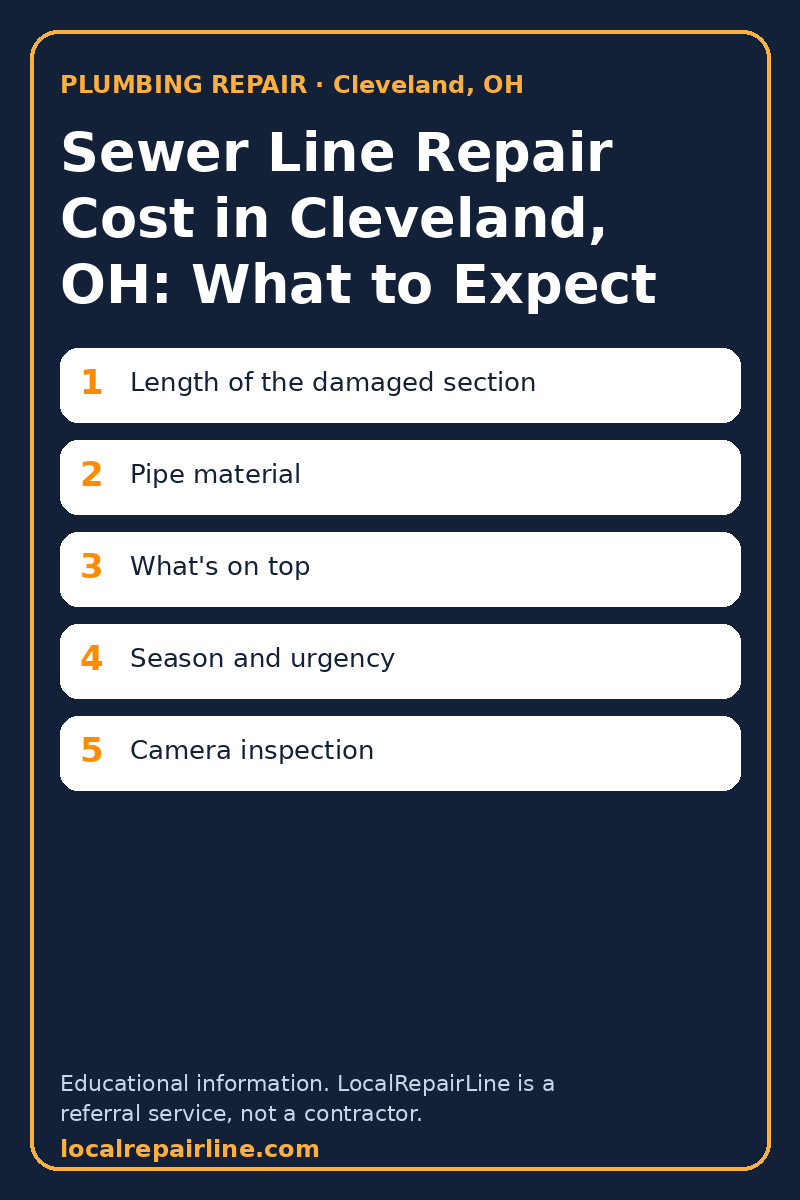
Spot Repair vs. Trenchless Lining vs. Full Replacement
Your plumber will usually pick from three approaches. Each has trade-offs.
Spot repair
If the camera shows one cracked or separated joint, digging up just that section can be the most affordable fix. The catch is that old pipe tends to fail in more than one place. Fixing one spot while the rest is brittle can mean paying for another dig later.
Trenchless lining
Lining puts a resin-coated sleeve inside the existing pipe, creating a new pipe within the old one. It often avoids tearing up the yard, driveway, or landscaping, which can offset a higher material cost.
It isn't right for every line. Badly collapsed, crushed, or severely bellied pipe may not be a candidate. Roots usually need to be cleared first.
Full replacement
When the line is collapsed, offset, or failing along most of its length, replacement may be the sensible choice. It costs more up front and brings the most disruption. It also replaces the aging pipe from end to end instead of patching it.
Ask your plumber why they're recommending one method over the others. A good answer points to what the camera showed.
Why Older Cleveland Homes and Winter Weather Change the Price
Many Cleveland-area homes are older, and older homes often have older sewer laterals. Clay pipe is made of short sections with many joints, and each joint is a place for roots to get in. Cast iron can corrode and flake from the inside. Some mid-century homes may have fiber-type pipe that can soften, deform, or collapse.
Roots are a big factor. They look for moisture, and a small gap in a joint is an open invitation. Once roots take hold, the line may need repeated cleaning or a more permanent repair.
Weather matters too. Cleveland sits on Lake Erie and gets heavy lake-effect snow, so the ground can stay cold and saturated for long stretches. Repeated frost and thaw cycles shift soil, which can stress older pipe over time.
In winter, digging is harder. Frozen or waterlogged ground slows the work, and an emergency dig in bad weather can cost more than a planned one in milder conditions. Spring is often wet in Northeast Ohio, and heavy rain can overload drainage and make a weak line show itself through backups.
If your line is stable and the problem isn't urgent, timing a planned repair for better weather may help. If sewage is already backing up, the season matters less than what the camera shows, so let a plumber's assessment guide your timing.
Hidden Line Items: Camera Inspection, Permits, Excavation, and Restoration
The headline number on a written breakdown often leaves things out. Ask about each of these.
- Camera inspection. Skipping it is one of the costliest shortcuts. Without it, you may pay for a full dig when lining would work, or fix the wrong section entirely.
- Permits. Ask your plumber whether the job needs a permit or inspection, and confirm with your local building or sewer department. Ask who pulls the permit and whether the fee is in the written breakdown.
- Excavation. Find out how much of the yard will be opened up and how deep.
- Restoration. Who puts back the sod, gravel, concrete, or pavers? Many plans stop at backfilling the trench.
- Cleanup and haul-away. Spoil and broken pipe have to go somewhere.
- Surprises. Ask how unexpected findings, like a second break or a buried obstruction, would be handled and priced.
A written breakdown that spells these out is easier to compare and less likely to grow later.
Who Pays for What: Homeowner Lateral vs. City Main, and Insurance Questions
The private lateral is the pipe running from the house to the connection with the main in the street. Who is responsible for it depends on where you live, so check with your city or sewer authority to find out whether it's yours. For the public main, ask the same office who maintains it. Where one ends and the other begins can vary, so confirm it with your city's sewer or water department before you assume.
That matters because a backup isn't always your pipe. If the camera shows the blockage or damage is in the main, ask the city's sewer or water department who handles the repair, since it may not be your cost.
Insurance is a separate question. Check your policy for how it treats underground sewer lines, including wear, age, and root damage. Ask your agent whether your policy covers sewer line damage or sewer backup, and what it leaves out. Read your policy or call your agent before the work starts, not after.
Warning Signs Worth Checking Out
Some signs suggest the line may be in trouble:
- Repeated backups in a basement floor drain, tub, or toilet
- Gurgling drains or toilets after other fixtures run
- Sewage smell in the basement or yard
- Several slow drains at once, not just one sink
- Soggy or sunken patches in the yard along the line's path
Problems like these can change over time, and a plumber can tell you how your line looks right now. A backup can reach floors, drywall, and stored belongings, so it helps to have the line looked at rather than waiting to see what happens. Cleanup after a backup is its own cost, and it varies by house and by what was affected.
When to call a local plumbing pro
If you're seeing repeated backups, gurgling drains, or a sewage smell in the basement, or if a camera inspection has shown roots, a crack, or a bellied line, it makes sense to have a plumber scope the line. Call a local plumbing pro in Cleveland, OH through LocalRepairLine to look at it and lay out the work in writing.
Price and repair method can't be settled without seeing the pipe. Anyone who names a firm number over the phone without a camera look is guessing.
How to Compare Written Breakdowns From Local Plumbers Without Overpaying
Compare more than one written breakdown when the situation allows it. Then compare them line by line, not just by the bottom number.
- Same scope. Make sure each written breakdown covers the same length of pipe and the same method.
- Camera findings. Ask to see the footage or a description of what was found and where.
- Method reasoning. Ask why they recommend digging, lining, or a spot fix.
- Restoration. Check what's included for lawn, concrete, and pavement.
- Permits and inspections. Confirm who handles them.
- After the repair. Ask what happens if a problem shows up later, and get the answer in writing.
Be cautious about written breakdowns that come in far lower than the rest. They may leave out restoration, use a narrower scope, or skip steps. Also be cautious about pressure to sign immediately when the situation isn't an active emergency.
FAQ
How much does it cost to replace a sewer line in Cleveland, Ohio?
Costs vary by house. Length, depth, pipe material, access, and what has to be restored afterward all affect the total. A short run under a lawn is a very different job from a long run under a driveway or slab, so a camera inspection and a written breakdown are the only reliable way to get a real number.
Is trenchless sewer repair cheaper than digging?
Not always. Lining can cut down on yard, driveway, and landscaping restoration, which can make the overall job cost less. But the lining materials and equipment can cost more than a simple dig, and some damaged pipe can't be lined at all. Costs vary by house, so compare written breakdowns that cover the same scope, including restoration.
Need a plumbing repair pro in Cleveland, OH?
Talk to an independent local contractor who serves your area.
📞 Call (833) 350-0420Plumbing repair in Cleveland, OHCall hours: 8am–8pm ET, 7 days