Furnace Not Working in Wilmington DE? A Troubleshooting Guide
You wake up, pull the blankets tighter, and realize the house feels noticeably colder than usual. You walk over to the supply register, hold out a hand, and feel nothing moving, or maybe just a faint draft of chilly air. When you wake up to a furnace not working Wilmington DE temperatures can drop the inside of your house quickly.
Before you assume the heating system has failed completely, check a few straightforward items on your own. Some common heating failures come down to a simple tripped switch or a clogged filter. Other issues involving fuel or internal electrical parts require professional equipment and training.
Immediate safety checks before inspecting your furnace
Safety comes first when dealing with gas and high-voltage heating equipment. Smell the air and listen closely before touching any panels or switches.
If you smell an odor like rotten eggs or sulfur, stop immediately. Natural gas suppliers add that scent so you can detect a leak right away. Leave the house right away, leave the door open behind you, and call your gas utility from down the street.
Step away if your carbon monoxide alarm sounds or if you see heavy black soot marks around the burner chamber. A burning electrical odor or visible smoke from the blower cabinet also means you should shut off the emergency switch and call for help. Basic homeowner troubleshooting is strictly for systems that shut down quietly without signs of gas leaks or electrical fires.
Need an HVAC repair pro in Wilmington, DE?
Talk to an independent local contractor who serves your area.
📞 Call (833) 669-0233HVAC repair in Wilmington, DECall hours: 8am–8pm ET, 7 daysYour call may first be answered by a short screening service that asks what the problem is and where you are. Stay on the line and you will be connected to an independent local pro.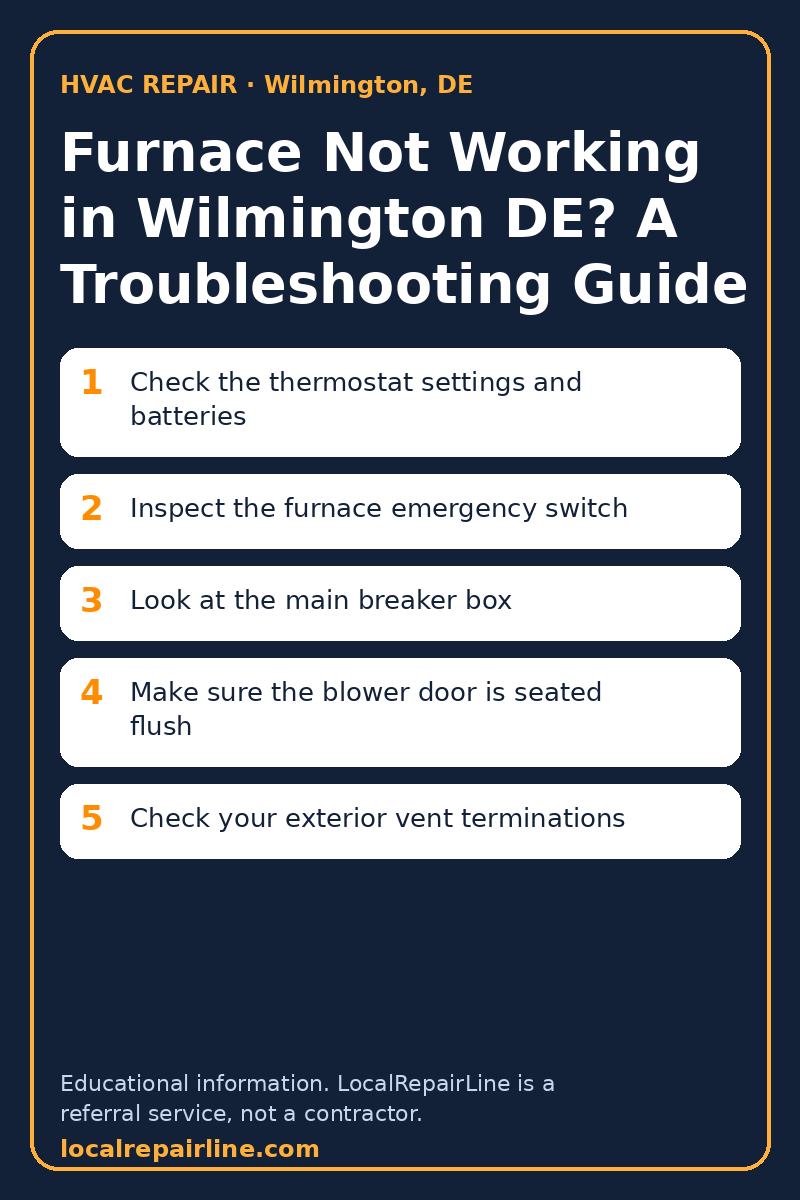
Furnace not working Wilmington DE: Basic power and thermostat checks
Many heating service calls turn out to be electrical supply issues outside the furnace itself. Work through this quick checklist before you start taking off panels:
- Check the thermostat settings and batteries. Ensure the thermostat is set to "Heat" rather than "Cool" or "Off." Bump the target temperature five degrees above the current room temperature. If the screen is blank or flashing a battery icon, install fresh alkaline batteries.
- Inspect the furnace emergency switch. Look near your basement stairs, utility closet door, or mounted on the side of the furnace. It looks like a standard light switch and often has a red cover plate. People frequently bump this switch while moving storage boxes, cutting all power to the heater.
- Look at the main breaker box. Find your home electrical panel and locate the breaker labeled for the furnace. If the breaker has tripped into the middle position, push it fully to "Off" first, then flip it firmly back to "On."
- Make sure the blower door is seated flush. Modern furnaces have a safety switch behind the main blower access door. If that door was knocked loose or not put back squarely, the safety switch will stay open and keep the entire system dead.
Dirty air filters and airflow lockouts
A clogged air filter is one of the most frequent causes of mid-winter furnace shutdowns. Wilmington experiences damp winter weather with overnight drops below freezing that put sudden strain on heating equipment. When cold snaps hit Delaware, your furnace runs long heating cycles to keep up, pulling high volumes of household air through the return ducts.
If that filter is choked with dust and pet hair, airflow drops to a crawl. Heat can't escape the furnace cabinet fast enough, causing the internal temperature to spike. When the heat exchanger gets too hot, a safety sensor called a high limit switch trips automatically.
This safety trip shuts off the gas burners to prevent damage, but it often leaves the blower fan running. That is why an overheating furnace will often blow cool or lukewarm air instead of heat.
Slide your filter out and hold it up to a light. If light can't pass through the pleated material, replace it immediately with a fresh filter of the correct size. Once the furnace cabinet cools down, the limit switch should reset and allow the burners to fire up again.
Clearing frozen condensate lines and blocked exterior vents
If you have a high-efficiency condensing furnace, it vents through white PVC pipes that exit through the side of your home. High seasonal humidity followed by freezing cold snaps raises the likelihood of moisture buildup and icing in these venting systems.
Winter storms can push wet snowfall against exterior furnace intake and exhaust pipes. High-efficiency furnaces also produce acidic water during normal combustion that must drain away freely.
- Check your exterior vent terminations. Clear away drifted snow, wet leaves, and hanging icicles from the PVC pipes on your outside wall. If the intake pipe is buried in snow, the furnace can't draw combustion air and will shut down.
- Look for frozen condensate lines. If your furnace drain tube runs through an unheated crawl space or drafty rim joist, standing water inside the tube can freeze solid overnight.
- Inspect the drain trap. When the drain line freezes, condensation backs up into the furnace collector box. A built-in pressure switch detects the standing water and prevents the burners from lighting.
If you suspect an ice blockage in an exposed plastic drain tube, you can gently thaw the line using a warm, damp towel. Never use an open flame or high-heat heat gun on plastic drainage lines.
How to read your furnace diagnostic blink codes
When a furnace refuses to start, the main control board usually signals what is wrong. You can read this information yourself without touching high-voltage wiring.
Look near the bottom half of the furnace cabinet for a small round clear plastic window, called a sight glass. Peer through this window while the furnace tries to start. You should see a small LED light shining on the circuit board inside.
If the light is steady, the board has power and is waiting for a command. If the system is locked out, that light will blink in a repeating pattern. It might blink three times quickly, pause, and repeat, or alternate between colors.
Count the blinks carefully. Then look at the inside face of the access panel, where manufacturers paste a diagnostic chart that translates the pattern into plain English.
Common blink codes point to an ignition lockout, a stuck pressure switch, or a dirty flame sensor. When basic checks like the thermostat and filter don't resolve the issue, and the LED signals an ignition lockout or switch failure, visit localrepairline.com to connect with a local heating professional in Wilmington, DE.
Gas valves and control boards require specialized diagnostic tools to service safely. Trying to force-start a locked-out furnace can cause electrical damage or create a safety hazard.
Warning signs that mean you should stop and call for heating repair
Some furnace problems can't be handled without specialized technical training. Turn the system switch to "Off" and reach out to a heating repair specialist if you notice any of the following symptoms:
- Short cycling that continues after a filter swap. If the burners ignite, run for a minute, shut off, and repeat endlessly, a crucial safety control is cutting the fuel supply.
- Loud booming or delayed ignition. A loud bang or pop when the furnace starts up means unburned gas is pooling in the combustion chamber before igniting. This can crack your heat exchanger and needs immediate evaluation.
- Continuous circuit breaker trips. If the breaker trips the second the blower fan tries to start, you have a shorted motor or a failing control board.
- Water pooling around the furnace cabinet. Persistent water beneath a high-efficiency furnace usually points to a cracked internal collector box, a broken drain pump, or a clogged internal trap.
- A yellow or unstable burner flame. If your furnace has an open viewing port and you see yellow, flickering flames instead of a crisp blue flame, the burners aren't getting proper combustion air.
When you contact a heating technician, ask them to put the scope and parts in writing before work starts so you understand the problem clearly. Total repair costs vary by house, depending on the age of your system, accessibility, and which specific component failed.
FAQ
Why is my furnace blowing cold air instead of heat?
This usually happens because the blower fan is running while the burners are locked out. A clogged air filter often causes the unit to overheat, which automatically shuts down the gas flame while leaving the fan running to cool the heat exchanger. It can also happen if your thermostat fan setting is switched to "On" instead of "Auto," forcing the fan to circulate unheated air continuously.
How do I reset my furnace after it shuts off?
Locate the power switch mounted on or near the furnace cabinet and flip it to "Off" for sixty seconds before flipping it back on. You can also turn off the furnace breaker at the main electrical panel for one minute. If the system shuts down again after one ignition attempt, don't keep resetting it, as the control board is locking the system out to protect your home.
Why does my furnace turn on for a few minutes and then shut off?
This behavior, known as short cycling, is most commonly caused by restricted airflow from a dirty filter or closed supply registers. It can also be caused by a dirty flame sensor rod that fails to detect the burner flame, prompting the control board to shut off the gas valve after a few seconds. In high-efficiency units, a partially blocked PVC exhaust pipe will also trigger a quick shutdown.
How can I tell if my furnace problem is an emergency?
A furnace issue is an immediate emergency if you smell natural gas, hear your carbon monoxide alarm sounding, or see smoke or scorch marks on the cabinet. It is also urgent during sub-freezing Delaware winter weather if you've uninsulated water pipes that are at risk of freezing inside exterior walls. If none of those hazards are present, your home will generally retain safe indoor temperatures for several hours while you troubleshoot or schedule standard service.
Need an HVAC repair pro in Wilmington, DE?
Talk to an independent local contractor who serves your area.
📞 Call (833) 669-0233HVAC repair in Wilmington, DECall hours: 8am–8pm ET, 7 days