Heat Pump Not Heating in Fort Wayne, IN? What to Check First
If you're searching for heat pump not heating Fort Wayne IN because your vents are blowing cool or lukewarm air, don't panic yet. Heat pumps move heat instead of making it, so the air often feels milder than what a furnace puts out.
Sometimes that's normal. Sometimes it's a real problem. This guide helps you tell which is which, what's safe to check yourself, and when to hand it off.
Heat Pump Not Heating Fort Wayne IN: Broken or Just Defrosting?
In cold, damp weather, frost builds up on the outdoor coil. Your heat pump runs a defrost cycle to melt it off. During that cycle it briefly reverses, and the air inside can feel cool for a few minutes.
Here's what a normal defrost cycle usually looks like:
- Steam or vapor rises from the outdoor unit as the frost melts.
- The outdoor fan stops or slows while the coil warms up.
- Indoor air turns cool or lukewarm for a short stretch, then warms back up.
- Water drips from the unit and any thin frost disappears.
- You may hear a whoosh or a change in the sound of the system when it switches modes.
If the cycle ends and warm air returns, your system is doing its job. Fort Wayne winters bring wet snow, sleet, and damp cold, so you'll likely see this often.
It becomes a problem if the cool air lasts much longer than a short cycle, or if the unit stays coated in thick ice instead of clearing. That points to something else going on.
Need an HVAC repair pro in Fort Wayne, IN?
Talk to an independent local contractor who serves your area.
📞 Call (833) 669-0233HVAC repair in Fort Wayne, INCall hours: 8am–8pm ET, 7 daysYour call may first be answered by a short screening service that asks what the problem is and where you are. Stay on the line and you will be connected to an independent local pro.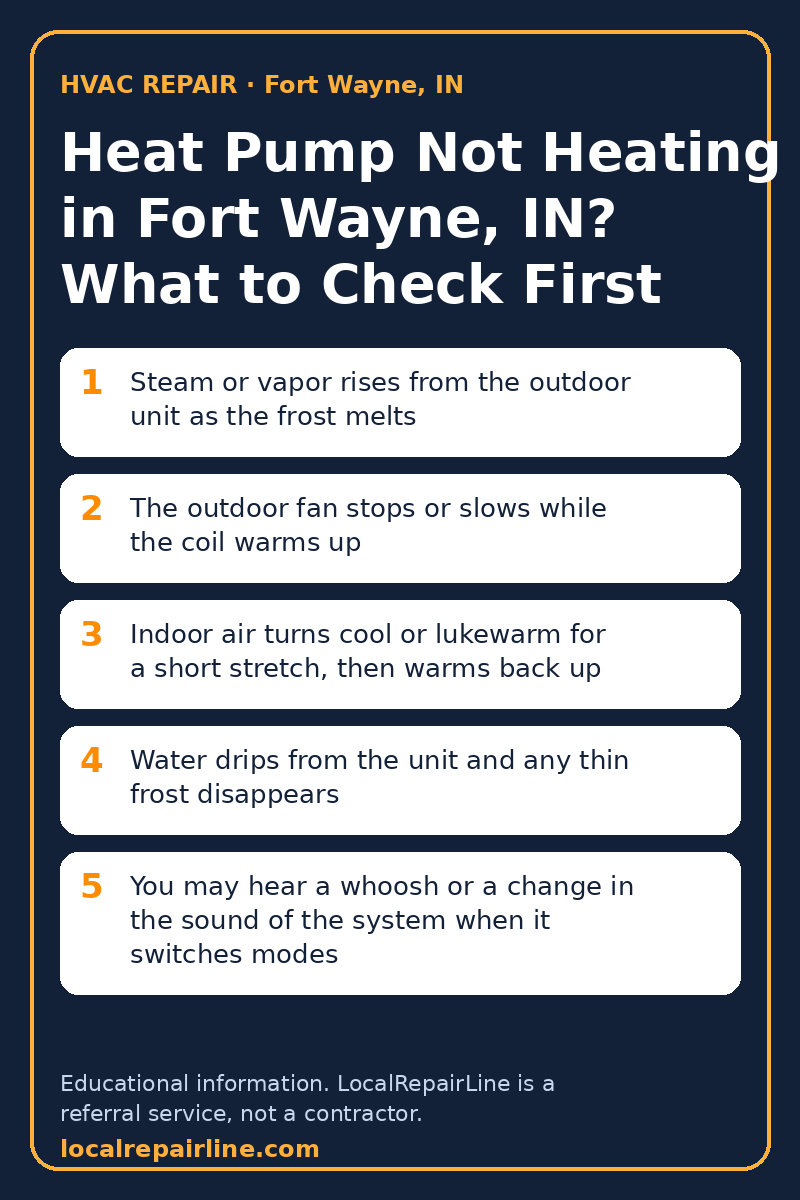
Quick Checks Before You Call: Thermostat, Filter, Breaker, and Airflow
Start with the simple stuff. These checks are basic, and sometimes they solve the problem on their own. Skip any step you're not comfortable with.
- Check the thermostat. Make sure it's set to heat (not cool or off) and the target temperature is a few degrees above the room temperature. If it's a battery model, replace the batteries.
- Check the fan setting. "On" runs the fan constantly, which can make air feel cooler between heating cycles. "Auto" is usually better for comfort.
- Swap a dirty filter. A clogged filter chokes airflow and makes the whole system work harder for less heat.
- Look at the breaker. Check your panel for a tripped breaker for the indoor unit and outdoor unit. Reset it once. If it trips again, stop and don't keep resetting it.
- Open the vents. Make sure supply vents and return grilles aren't blocked by furniture, rugs, or closed dampers.
Don't open the equipment panels or poke around inside the outdoor unit. Electrical parts and moving fans are a good reason to stop at the checks above.
Snow, Ice, and Debris: Keeping a Fort Wayne Outdoor Unit Clear
Northeast Indiana winters can bury an outdoor unit under wet snow or coat it in ice after a storm. When the coil can't get air, it can't pull in heat, and your system struggles.
After a heavy snowfall, gently brush loose snow off the top and sides of the unit. Use a soft broom or your gloved hands. Clear a few feet of open space around it so air can move.
If ice has formed, don't chip at it with a shovel, hammer, or screwdriver. The coil fins and refrigerant lines are thin and damage easily. Light ice is usually something the defrost cycle handles on its own, so skip hot or boiling water and call a technician if it doesn't clear.
Also look for leaves, grass clippings, and drifted debris at the base. Spring and fall can swing between heating and cooling modes, so keeping the area tidy year-round helps.
A thin glaze that melts during a defrost cycle is one thing. A unit that's encased in thick ice, or has ice on the lines and cabinet that doesn't clear, is another. That second case points to a fault, and it's time to stop clearing and call someone.
Common Causes of Weak or Cold Air: Refrigerant, Reversing Valve, and Compressor
If your checks didn't help, the cause is likely mechanical. Here are the usual suspects, in plain terms.
Low refrigerant
Refrigerant carries heat. A system doesn't "use up" refrigerant, so low levels usually mean a leak somewhere. Signs include weak heat, ice on the outdoor unit or lines, and a hissing sound.
Topping it off without fixing the leak is a short-term patch. Costs vary by house and by where the leak is.
A stuck reversing valve
This valve switches the system between heating and cooling. If it sticks, your heat pump might blow cool air while running in what should be heating mode. You might hear odd clicking or whooshing, or the system might seem stuck in a defrost-like state.
Compressor or fan trouble
The compressor is the heart of the outdoor unit. Grinding, loud buzzing, repeated clicking, or a unit that hums but never starts are warning signs. A failed outdoor fan motor can cause similar symptoms and lead to ice.
This is the point to talk to a local HVAC pro in Fort Wayne, IN instead of guessing. Call if you've checked the thermostat, replaced a dirty filter, and cleared snow and ice, and the air is still cool. Call too if you see heavy ice buildup, hear grinding or buzzing, or the breaker keeps tripping. These problems usually involve refrigerant or electrical parts that need a trained technician and the right tools, and a local pro network can help you find one.
Emergency Heat vs. Auxiliary Heat: What They Cost You in a Cold Snap
Many heat pumps have electric resistance strips or a gas furnace as backup. They work in two ways, and the difference matters for your utility bill.
Auxiliary heat kicks in automatically. When it's very cold or the house is far from the set temperature, the backup helps the heat pump catch up. You may see an "AUX" light on your thermostat during a cold snap, and that's normal for short stretches.
Emergency heat is a manual setting. It shuts off the heat pump and runs only the backup source. It's meant for real emergencies, like an outdoor unit that has failed.
Running backup heat for long stretches can add to your energy use, and how much it affects your bill varies by house and by the type of backup your system has. Leaving the thermostat on emergency heat for weeks can quietly drive up your bill, and you may not notice until it arrives.
If you've switched to emergency heat, use it as a short bridge to get through a cold night until a technician can look at the system. Then switch back to normal heat once it's repaired. If your AUX light seems to stay on constantly, even on mild days, that's worth mentioning to a pro.
Repair or Replace? How Age and Repair Costs Guide the Decision
Before you commit to either, think about three things: age, repair size, and how the system has been performing.
- Age. Heat pumps wear out over time, so check the age on the label of your outdoor unit or in your paperwork. Older systems tend to have more frequent breakdowns and lower efficiency.
- Repair size. A capacitor, contactor, or sensor is usually a modest repair. A failed compressor or a major refrigerant leak is a bigger one.
- Repair history. If you've had multiple repairs in a couple of winters, the next one probably won't be the last.
A common rule of thumb: if a repair cost approaches a large share of a new system, and the unit is already older, replacement deserves serious thought. A newer system with a single failed part is usually worth repairing.
Cold-climate performance matters here too. Newer models are often built to keep producing heat in colder weather than older ones. That can reduce how often backup heat runs in a Fort Wayne winter. Costs vary by house, so ask the technician to lay out both options and what each involves, then compare them side by side.
What a Technician Will Check and How to Prepare for the Visit
A good technician will usually start with the basics, then work toward the mechanical parts. Expect them to check thermostat settings and wiring, airflow, and the filter. They'll also look at electrical components, the outdoor coil and fan, refrigerant pressures, the reversing valve, and defrost controls.
You can help the visit go smoothly:
- Note when the problem started and whether it comes and goes.
- Write down any noises, smells, or error codes on the thermostat.
- Mention if you've used emergency heat and for how long.
- Clear a path to the indoor and outdoor units.
- Have your system's age and any past repair records handy.
Ask the technician to explain what failed, what the repair involves, and what your options are. If a replacement comes up, ask why, and whether a repair is realistic.
FAQ
Why is my heat pump blowing cold air in winter?
The most common reasons are a normal defrost cycle, a thermostat set to the wrong mode, or a clogged filter. Less often, low refrigerant, a stuck reversing valve, or a failing compressor is to blame. If simple checks don't fix it, call a local technician.
Is it normal for a heat pump to blow cool air in defrost mode?
Yes, briefly. During defrost the system reverses to melt frost off the outdoor coil, so the air inside can feel cool for a few minutes. If warm air returns once the cycle ends, that's normal. If the cool air keeps going or the unit stays iced over, it's time to call a technician.
Need an HVAC repair pro in Fort Wayne, IN?
Talk to an independent local contractor who serves your area.
📞 Call (833) 669-0233HVAC repair in Fort Wayne, INCall hours: 8am–8pm ET, 7 days