Heat Pump Not Heating in South Bend, IN? What to Check First
When you type heat pump not heating South Bend IN into a search bar, you're probably standing near a vent that feels cooler than you expected. Sometimes that's a real breakdown. Other times it's a heat pump doing its job on a hard Northern Indiana winter day.
This guide helps you tell the difference, run a few safe checks, and know when to stop guessing.
Is Your Heat Pump Really Broken, or Just Working Through a South Bend Cold Snap?
A heat pump doesn't make heat the way a furnace does. It moves heat from outside air into your home. That works well, but the air from the vents usually feels warm rather than hot.
If you're used to a gas furnace, that can feel like "lukewarm." It may be completely normal.
South Bend winters add a few twists. Lots of days and nights stay cold, and lake-effect snow off Lake Michigan can pile up fast. The system works harder and runs defrost cycles more often. Here's what usually counts as normal:
- Air from the vents feels warm but not hot, and the house slowly reaches the thermostat setting.
- The outdoor fan stops for a few minutes, and you may see a little steam rising from the unit.
- Vent air turns cooler for a short stretch, then warms back up.
- The system runs for long stretches on very cold days instead of cycling on and off.
And here's what points to a real problem:
- Air stays cool for much longer than a short defrost pause.
- The house keeps losing temperature even though the system runs.
- The outdoor unit is wrapped in ice or making grinding, squealing, or banging sounds.
- The breaker keeps tripping.
Need an HVAC repair pro in South Bend, IN?
Talk to an independent local contractor who serves your area.
📞 Call (833) 669-0233HVAC repair in South Bend, INCall hours: 8am–8pm ET, 7 daysYour call may first be answered by a short screening service that asks what the problem is and where you are. Stay on the line and you will be connected to an independent local pro.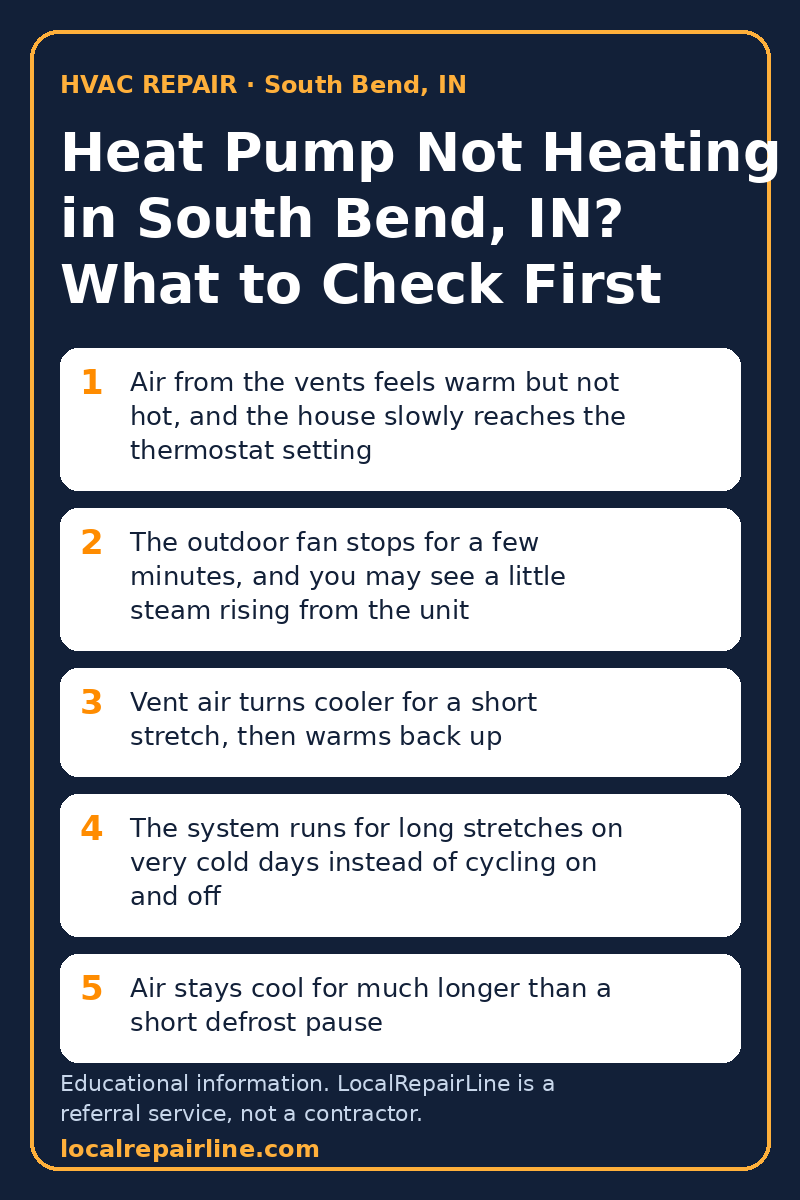
Heat Pump Not Heating South Bend IN? Start With These Quick Checks
Most simple fixes take a few minutes and no tools. Work through these in order:
- Check the thermostat. Make sure it's set to "Heat" (not "Cool" or "Off"), and set the temperature a few degrees above the current room temperature. Replace the batteries if the display is dim or blank.
- Look at the air filter. A clogged filter chokes airflow and can make the system feel weak. Swap in a clean one if it looks gray and packed with dust.
- Check the breakers. Look at both the indoor and outdoor unit breakers in your panel. If one is tripped, reset it once. If it trips again, leave it off and call a pro.
- Open the vents. Make sure supply registers are open and not blocked by rugs, furniture, or drapes.
- Look outside. Check that the outdoor unit isn't buried in snow or coated in ice.
If you changed the thermostat setting recently, give the system a little time. Heat pumps respond more slowly than furnaces, especially after a big temperature jump.
Snow, Ice, and Defrost Mode: Lake-Effect Problems With the Outdoor Unit
The outdoor unit pulls heat from the air. If snow blocks it or ice coats the coil, it can't do that well.
What defrost mode looks like
When frost builds on the outdoor coil, the system briefly reverses itself to melt it. The outdoor fan may shut off, steam may rise, and cooler air may come from your vents for a few minutes. That's normal.
Defrost should be a pause, not a long stretch. If the unit stays frozen over after the cycle ends, or the air stays cool for a long time, something may be wrong.
Caring for the unit in lake-effect snow
- Clear snow gently. Use a soft broom or your gloved hands to brush snow off the top and sides.
- Keep space around it. Leave open room on all sides so air can move through. Shovel drifts back from the unit, and watch for roof runoff or icicles dripping onto it.
- Don't chip ice. Ice picks, shovels, and screwdrivers can puncture or bend the coil, and that turns a small problem into an expensive one.
- Don't cover it. Tarps and boards trap moisture and block airflow.
- Check after storms. A heavy lake-effect band overnight can bury a unit before you notice.
If the unit is thickly iced after you've cleared snow, turn the system off at the thermostat and call a technician rather than attacking the ice.
Common Causes of Cool Air From a Heat Pump: Refrigerant, Reversing Valve, and Compressor
If the quick checks don't solve it, the cause is likely inside the system. These are the usual suspects, though only a technician can confirm which one you have.
Low refrigerant. Refrigerant carries heat through the system, and it doesn't get "used up." If levels are low, there's usually a leak. Topping it off without finding the leak tends to be a short-term fix.
A stuck reversing valve. This valve switches the system between heating and cooling. If it sticks, your heat pump may blow cool air even when set to heat.
Compressor trouble. The compressor is the heart of the system. Warning signs include loud or odd noises, a hot-smelling outdoor unit, or a breaker that won't stay on.
Failed sensors or controls. A bad defrost sensor or control board can leave the unit stuck in defrost, or never entering it. Ice buildup is a common clue.
Weak airflow. Dirty coils, a failing indoor blower, or leaky ducts can make heat feel faint even when the system itself is fine.
Costs vary by house, system age, and the part involved. A sensor or capacitor repair is a different conversation than a compressor.
Emergency Heat: When to Use It and What It Does to Your Electric Bill
Most thermostats have an "Emergency Heat" or "Aux" setting. It bypasses the heat pump and uses electric heating elements inside the indoor unit. It does warm the house, but electric resistance heat generally costs much more to run than the heat pump doing its normal job.
The danger isn't using it for an evening. It's leaving it on for days because the house feels comfortable. The problem hides while the electric bill climbs.
Use emergency heat only as a short bridge: when the outdoor unit is clearly out of action, like iced over or shut down, and you're waiting on a repair. If you do switch to it, make a plan to have the system looked at so it doesn't quietly become your everyday heat.
Don't confuse it with auxiliary heat that comes on automatically during very cold weather or after a big temperature change. That's normal in short bursts. But if the backup elements seem to run all the time, it's worth having the system looked at.
Repair or Replace? Cost Questions Worth Asking Before You Decide
When a heat pump fails in the middle of winter, it's tempting to say yes to the first fix offered. A few questions first can save frustration.
- How old is the system? Older equipment may be nearing the end of its useful life, so a big repair may buy limited time.
- What exactly failed? A small part and a compressor or coil are very different repairs.
- Is it a repeat problem? Several repairs in a short time often point toward replacement.
- What refrigerant does it use? Older systems may use a type that's harder to source, which can affect repair costs.
- What does the written plan include? Ask exactly what's in it: the part, the labor, and any follow-up visit if the problem comes back.
- Is the system sized right? A poorly matched system can struggle in a South Bend winter and still handle a humid summer badly.
Since your heat pump must handle muggy summers and cold winters, it's worth thinking about the full year. A replacement may pay off in comfort and efficiency, but costs vary by house, equipment, and ductwork. Get the numbers in writing and compare them.
When to Call a Local South Bend HVAC Pro
Once you've run through the basics, you have a clear line. If the thermostat is set correctly, the filter is clean, the outdoor unit is clear of snow and ice, and the system still blows cool air beyond a normal defrost cycle, it's time to talk to a local HVAC pro in South Bend, IN instead of guessing, and this homeowner resource can help you get started.
Call sooner if you notice any of these:
- The outdoor unit is iced over even after a defrost cycle.
- You hear grinding, squealing, or banging.
- The breaker trips repeatedly.
- You smell burning or see water or oily residue near the unit.
- The house keeps getting colder.
Calling when you first spot these signs gives the technician more to work with. Emergency heat is meant as a short stopgap, not a multi-day plan. A technician can usually sort out a problem more easily when you can say exactly what changed and when.
When you call, describe what you've seen: how long the air has been cool, whether the outdoor unit is iced, what the thermostat is set to, and any noises or smells. That helps the technician come prepared.
FAQ
Why is my heat pump blowing cool air when it's set to heat?
It may be in a normal defrost cycle, which usually lasts a few minutes. Vent air from a heat pump also feels cooler than furnace air even when everything works. If the air stays cool for a long stretch, check the thermostat, filter, and outdoor unit, then call a technician if nothing changes.
Is it normal to see steam coming off my outdoor unit?
Yes, often. During defrost, the unit melts frost from the coil, and the warm moisture can rise as steam. It should stop when the cycle ends. If the unit stays iced over afterward, something may be wrong.
Should I switch to emergency heat if my heat pump isn't heating?
Only as a short bridge while you wait on a repair, such as when the outdoor unit is clearly iced over or shut down. Emergency heat uses electric elements that generally cost much more to run than the heat pump. If you switch to it, plan to have the system looked at so it doesn't become your everyday heat.
Can I clear snow and ice off the outdoor unit myself?
You can brush loose snow off gently with a soft broom or gloved hands and keep drifts back from the sides. Don't chip at ice with tools, since that can damage the coil. If the unit is thickly iced after you've cleared the snow, turn the system off at the thermostat and call a technician rather than attacking the ice.
Need an HVAC repair pro in South Bend, IN?
Talk to an independent local contractor who serves your area.
📞 Call (833) 669-0233HVAC repair in South Bend, INCall hours: 8am–8pm ET, 7 days