Emergency Furnace Repair Dover DE: What to Do Before You Call
When the heat quits on a raw Dover night, you want answers fast. This guide covers emergency furnace repair Dover DE homeowners can plan for: what's safe to check, what means stop, and how to keep your house and pipes in decent shape while you wait for a repair.
Dover has a humid subtropical, Mid-Atlantic climate, and winters here are properly cold. Furnaces get their hardest workout from December through February.
Do You Need Emergency Furnace Repair Dover DE Tonight?
Not every furnace problem needs a middle-of-the-night call. The question is whether the problem is a safety risk, or whether the house is losing heat faster than you can manage.
Treat it as an emergency if any of these apply:
- You smell gas or something burning.
- A carbon monoxide alarm is going off.
- The temperature outside is dropping into the cold range and your home is cooling quickly.
- Someone in the house is very young, elderly, ill, or otherwise vulnerable to cold.
- A winter storm is moving in and the furnace is already struggling.
If the furnace is making an odd noise but still heating, or the house is only a little cool, it can often wait for normal business hours. If the house is safe and holding its heat, waiting gives you time to schedule calmly and ask questions.
Need an HVAC repair pro in Dover, DE?
Talk to an independent local contractor who serves your area.
📞 Call (833) 669-0233HVAC repair in Dover, DECall hours: 8am–8pm ET, 7 daysYour call may first be answered by a short screening service that asks what the problem is and where you are. Stay on the line and you will be connected to an independent local pro.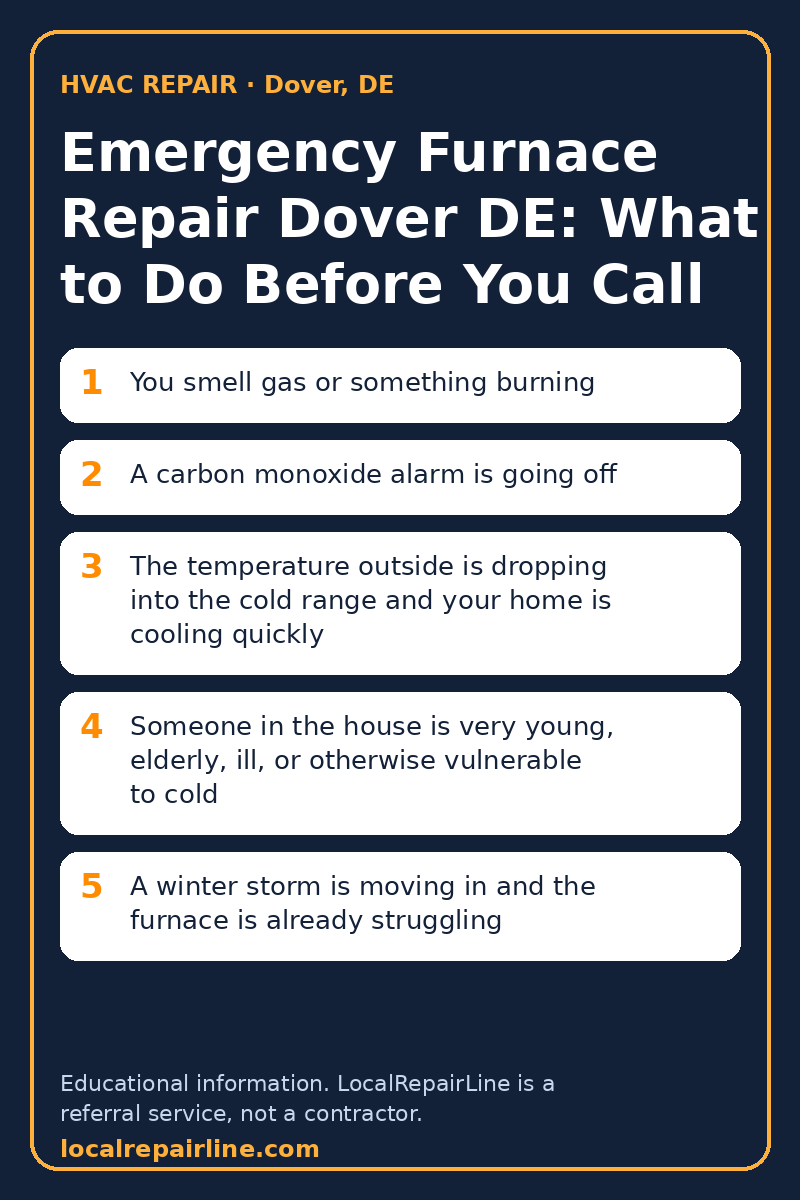
Safe Checks to Try Before Calling a Pro
A surprising number of "dead furnace" calls come down to something simple. These checks need no tools and no opening of panels.
- Check the thermostat. Make sure it's set to "heat," the temperature is set above the room temperature, and the batteries are fresh if it uses them.
- Check the breaker and the switch. Look at the breaker for the furnace in your panel. Many furnaces also have a wall switch near the unit that looks like a light switch and can get flipped by accident.
- Look at the air filter. A badly clogged filter can make a furnace overheat and shut itself off. Swap in a clean one if yours is filthy.
- Check the vents and returns. Make sure furniture, rugs, or boxes aren't blocking them.
- Look at the condensate drain, if you have a high-efficiency unit. These furnaces drain water through a small pipe. If it's clogged or iced up, the furnace may refuse to run.
- Reset once, at most. If your furnace has a visible reset button, follow the label and try it one time.
If the furnace doesn't come back after these steps, stop there. Repeatedly forcing a restart can make a small problem bigger.
Don't take the cabinet off, and don't relight an older pilot unless you know the procedure for your exact model. When in doubt, leave it alone.
Warning Signs That Mean Shut It Off Immediately
Some symptoms are your cue to stop troubleshooting entirely.
- A gas smell. Don't flip switches or use your phone inside. Leave the house, then call 911 or your gas utility from outside.
- A carbon monoxide alarm. Get everyone outside into fresh air and call 911. Don't go back in to investigate.
- Headaches, dizziness, or nausea that ease when you leave the house, especially if several people feel it at once.
- Soot, scorch marks, or black staining around the furnace or vents.
- A burning or hot-metal smell that doesn't fade after the first startup of the season.
- Repeated short-cycling or lockouts, where the furnace starts, quits, and tries again or shuts down for good.
- Loud banging, scraping, or squealing that gets worse each time it runs.
This is the moment to stop guessing. Turn the furnace off at the thermostat, and call a qualified local HVAC pro in Dover, DE, such as Local Repair Line. The same goes if you've finished the basic checks, the furnace is still dead, and the house is cooling on a cold night. These problems involve combustion, venting, and electrical parts that aren't safe for a DIY fix.
When you call, say what you smell, hear, or see, whether an alarm sounded, and how cold the house is getting. That gives whoever you call a clearer picture of the problem.
Keeping Your Dover Home Warm and Pipes Protected While You Wait
Dover's damp coastal air makes cold days feel raw, and nor'easters or winter storms can add snow, ice, and strong winds. Wind pulls heat out of a house quickly, so your first goal is to hold in what warmth you have.
How long a house stays comfortable depends on its insulation, how windy it is, and how cold it gets outside. A tight, well-insulated home may coast for a good while, while a drafty one can cool noticeably faster.
Hold the heat in
- Close doors to rooms you don't need and gather everyone in one room.
- Shut curtains at night and open them on sunny days.
- Block door drafts with a rolled towel.
- Layer clothes and blankets before reaching for any extra heat source.
Protect your pipes
- Open cabinet doors under sinks on exterior walls so warmer room air reaches the pipes.
- Let a faucet drip slowly on the coldest nights, especially for lines that run along outside walls.
- Keep the garage door closed.
- Find your main water shutoff now so you can act fast if a pipe does burst.
Use temporary heat carefully
If your furnace is down, a space heater can help, but only if you use it with care. Plug it straight into a wall outlet, not a power strip or extension cord, and keep it well clear of bedding, curtains, and furniture. Never leave it running while you sleep or leave the house.
Never use a gas oven, a grill, or a generator indoors or in an attached garage to heat your home. These can fill the house with carbon monoxide.
Common Causes of Winter Furnace Breakdowns
Knowing the usual suspects helps you describe the problem and understand what you're being told.
- Dirty filters and restricted airflow. These cause overheating and shutdowns.
- Ignition or flame sensor trouble. The furnace tries to light, then quits.
- Thermostat problems. Wiring faults, dead batteries, or a failing unit.
- Blower motor or capacitor issues. You may hear the furnace start but feel little air.
- Clogged condensate lines. These are common in high-efficiency units in cold weather.
- Worn parts on an older system. Heavy winter use is often when weak parts finally give out.
Damp coastal air can also affect equipment over time, so rust and corrosion are worth mentioning if you notice them.
Repair or Replace: Making the Call at 2 a.m.
A cold house at 2 a.m. is a bad time to decide on a big purchase. In most cases, aim to get safe, steady heat tonight and make the larger decision when you're rested and warm.
Costs vary by house, but a few things drive the price of a repair:
- The part that failed and how easy it is to get.
- The age and model of the furnace.
- How urgent the repair is and when it needs to happen.
- How hard the unit is to reach.
Replacement starts to make more sense when:
- The furnace is old and breaking down repeatedly.
- The repair cost is a large share of what a new unit would cost.
- A technician finds a cracked heat exchanger or another serious safety problem.
- Your heating bills have been climbing for no clear reason.
Ask them to put the parts and labor in writing before work begins. Getting the house safe and steady first lets you wait on a replacement decision until you're rested and have had time to weigh your options.
What to Expect When the Technician Visits
A good visit usually starts with questions. The technician will ask what happened, what you noticed, and what you've already tried.
Expect a safety check first, especially for gas and carbon monoxide. After that, the technician will typically look at the thermostat, ignition, airflow, and safety controls to find out why the furnace stopped.
Before work starts, you should hear what's wrong, what the fix involves, and whether it can be done during the visit or needs a part. If a part has to be ordered, ask what you can do to stay safe and warm in the meantime.
FAQ
Is a furnace that won't turn on always an emergency?
No. If you have no gas smell, no carbon monoxide alarm, and the house is only mildly cool, it can often wait for normal business hours. It becomes more urgent when the weather is very cold, the house is cooling fast, or someone in your home is vulnerable to cold.
What should I check first if my furnace stops working?
Start with the thermostat settings and batteries, then the furnace breaker and the nearby wall switch. Next, look at the air filter, the vents, and the condensate drain if you have a high-efficiency unit. If none of that helps, stop and call a pro rather than opening the furnace.
Is it safe to use a space heater until the furnace is fixed?
It can be, if you're careful. Plug it directly into a wall outlet, keep it well away from anything that can burn, and turn it off when you sleep or leave. Never use a gas oven, grill, or generator indoors to heat the house.
How can I keep pipes from freezing if the heat is out?
Open the cabinet doors under sinks on exterior walls and let a faucet drip slowly on the coldest nights. Keep the garage door closed and know where your main water shutoff is. Closing off unused rooms also helps you keep what heat you have in the living areas.
Should I repair or replace my furnace after a breakdown?
It depends on the furnace's age, how often it has failed, and how serious the problem is. Costs vary by house, so ask for a written breakdown that lists parts and labor. If the repair is a large share of the cost of a new unit, or a safety problem like a cracked heat exchanger turns up, replacement is worth considering.
Need an HVAC repair pro in Dover, DE?
Talk to an independent local contractor who serves your area.
📞 Call (833) 669-0233HVAC repair in Dover, DECall hours: 8am–8pm ET, 7 days