No Hot Water Emergency Plumber Dayton OH: Check This First
You step into the shower on a frosty Dayton morning and the water never warms up. If you're searching for a no hot water emergency plumber Dayton OH, take a few calm minutes first.
Some causes take a minute to fix. Others, like a gas smell or water around the tank, mean you should stop and get help.
Is It an Emergency? When to Call a No Hot Water Emergency Plumber in Dayton OH
Cold showers are miserable, but no hot water by itself usually isn't dangerous. What matters is what comes with it.
Stop troubleshooting and treat it as urgent if you notice any of these:
- A gas smell near the heater or furnace area. Leave the house, then contact your gas utility's emergency line or emergency services from outside. Don't flip switches or light anything.
- Water pooling around the base of the tank, or water dripping from the tank itself.
- A breaker that trips again right after you reset it.
- Scorched marks, a burning smell, or crackling near the heater or its wiring.
- Rumbling, popping, or banging from the tank.
- Rust-colored hot water from the taps.
If none of that's happening, you likely have time to run a few checks. Even then, the problem may still be bigger than a quick fix.
Need a plumbing repair pro in Dayton, OH?
Talk to an independent local contractor who serves your area.
📞 Call (833) 350-0420Plumbing repair in Dayton, OHCall hours: 8am–8pm ET, 7 daysYour call may first be answered by a short screening service that asks what the problem is and where you are. Stay on the line and you will be connected to an independent local pro.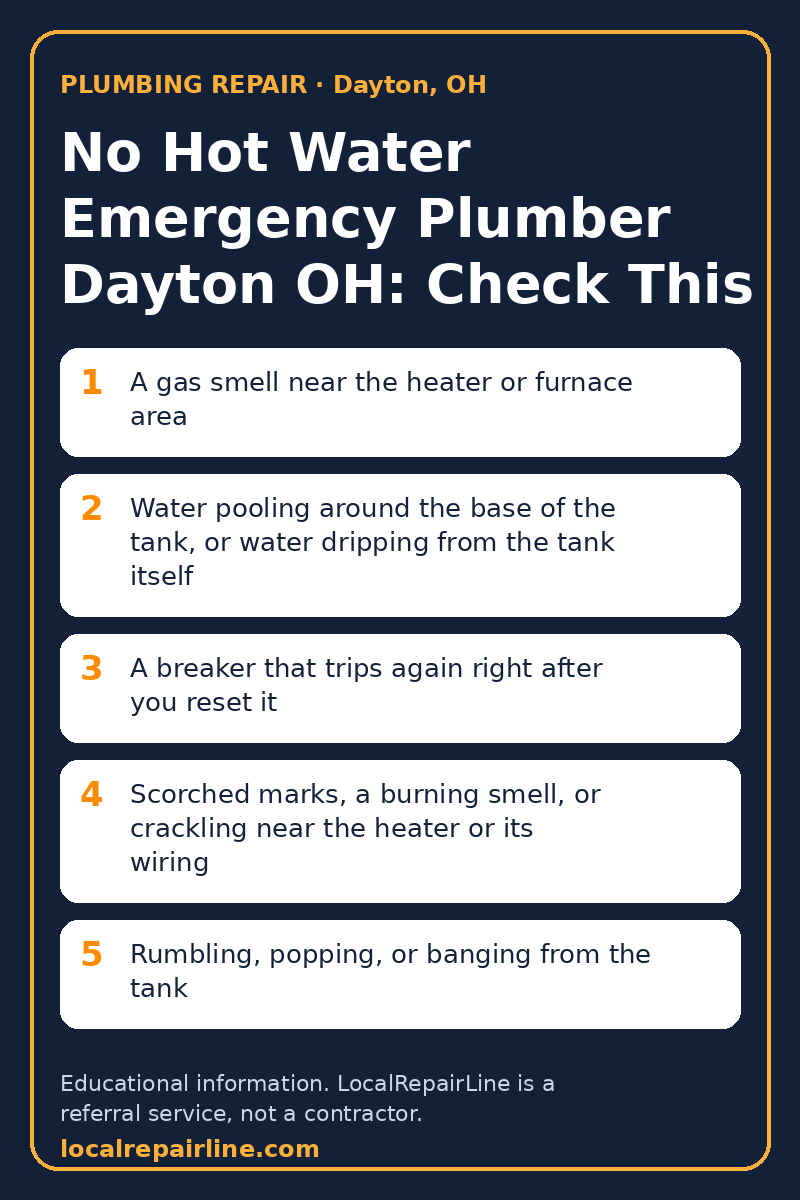
Quick Safe Checks Before You Call
Work through these in order. Don't open panels on a gas unit or touch wiring you can't see clearly.
- Check other hot taps. If the kitchen sink is hot but the shower is cold, the heater may be fine and the problem could be a mixing valve or fixture.
- Look at your electrical panel (electric heaters). Find the breaker for the water heater. If it's tripped, switch it fully off, then back on once.
- Check the thermostat setting. Someone may have bumped the dial. Compare it with the instructions on the heater's label.
- Check the pilot light (gas heaters). Look through the viewing window or follow the label. If it's out, relight it only by following the printed steps, and only if you smell no gas.
- Look at the gas valve and power switch. A closed valve or a switched-off unit is an easy thing to miss.
- Wait and retest. Give the heater a while to recover, then check a tap again.
A note on reset buttons
Many electric tanks have a small red reset button behind a panel. Turn the power off at the breaker before you open anything. If you aren't comfortable doing that, skip it.
If the heater works for a day and quits again, something is causing it. That's a sign to call, not to keep resetting.
Gas vs. Electric vs. Tankless: Why Each Loses Hot Water Differently
Knowing your type helps you describe the problem on the phone. It also helps you guess what's behind it.
Gas tank heaters
These rely on a flame to heat the water. A pilot light that blows out, a worn part that senses the flame, or a gas supply issue can all leave you with cold water. Sediment at the bottom of the tank can also make the burner work harder and fade out over time.
Electric tank heaters
These use heating elements and a thermostat. A tripped breaker, a failed element, or a bad thermostat is a common story. If only part of the tank is heating, you may get a little warm water that runs out quickly.
Tankless heaters
These heat water as it flows, so they don't store any. Error codes, mineral buildup, a gas or power supply problem, or a blocked vent can shut them down. Check the display for a code and look up what it means in the manual, but leave internal work to a pro.
Why Dayton's Cold Snaps Expose Failing Water Heaters
Dayton has four real seasons, and winter is the hard one. When a cold snap settles over the Miami Valley, the water coming into your home is much colder than it is in summer. Your heater has to work harder to bring that water up to temperature.
A healthy heater handles that. A tired one often doesn't. Sediment buildup, a weakening element, or a worn burner may go unnoticed in mild weather, then show up fast when demand is high and the incoming water is icy.
Winter also means more long, hot showers, more laundry, and more guests. That's the heaviest load of the year on an aging tank.
Spring and fall temperature swings and humid summers can still bring problems, so a heater can fail in any season. But a cold morning makes it impossible to ignore.
Repair or Replace? Cost Decisions Homeowners Often Regret
Pressure leads to quick decisions. Here are the common regrets, and how to avoid them.
Paying to repair a worn-out tank
Look for the manufacture date on the label. Tanks wear out with age, and how long yours lasts depends on the model and your water conditions. If your heater is older, has needed repairs before, or is leaking from the tank itself, a repair may only buy you a short stretch.
A leak from the tank body is generally not a repair situation. The tank is what holds the water, and once it fails, replacement is usually the sensible path.
Replacing a unit that needed a small fix
On the other hand, a heater that's in decent shape with a failed thermostat, element, or pilot component may be worth repairing. Replacing a working tank over a small part is an expense you may not need.
Ask the plumber to explain the failure, show you the part if possible, and say whether the tank itself is sound.
Questions worth asking
- How old is the heater, and how much life might it have left?
- Is the problem a part or the tank?
- Has this unit had repeated failures?
- What are the cost differences between repair and replacement, and what's included?
- Does the replacement need venting, gas line, or electrical changes?
Costs vary by house. The type of heater, its size, venting, and how easy it is to reach all change the total. Taking a moment to compare your options helps you avoid rushing into a choice.
When to Stop Guessing and Talk to a Local Plumbing Pro in Dayton, OH
If you've checked the breaker or pilot light and you still have cold water, this is the point to talk to a local plumbing pro in Dayton, OH like Local Repair Line instead of guessing. The same goes if you notice a gas smell, water pooling around the tank, rumbling or popping noises, or rust-colored water.
These signs mean the problem is past a DIY fix, and some may be unsafe. Gas, water, and electricity are a bad mix for trial and error.
While you wait for help, keep these in mind:
- If you see a leak, shut off the cold water supply valve on the pipe feeding the tank, and turn off power or gas to the heater if you can do it safely.
- If you smell gas, get out and call from outside.
- Keep kids and pets away from the heater area.
- Don't try to drain or open a tank that's making loud noises.
What an Emergency Plumber Visit Looks Like and How to Prepare
A typical visit starts with questions. When did the hot water stop? Did anything happen first? Have you noticed noises, leaks, or smells?
Then the plumber will usually inspect the heater, test power or gas, check safety controls, and look at the tank, connections, and venting. After that, you should get a clear explanation of what failed and your options.
To make it go smoothly:
- Clear a path to the heater, including any boxes or laundry.
- Have the model label information handy, if you can read it.
- Write down what you've already tried.
- Know where your main water shutoff and electrical panel are.
- Ask for the repair and replacement options in plain terms, with what each includes.
Pricing can differ from one company and situation to the next. Ask about pricing before work begins.
How to Avoid a Cold-Shower Surprise Next Winter
A little attention before the cold arrives goes a long way.
- Check the heater's age and note when it might need replacing, so it isn't a surprise.
- Look for early signs: rust at the base, damp spots, odd noises, or water that runs lukewarm faster than it used to.
- Ask about flushing the tank if sediment is a concern. Your manual or a plumber can tell you what suits your unit.
- Keep the area clear around the heater and its vent.
- Know your shutoffs for water, gas, and power.
- Plan ahead if the heater is old. Replacing on your schedule beats replacing on a frozen morning.
FAQ
Why do I have no hot water all of a sudden?
The common causes are a tripped breaker, a pilot light that went out, a thermostat setting that changed, or a failed heating element or burner part. A tankless unit might have an error or supply issue. If the quick checks don't restore hot water, a plumber can look into what's causing it.
How do I know if my water heater needs repair or replacement?
Age, repeated problems, and where the failure is all matter. A bad part on a tank that's otherwise sound is often worth repairing. A leaking tank, heavy rust, or an older unit that keeps failing usually points toward replacement.
Is no hot water a plumbing emergency?
Not always. Cold water alone is an inconvenience, but it becomes an emergency if you smell gas, see water pooling around the tank, or notice burning smells or a breaker that keeps tripping. In those cases, stop troubleshooting, shut off power or water only if you can do it safely, and contact a local plumber. If you smell gas, go outside first and contact your gas utility's emergency line.
Need a plumbing repair pro in Dayton, OH?
Talk to an independent local contractor who serves your area.
📞 Call (833) 350-0420Plumbing repair in Dayton, OHCall hours: 8am–8pm ET, 7 days