Sewer Line Repair Cost in Lansing, MI: What Homeowners Pay
If you're staring at a gurgling drain or a soggy patch of yard, you want a number. The honest answer on sewer line repair cost Lansing MI homeowners face is a wide range, and it depends on what's wrong, where it's wrong, and how the plumber gets to it.
This guide explains what moves the price, which fixes cost more, and which add-ons catch people off guard. Costs vary by house, so treat everything here as a way to understand a written breakdown, not predict your bill.
Sewer Line Repair Cost Lansing MI: What You'll Typically Pay
Think of sewer work in three tiers. A cleaning or minor fix sits at the low end. A spot repair or lining sits in the middle. Full replacement sits at the high end.
A few things decide which tier you land in:
- Length of the problem. One cracked section costs far less than a whole run from house to street.
- Depth. Deeper pipe means more digging, more shoring, and more labor.
- Pipe material. Older Lansing-area homes may have clay, cast iron, or other older materials. These can crack, corrode, or let roots in at the joints.
- Access. A line under open lawn is easier than one under a driveway, porch, or mature tree.
- Season. Frozen ground makes digging slower and harder.
Until someone looks inside the pipe, any number is a guess. That's why the first dollar you spend should usually go toward finding out what you're dealing with.
Need a plumbing repair pro in Lansing, MI?
Talk to an independent local contractor who serves your area.
📞 Call (833) 350-0420Plumbing repair in Lansing, MICall hours: 8am–8pm ET, 7 daysYour call may first be answered by a short screening service that asks what the problem is and where you are. Stay on the line and you will be connected to an independent local pro.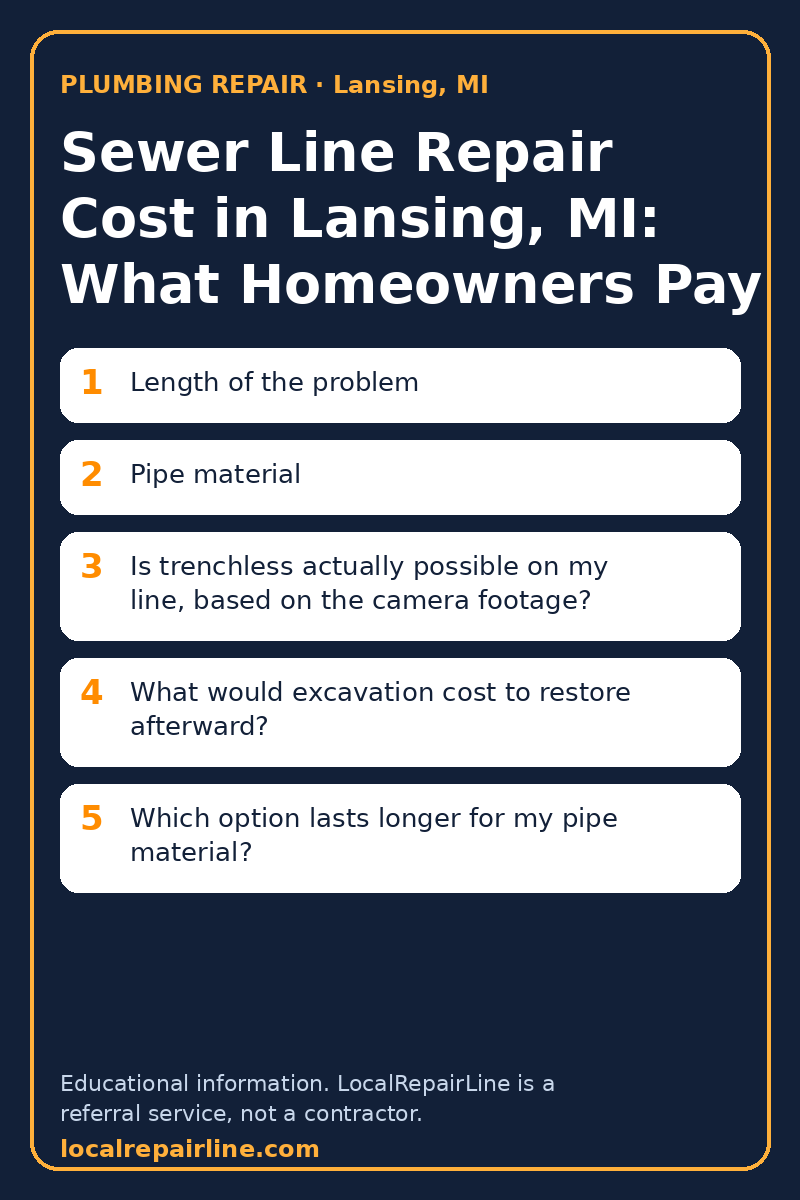
Spot Repair, Lining, or Full Replacement: How the Price Changes
The right fix depends on the pipe's condition, not just the symptom. Here's how the three main options compare.
Spot repair
If a camera shows one broken or offset section and the rest of the line looks sound, a plumber may dig down and replace just that piece. This is usually the most modest job, though it's still excavation.
The catch is that old pipe tends to fail in more than one place. If the rest of the line is tired, you may be paying for repairs again in a few years.
Pipe lining
Lining pushes a resin-coated sleeve into the existing pipe, which hardens into a new inner wall. It can seal cracks and block root entry without digging up the whole line.
It generally costs more than a small spot repair but often less than a full dig. It doesn't work on every pipe. A collapsed or badly shifted line may not accept a liner.
Full replacement
When the pipe is collapsed, severely bellied, or failing along most of its length, replacement is often the sensible call. It's the biggest bill, but it deals with the whole failing run instead of patching one spot at a time.
Ask your plumber to explain why a cheaper option won't hold. A good answer points to what the camera showed.
Trenchless vs. Traditional Digging: Which Costs More in Michigan Soil
Trenchless methods, like lining or pipe bursting, need only small access pits. Traditional repair opens a trench along the whole line.
Trenchless often costs more for the pipe work itself. But it can cost less overall once you count what digging tears up: lawn, landscaping, walkways, and sometimes a driveway.
Traditional digging can still be the better fit. Some lines are too damaged for trenchless repair, and a short, shallow run in open yard may be cheap to dig.
Before you sign, ask:
- Is trenchless actually possible on my line, based on the camera footage?
- What would excavation cost to restore afterward?
- Which option lasts longer for my pipe material?
Compare the total cost of each option, not just the line items on the page.
Hidden Costs Lansing Homeowners Don't Expect
The number on the first page of a written breakdown is rarely the whole bill. These are the extras people often overlook.
- Camera inspection. Some plumbers charge separately for it, and some fold it into the job. Either way, skipping it is a mistake. Paying for a repair without seeing the pipe is how people end up fixing the wrong thing.
- Permits. Permit and inspection rules depend on the city and the type of work, so check with the City of Lansing. Ask your plumber whether one is needed, who pulls it, and whether the fee is in your written breakdown.
- Restoration. Concrete, pavers, sod, and shrubs don't replace themselves. Find out whether the written breakdown includes putting things back, or only backfilling the hole.
- Driveway and sidewalk work. If the line runs under paved areas, cutting and re-pouring can add a lot. This is also where trenchless methods can save money.
- Cleanup and water damage. A backup that reached the basement can mean flooring, drywall, and sanitizing work that has nothing to do with the plumbing bill.
- Surprises underground. Another pipe, an old repair, or a tree root mass can change the job once the crew is digging. Ask how changes are priced before work starts.
Also find out who owns which part of the line before you sign. The lateral is the pipe running from your house toward the street, and the main is the larger public line it connects to. Where responsibility passes from one to the other can vary, so check with the City of Lansing before you pay for work that might not be yours to fix, or before you assume something is the city's job.
How Winter Frost, Spring Thaw, and Tree Roots Affect Your Repair
Lansing has four real seasons, and your pipes feel all of them.
Cold, snowy winters drive frost into the ground. Frozen soil is harder to dig, so winter excavation can take longer and cost more. Frost movement can also stress older pipes and joints that were already marginal.
Spring is when problems tend to show up. Snowmelt and heavy rain saturate the soil. A line that cracked or sagged over the winter may suddenly back up, and slow drains that seemed fine in January start acting up.
Summer adds its own strain. Warm, humid weather and sudden thunderstorms can overload drainage, which makes any existing line problem worse. Roots are also actively growing then, and they go looking for moisture. A tiny joint gap is all they need.
Roots matter for cost because they change the scope. Clearing roots is one thing. Fixing the damaged pipe they invaded is another. If roots keep returning, cutting them out repeatedly may cost more over time than repairing or lining the pipe.
If you can schedule non-emergency work for milder weather, you may avoid frozen-ground slowdowns. An active backup is a different situation, though, and in that case the season is just one factor among several as you plan the repair.
Warning Signs of a Main Line Problem and How to Get a Clear Written Breakdown
Some signs mean the problem is in the main line, not one clogged fixture:
- Several drains backing up at once
- Gurgling toilets or bubbling in tubs and floor drains
- A sewage smell in the yard or basement
- A wet, sunken, or unusually green patch of lawn over the line
If you see any of these, stop guessing. Only a camera inspection can show whether you need a small repair, lining, or full replacement. This is the point to call a local plumbing pro in Lansing, MI, such as LocalRepairLine, rather than pouring in drain cleaner or hoping it clears on its own.
To get a written breakdown you can trust, follow this checklist:
- Ask for a camera inspection and request to see the footage.
- Get the problem location and length described in plain terms.
- Ask for repair, lining, and replacement options where they apply.
- Confirm what's included: permits, cleanup, backfill, and restoration.
- Ask how surprises found during the dig are handled and priced.
- Get at least one more opinion if the plan involves full replacement.
If sewage is already coming up in your home, it helps to hold off on running water while you arrange to have a plumber look at the line. Keep kids and pets out of the affected area.
FAQ
How much does it cost to replace a sewer line in Lansing, MI?
Costs vary by house, and the range is wide. Length, depth, pipe material, access, and how much needs restoring afterward all push the number up or down. A camera inspection and a written breakdown are the only reliable way to know what you'll pay.
Does homeowners insurance cover sewer line repair in Michigan?
Coverage varies a lot from one policy to the next, so don't assume sewer damage is or isn't covered. Some policies treat sudden damage differently from wear, age, or root intrusion, and water backup coverage may be a separate add-on. Read your policy and call your insurer before work starts, since coverage depends on your specific plan.
Who is responsible for the sewer line between my house and the street in Lansing?
It depends on where your line meets the public main and how local rules divide responsibility between you and the city. Exact boundaries can differ by property. Contact the City of Lansing to confirm where your responsibility ends before you sign a contract.
Is trenchless sewer repair cheaper than digging up my yard?
Not always. The pipe work itself may cost more, but you may spend far less on restoring lawn, walkways, and driveways. It also won't work on every line, so the camera footage decides.
Need a plumbing repair pro in Lansing, MI?
Talk to an independent local contractor who serves your area.
📞 Call (833) 350-0420Plumbing repair in Lansing, MICall hours: 8am–8pm ET, 7 days