Sewer Line Repair Cost Pittsburgh PA: A Homeowner's Guide
If you're searching for sewer line repair cost Pittsburgh PA, you probably have a slow drain, a backup, or a home inspection report with the words "sewer scope" on it. Either way, you want a number.
Here's the honest version: costs vary by house, and the spread is wide. A small fix and a full dig-up can be very different bills. This guide explains what drives that gap in older Pittsburgh-area homes, so you can ask better questions before anyone starts digging.
Sewer Line Repair Cost Pittsburgh PA: What to Expect
Think of sewer work in three rough tiers. A clearing or cleaning job sits at the low end. A localized repair or a pipe liner lands in the middle. A full replacement, especially under a driveway, porch, or mature trees, sits at the high end.
What pushes a job up or down comes down to a handful of things:
- Pipe length. A longer run from the house to the connection point means more material and labor.
- Depth. Deeper pipe means bigger trenches and more shoring.
- Pipe material and condition. Clay, cast iron, and bonded fiber each fail differently.
- What's on top. Lawn is easy to restore. Concrete, pavers, and mature landscaping are not.
- Access. Tight yards and obstacles slow the work.
- Where the failure is. One bad joint costs less than a pipe that's failing along its whole length.
Any plumber who names a firm number over the phone, before looking inside the pipe, is guessing. You'll see why in a later section.
Need a plumbing repair pro in Pittsburgh, PA?
Talk to an independent local contractor who serves your area.
📞 Call (833) 350-0420Plumbing repair in Pittsburgh, PACall hours: 8am–8pm ET, 7 daysYour call may first be answered by a short screening service that asks what the problem is and where you are. Stay on the line and you will be connected to an independent local pro.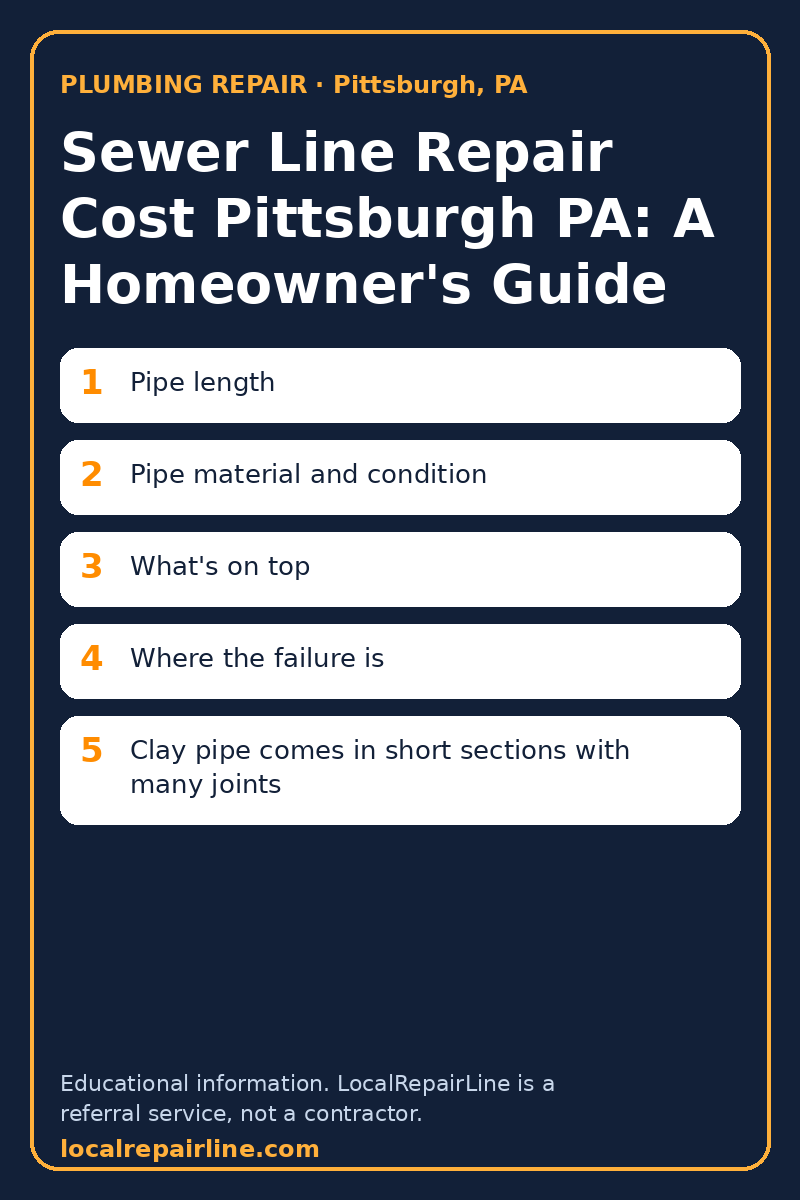
Spot Repair, Relining, or Full Replacement: How the Price Changes
These three options fit different problems. The right one depends on what the camera shows, not on which one sounds like the smaller bill.
Spot repair
If one section is cracked, offset, or collapsed and the rest of the pipe is sound, a plumber can dig down and swap just that piece. This is usually the smaller bill. It's also only a smart choice when the remaining pipe really is in good shape.
Relining (trenchless)
Relining pushes a resin-coated liner through the existing pipe, which then hardens into a new pipe inside the old one. It can save your yard, driveway, and landscaping, though the repair itself isn't always cheaper. It generally needs a pipe that's still mostly intact, so a badly collapsed or crushed line may rule it out.
Full replacement
When the pipe is cracked in many places, sagging, or crushed, replacement may be the only lasting fix. It costs the most up front. It can also cost less over time if you'd otherwise pay for repeated patches.
Trenchless methods like pipe bursting, which pulls a new pipe through as the old one breaks apart, sit between relining and open-trench replacement. Your plumber can tell you which methods fit your line.
Why Older Pittsburgh Homes Often Cost More to Fix
Many older homes in the Pittsburgh area have sewer lines that have been in the ground for a very long time. The material matters a lot.
- Clay pipe comes in short sections with many joints. Roots love those joints.
- Cast iron can corrode from the inside and flake or crack with age.
- Bonded fiber pipe, used in some mid-century homes, can soften, deform, and collapse. If your home has it, expect replacement talk rather than patch talk.
Then there's the weather. Pittsburgh winters are cold with regular snow, so the ground frosts and thaws again and again. That movement stresses buried pipe and can shift joints.
Spring brings heavy, frequent rain that saturates the soil. Weak spots in an aging line often show themselves then, as water finds the cracks and the pipe gets overloaded.
Summers are warm and humid, with thunderstorms. Those wet-dry swings keep soil moving around the pipe and encourage root growth toward any small leak. A hairline crack in a clay joint can turn into a root-packed blockage in a few seasons.
All of this means older homes tend to need more than a quick fix. The price goes up when the problem is a pipe that's worn out along its length, not a single bad spot.
Hidden Line Items That Surprise Homeowners
The pipe itself is only part of the bill. These are the line items that catch people off guard:
- Permits and inspections. Ask your local municipality whether your job needs a permit or an inspection, since the rules can differ from place to place.
- Restoration. Replacing a sidewalk slab, driveway section, or street cut can cost more than the pipe work above it.
- Landscaping. Trenching through gardens, shrubs, or mature trees leaves a mess that someone has to repair.
- Interior damage. If a backup already flooded a basement, cleanup and repairs are a separate cost.
- Ownership questions. The part of the line under a street or at the connection may belong to someone else.
That last one matters. Ownership rules differ by location, so the pipe you're responsible for may end at your property line or somewhere else, with the municipality or sewer authority covering the rest. The dividing line varies, so call your local municipality before you assume.
When you get the plan in writing, check whether it lists permits, excavation, pipe material, backfill, and restoration separately. If those are lumped into one vague number, ask for a breakdown.
Why a Camera Inspection Should Come First
A sewer camera is a small waterproof camera on a flexible cable. A plumber feeds it into the line and watches live video of the pipe's condition.
It shows cracks, root intrusion, sags, offsets, and collapses. It also shows how far along the pipe the damage runs, which is the question that decides repair versus replacement.
Skipping the camera can backfire. A homeowner pays for a quick patch at the first problem spot, then finds out the pipe is failing a few feet down. Now they've paid twice.
If you're buying a house, a sewer scope before closing can show you a problem while you still have room to negotiate. Ask for the recording, not just a verbal summary.
A solid written breakdown should include:
- The camera findings and where the problem sits along the pipe
- The proposed method (spot repair, liner, or replacement) and why
- Materials, permits, and restoration, spelled out
- What happens if the crew finds something unexpected once they dig
Signs Your Sewer Line May Need a Closer Look
Some sewer problems can wait for a proper inspection and written plan. These are worth paying attention to:
- Slow drains in several fixtures at once, not just one sink
- Sewage odors indoors or in the yard
- Wet, soggy, or sunken patches in the lawn, especially in dry weather
- Gurgling toilets or drains when you run water elsewhere
- Repeated backups, even if each one clears
If several of these sound familiar, ask a local plumber in the Pittsburgh area, such as one found through LocalRepairLine, about a camera inspection. It's the only reliable way to get an accurate written breakdown, and a plumber has to do it.
Don't keep pouring drain cleaner down a line that may be cracked or collapsed. It won't fix a broken pipe, so the problem is likely to come back.
FAQ
How much does it cost to replace a sewer line in Pittsburgh, PA?
It varies widely by house. Length, depth, pipe material, what's above the pipe, and restoration all change the total. Full replacement is the high end of sewer work, and you'll only get a real number after a camera inspection and a written breakdown.
Is trenchless sewer repair cheaper than digging up the yard?
Not always. Trenchless methods can save you from tearing up the lawn, driveway, or landscaping, which may offset a higher repair price. But they only work if the pipe is still in reasonable shape, so a camera inspection decides whether it's an option.
Does homeowners insurance cover sewer line repair?
Coverage depends on your policy, so read the wording closely for anything it says about sewer lines, wear, age, or root damage. Look in your policy for any wording on sewer lines or water backup. Read it and ask your agent before work begins.
Who is responsible for the sewer line between my house and the street?
Ownership rules differ by location, so the answer depends on your municipality or sewer authority. Where the responsibility switches can vary, sometimes at the property line and sometimes elsewhere. Contact your local municipality to confirm before you hire anyone.
Need a plumbing repair pro in Pittsburgh, PA?
Talk to an independent local contractor who serves your area.
📞 Call (833) 350-0420Plumbing repair in Pittsburgh, PACall hours: 8am–8pm ET, 7 days