Does Insurance Cover Frozen Pipes Columbus OH? What to Know
Searching "does insurance cover frozen pipes Columbus OH" usually means one of two things. Your pipes just froze or burst, or a hard cold snap is on the way. Either way, you want a straight answer.
It may, but your policy's wording decides it. How the pipe failed, what you did before and after, and what paperwork you have can change how much the insurer pays.
Does Insurance Cover Frozen Pipes Columbus OH? The Short Answer
Some homeowners policies cover sudden and accidental water damage from a pipe that froze and burst, but only your policy's wording can tell you for sure. That usually means the damage to your floors, walls, ceilings, and belongings.
Coverage tends to shrink or disappear when the loss looks like it came from neglect, and policy exclusions may apply. Think heat shut off, a vacant house, or a known problem left alone.
Every policy is different, so read yours or call your agent to confirm the details. Look for words like "sudden and accidental," "freezing," "vacancy," and "reasonable care."
Need a plumbing repair pro in Columbus, OH?
Talk to an independent local contractor who serves your area.
📞 Call (833) 350-0420Plumbing repair in Columbus, OHCall hours: 8am–8pm ET, 7 daysYour call may first be answered by a short screening service that asks what the problem is and where you are. Stay on the line and you will be connected to an independent local pro.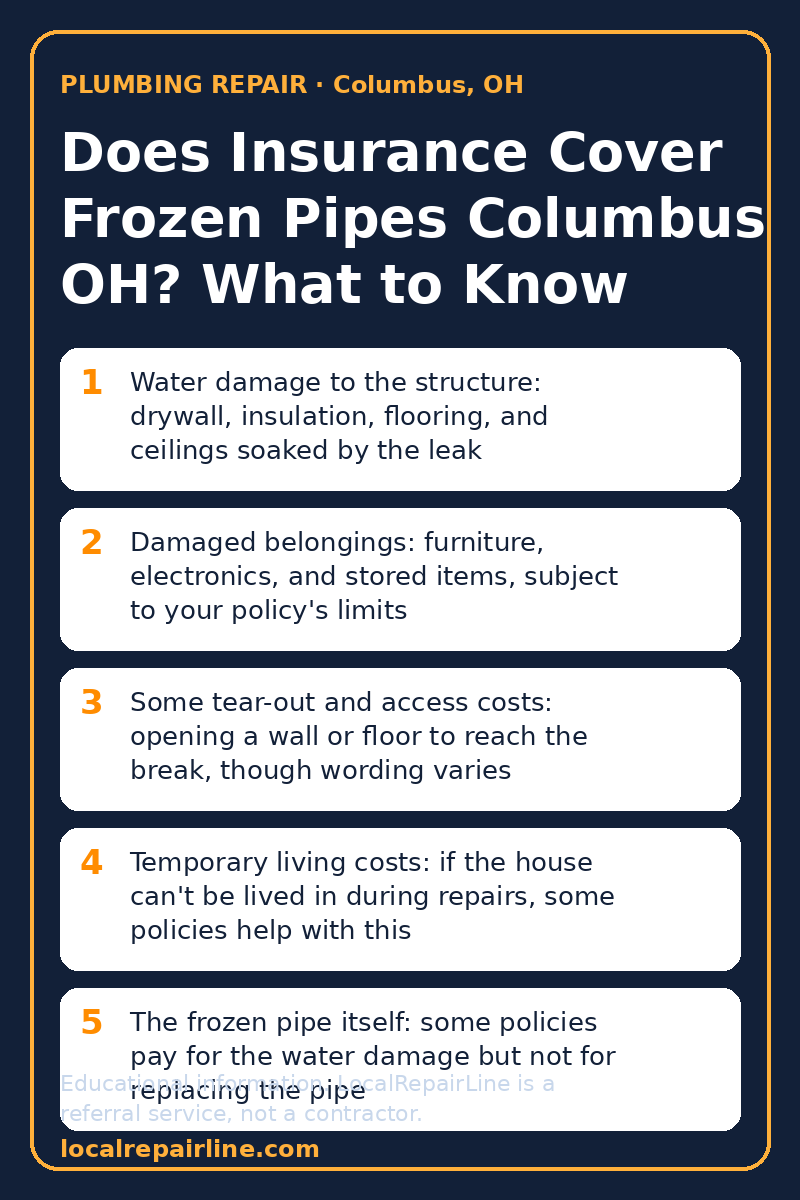
What a Columbus Policy Usually Pays For (and What It Doesn't)
Columbus has four real seasons, and winter can bring snow, ice, and sudden arctic drops. When a pipe fails, the damage can spread fast. Here is what policies commonly address:
- Water damage to the structure: drywall, insulation, flooring, and ceilings soaked by the leak.
- Damaged belongings: furniture, electronics, and stored items, subject to your policy's limits.
- Some tear-out and access costs: opening a wall or floor to reach the break, though wording varies.
- Temporary living costs: if the house can't be lived in during repairs, some policies help with this.
Here is what often isn't covered, or is covered only in part:
- The frozen pipe itself: some policies pay for the water damage but not for replacing the pipe.
- Slow leaks or long-term seepage: check your policy, since the wording may separate these from a sudden event.
- Damage from neglect: such as no heat in the house.
- Your deductible: a small leak can cost less to fix than your deductible, so filing may not pay off.
Repair costs vary by house. They depend on where the pipe is, how much water got out, and what it soaked.
Why the damage often shows up after the cold ends
Columbus can swing between freezing nights and milder afternoons, especially in late winter and early spring. Ice in a pipe can crack it without any water spraying out. The leak starts when the ice melts and water moves again.
So you might see no problem during the coldest days. Then a wet ceiling or a hissing wall shows up days later. It may still trace back to the freeze, and your plumber's findings can help document what happened.
Common Reasons Frozen Pipe Claims Get Denied or Reduced
Most problems come from a few avoidable gaps. Watch for these:
- Vacant or unoccupied home: many policies limit coverage if the house sits empty for a set period. Check your policy's definition of vacancy.
- Heat off or set too low: your policy may require you to keep the home heated, or to drain the water system if you leave. Check the wording.
- Skipped "reasonable care": this means taking sensible steps to protect the property, like keeping heat on, fixing known weak spots, and acting quickly once water appears.
- Delay in stopping the water: if water runs for hours or days, the extra damage may be treated as preventable, and your policy may expect you to limit further damage.
- No proof of cause: if no one can show where and why the pipe failed, the cause of the loss may be hard to establish.
- Unrelated or older damage: old stains and past leaks can muddy what's new.
Policies word "reasonable care" differently, so check how yours describes it. In general terms, it points to taking sensible steps: not ignoring obvious risks, and acting fast when something goes wrong.
What to Do in the First Hour: Protect Your Home and Your Claim
Stopping the water comes first, but the order you do things in matters. Safety comes before any claim paperwork.
- Shut off the main water valve. If you can't find it or it won't turn, call a plumber right away.
- Stay away from electrical hazards. If water is near outlets, the panel, or ceiling fixtures, turn off power only if you can do it safely, or call for help.
- Take photos and video before you clean up. Capture the broken pipe, wet areas, damaged items, and standing water.
- Move belongings out of the way. Protect what you can, and keep damaged items for the adjuster if possible.
- Start drying. Mop up, run fans, and open cabinet doors where it's safe.
- Call your insurer or agent. Report the loss and ask what they need from you.
- Keep every receipt. Emergency repairs, fans, and temporary fixes may be part of your claim.
Don't throw out the damaged section of pipe if the plumber removes it. Ask them to set it aside, since it may help show the cause.
Why a Plumber's Documentation Matters for Your Claim
A claim goes more smoothly when you can show what failed, where, and why. A plumber who inspects the break is in a good position to answer those questions in writing.
Ask for a short written note or invoice that covers:
- The exact location of the break (for example, an exterior wall, crawlspace, garage, or outdoor spigot line).
- The cause, in plain terms, such as ice expansion or a split from cold exposure.
- What work was done to stop the leak and make repairs.
- The date and time of the visit.
Pair that with your photos and receipts. Together they can help show the loss was sudden, you acted promptly, and the cause fits a cold-related failure.
This is the point to call a local plumbing pro in Columbus, OH instead of guessing, and localrepairline.com is one place to start. A plumber can shut off the water, thaw or repair the pipe, and document what they find. That helps protect your house, and the paperwork gives you something solid to share with your insurer.
Preventing Frozen Pipes During Columbus Cold Snaps
A sudden drop in temperature can stress pipes that handled earlier cold fine. Some parts of the house are more exposed than others:
- Exterior walls: especially where insulation is thin.
- Crawlspaces and basements: pipes near vents or rim joists.
- Garages: lines that run through unheated space.
- Outdoor spigots: disconnect hoses and shut off interior supply valves where you have them.
- Kitchen and bath sinks on outside walls: open the cabinet doors so warm air can reach the pipes.
Before a cold snap, keep the heat on and set to a steady temperature, even if you're away. Let a faucet drip on exposed lines during the worst nights. Seal drafts near pipes.
If you travel, ask your agent what your policy expects. Some want the heat maintained. Others may want the water shut off and drained.
When to Call a Local Plumber Instead of Waiting
Call a plumber if you see any of these:
- Water coming from a ceiling, wall, or floor.
- No water at a faucet during very cold weather. That can mean a frozen line.
- Bulging, frosted, or visibly cracked pipes.
- A sudden drop in water pressure after a cold night.
- A damp spot that appears after temperatures climb.
Thawing a pipe with open flame or high heat is risky. It can damage the pipe or start a fire. A plumber can thaw it safely, check for cracks, and tell you whether a repair is needed before the water comes back on.
Calling early often limits the damage, and it gives you written findings for your insurer.
FAQ
Does homeowners insurance cover burst pipes from freezing in Ohio?
Often, yes, when the burst is sudden and accidental. Coverage for the resulting water damage is common, but whether yours applies depends on your policy's wording. Check for exclusions tied to neglect, vacancy, or heat being off.
Will my insurance pay for the pipe itself or only the water damage?
Many policies pay for the water damage and some access or tear-out work, but not always for replacing the pipe. Wording varies a lot, so ask your agent exactly what's included. Costs vary by house and by where the break is.
Does insurance cover frozen pipes if the house was vacant or the heat was off?
It may not. Some policies limit or exclude coverage for vacant homes, and an insurer may question whether turning the heat off meets the reasonable-care expectations in your policy. Your agent can tell you how your policy treats both, so ask what steps it requires if you'll be away.
Should I call my plumber or my insurance company first for a frozen pipe?
If water is flowing, shut off the main valve and call a plumber first to stop the damage. Then notify your insurer promptly, and give them photos, receipts, and the plumber's written findings. Acting quickly shows reasonable care.
Need a plumbing repair pro in Columbus, OH?
Talk to an independent local contractor who serves your area.
📞 Call (833) 350-0420Plumbing repair in Columbus, OHCall hours: 8am–8pm ET, 7 days