Water Heater Leaking From Bottom in Lansing MI: What to Do Now
You typed water heater leaking from bottom Lansing MI into your phone because there's water on the floor and you want to know how bad it is. Fair question. The answer depends on where the water is actually coming from.
First, stop the water and the power. Then figure out whether you have a fitting that can be fixed or a tank that has failed inside.
Stop the Damage First: Shut Off Power, Gas, and Water Safely
Do this before you diagnose anything. Cutting off the supply first keeps the problem from growing while you figure it out.
If water is standing near outlets, a breaker panel, or the heater's electrical connections, stay out of it. Don't wade in. Shut off the power at the panel only if you can reach it while staying dry. Otherwise, call a plumber or electrician and tell them what you're seeing.
- Electric heater: Switch off the dedicated breaker at your panel.
- Gas heater: Turn the gas control knob to "Off" or "Pilot." If you smell gas, leave the house and call your gas utility's emergency line from outside.
- Cold water supply: Find the shutoff valve on the pipe feeding the top of the tank. Turn the handle until it stops. A lever handle should sit crosswise to the pipe when closed.
- Hot taps: Open a hot faucet upstairs to relieve pressure and slow the leak.
- Contain it: Set a bucket or wet-dry vacuum nearby. Move boxes, rugs, and stored items off the floor.
If the shutoff valve won't turn, don't force it. Use your main water shutoff instead. Look for it near where the water line enters the house, often close to the water meter.
Need a plumbing repair pro in Lansing, MI?
Talk to an independent local contractor who serves your area.
📞 Call (833) 350-0420Plumbing repair in Lansing, MICall hours: 8am–8pm ET, 7 daysYour call may first be answered by a short screening service that asks what the problem is and where you are. Stay on the line and you will be connected to an independent local pro.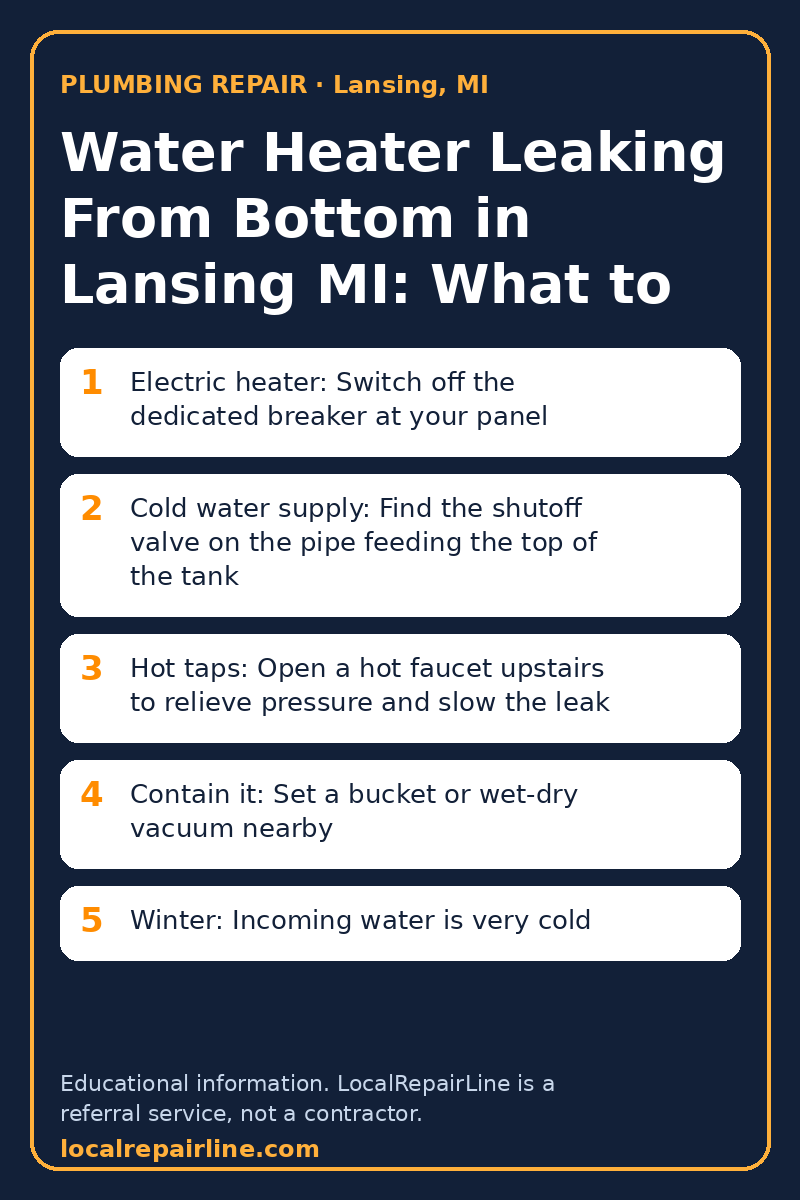
Is It Really a Leak? Condensation, Spring Dampness, or Tank Failure
In mid-Michigan, a puddle doesn't always mean a failed tank. Three local conditions can fool you.
- Winter: Incoming water is very cold. A gas heater working hard to heat it can produce condensation that drips from the burner area or flue.
- Spring thaw and heavy rain: Damp basements and groundwater seepage can leave water near a floor drain or along the wall. It can look like a heater leak when it isn't.
- Summer humidity: A cold tank and cold supply pipes can sweat and drip, especially in a closed-off utility corner.
The dry paper towel check
This simple test sorts most cases out.
- Dry the tank base, the drain valve, the pipe connections, and the floor under the unit.
- Wrap a dry paper towel around the drain valve and each pipe fitting.
- Slide a sheet of dry cardboard or a few fresh towels under the tank.
- Wait about an hour, then check again. For a slow leak, check again the next morning.
Where the towel gets wet tells you what's going on. Wetness only at a fitting points to a connection. Water at the end of the relief valve pipe points to the relief valve. Water coming from the tank's base or seam, with every fitting dry, points to the tank itself.
Also check whether the water is only appearing after a rainstorm, or only when the heater is firing. Rain-linked water often means seepage. Water that shows up only when the burner runs can be condensation.
Water Heater Leaking From Bottom Lansing MI: Common Causes
Several things can put water at the base of a tank. Some are small, and some aren't.
- Loose or worn drain valve: A slow drip from the spigot near the bottom. Sometimes it's a loose cap or a worn valve washer.
- Temperature-pressure relief valve discharge: This valve opens when pressure or temperature gets too high. The water usually runs down a pipe to the floor and can look like it's coming from underneath.
- Leaking pipe connections: Water runs down the outside of the tank from the top and pools at the base. It looks like a bottom leak but isn't.
- Electric element gasket: Electric tanks have heating elements behind small access panels. A bad gasket can drip down the side.
- Condensation: Common on gas units and on cold tanks in humid weather.
- Internal tank failure: Rust and sediment can eat through the steel lining and the tank wall. Water seeps from the seam or base, and it won't stop.
Hard water and sediment build-up wear on a tank over time. Add many Michigan winters of heating very cold water, and an aging tank is under steady stress.
Fixable Leaks vs. a Tank That Needs Replacing
Some leaks come from a part that can be fixed. Others mean the tank has reached the end of its life.
Usually fixable
- A drain valve that drips can often be tightened or swapped.
- A relief valve that discharges because of a failing valve, or because of high household water pressure, can be addressed. A plumber can sort out which one it is.
- A loose supply or hot-water connection can be tightened or re-sealed.
- Condensation can be managed, and often stops once the tank heats up.
Usually means replacement
- Water is coming from the tank's base or seam after the dry paper towel check ruled out the fittings.
- You see rust streaks, a damp insulation jacket, or water pooling on the burner compartment floor.
- The tank is old and also has rusty hot water or a rumbling sound from sediment.
This is the point to call a local plumbing pro in Lansing, MI instead of guessing. If the towel test shows water still coming from the base or seam after the drain valve and pipe connections are ruled out, the tank has likely failed internally. Once the steel has given way, a tank leak doesn't reverse, so the next step is a plumber from Local Repair Line confirming the source and talking through replacement.
Repair or Replace: What Affects the Cost
The worst money decision here is paying for a repair on a tank that's already failing inside. A new drain valve or heating element can't fix a rusted-through tank wall.
Costs vary by house, so here are the factors that matter.
- Tank age: The older the tank, the less sense it makes to spend on parts. Check the label for the manufacture date. A tank in its second decade deserves skepticism.
- Leak location: A fitting leak is often a repair. A leak from the tank body means replacement.
- Fuel type and venting: Gas units, electric units, and tight utility closets change the labor involved.
- Access and add-ons: Stairs, a finished basement, or an older install may add time and parts. Expansion tanks, new shutoff valves, and drain pans may be recommended.
- Water damage: If the floor or wall got wet, drying and repairs can cost more than the heater.
Ask the plumber a few direct questions. Where exactly is the leak coming from? Could a repair fail again in a few months? What would you do if it were your tank? A straight answer is a good sign.
Protecting Your Basement and Calling a Lansing Plumber
Basements hide leaks. A slow drip beside a finished wall, a storage shelf, or a floor drain can run for weeks before you notice the smell or the warped trim.
Prevent the next flood
- Drain pan: Put a pan with a drain line under the tank, if there's room and your plumber agrees.
- Floor drain: Keep it clear so a leak has somewhere to go. Don't stack boxes or stored items against the heater or over the drain.
- Leak alarm: A small battery-powered water alarm on the floor near the tank can warn you early.
- Regular look: Glance at the base, the fittings, and the relief valve pipe now and then, especially after winter.
When to make the call
If the leak is steady, the water is coming from the tank itself, or you can't tell where it's from, call a plumber. Describe what the paper towel test showed. That saves time and helps them come prepared.
FAQ
Is a water heater leaking from the bottom always a failed tank?
No. Water that runs down from a loose fitting, a relief valve pipe, or condensation can pool at the base and look like a tank leak. Run the dry paper towel check first. If the fittings stay dry and water still seeps from the base or seam, the tank has likely failed.
Can I keep using the water heater while it leaks?
It's safer not to. Shut off the power or gas and the cold water supply, then have it looked at. A leaking tank may get worse over time, and a heater running without a full tank can be damaged, so leave it off until someone has checked it.
How can I tell condensation from a real leak?
Condensation tends to show up on gas units in cold weather, or on cold tanks in humid weather, and often stops once the tank warms up. A real leak keeps going no matter the season or whether the burner is running. Dry everything and check again after an hour and the next morning.
How much does it cost to fix or replace a leaking water heater?
Costs vary by house. Tank age, leak location, fuel type, venting, access, and any water damage all affect the total. A fitting repair is a smaller job than a replacement, but a leak from the tank body means replacement is the sensible route.
Need a plumbing repair pro in Lansing, MI?
Talk to an independent local contractor who serves your area.
📞 Call (833) 350-0420Plumbing repair in Lansing, MICall hours: 8am–8pm ET, 7 days