Water Heater Leaking From Bottom? Grand Rapids, MI Guide
Typing "water heater leaking from bottom Grand Rapids MI" into your phone usually means one thing: there's water on the floor and you want answers now. Some bottom leaks are a loose fitting you can sort out in minutes. Others mean the tank has failed and it's time to plan a replacement.
This guide helps you tell them apart, stop the water safely, and avoid paying twice for the same problem.
Is a Leak From the Bottom of Your Water Heater an Emergency?
How serious it is depends on how much water you see and where it's coming from. A steady stream or a growing puddle means it's time to shut off the water and the power or gas, then work out where the water is coming from. A few drops that dry up on their own may be condensation.
Either way, don't ignore it. Leaks rarely fix themselves, and water near electrical parts or gas controls is a safety concern worth taking seriously.
If you smell gas, skip everything below. Leave the house and call your gas utility's emergency line from outside.
Need a plumbing repair pro in Grand Rapids, MI?
Talk to an independent local contractor who serves your area.
📞 Call (833) 350-0420Plumbing repair in Grand Rapids, MICall hours: 8am–8pm ET, 7 daysYour call may first be answered by a short screening service that asks what the problem is and where you are. Stay on the line and you will be connected to an independent local pro.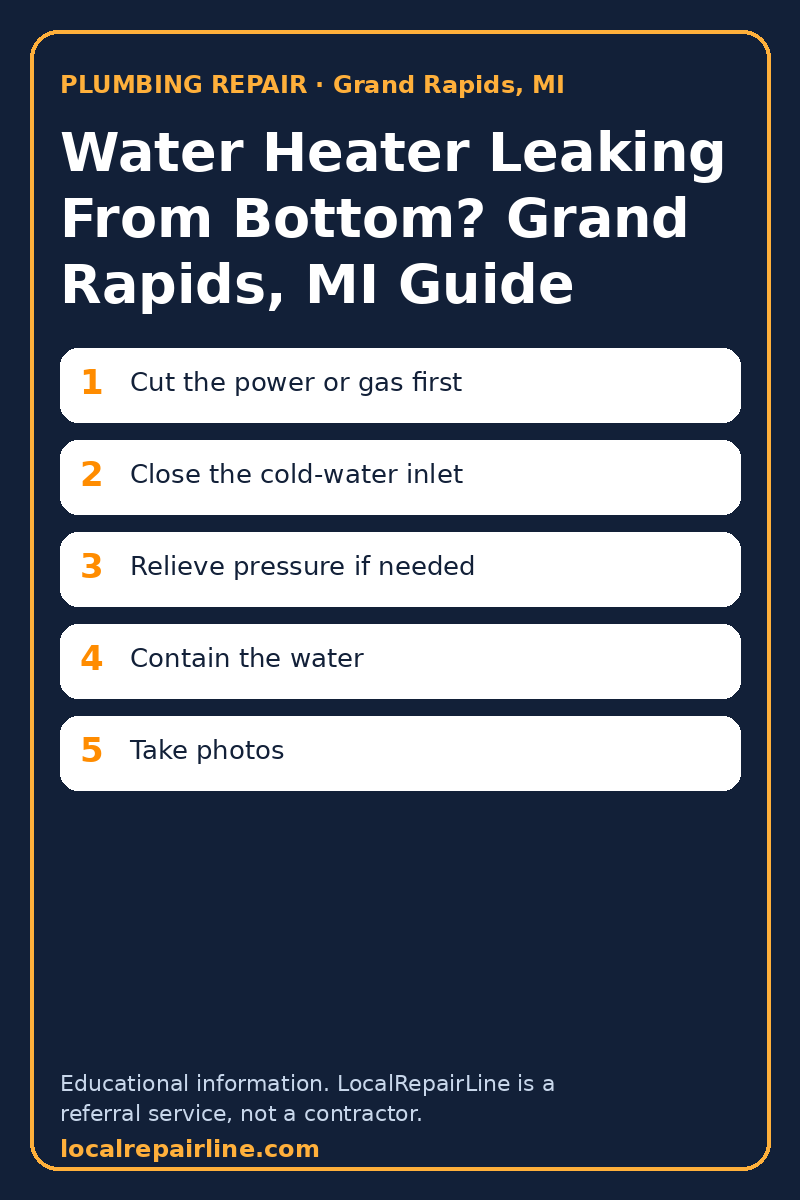
First 10 Minutes: How to Shut Off Water, Power and Gas Safely
Work through these in order. Keep your feet out of standing water.
- Cut the power or gas first. For an electric heater, turn off its breaker, but only if you can reach the panel without stepping through water. If you can't, stay out and call a plumber or electrician. For a gas heater, turn the gas control knob to "off" or "pilot," or close the gas shutoff on the supply line.
- Close the cold-water inlet. Look for a valve on the pipe at the top of the tank and turn it clockwise until it stops. A lever handle is closed when it sits crosswise to the pipe.
- Relieve pressure if needed. Open a hot faucet upstairs. This helps the system stop pushing water toward the leak.
- Contain the water. Use towels, a wet/dry vac or a bucket. Move boxes, rugs and anything absorbent away from the area.
- Take photos. Wet floors, stored items and the tank's label may matter later for your records or an insurance conversation.
If you can't find the shutoff valve or it won't turn, close the main water shutoff for the house. In many Michigan homes it sits near where the water line enters the basement.
Hot water can scald. Don't open the drain valve to empty the tank unless the water has had time to cool and you have a hose running to a floor drain or outdoors.
Water Heater Leaking From Bottom Grand Rapids MI: Where the Water Is Really Coming From
Water pooling at the base doesn't always start at the base. It can run down the jacket from higher up, so check each source before you decide the tank is finished.
Start by drying everything with a towel. Then watch for a while, or tuck dry paper towels or cardboard around the tank. This shows you exactly where new water appears.
Condensation
Incoming water in a Grand Rapids winter is very cold. A cold tank or cold pipes in a humid basement can sweat, especially after heavy hot water use. Gas units can also drip a little from the burner area when they heat up from a cold start.
Condensation looks like beads of water across a wide area, not a steady drip from one spot. It often shows up during heavy use and then dries up. In spring, when thaw and rain add moisture to the basement, it's easy to confuse with groundwater or a leak.
Relief valve discharge
The temperature and pressure relief valve has a pipe that runs down the side of the tank, usually ending near the floor. If water drips from the end of that pipe, the valve is doing its job or is worn out.
Causes include high pressure, excess heat or a valve that no longer seats right. Don't cap or plug the pipe. That valve is a safety device, and a plumber should evaluate it.
Drain valve and fittings
The drain valve sits low on the tank, so a drip there lands right at the base. A loose valve or a worn plastic one can seep. Gently snug it, and if a hose cap is missing, check that too.
Also look at the connections on top of the tank, plus the hot and cold lines and any shutoff valves. A weeping fitting up high can drip down the jacket and look like a bottom leak.
On electric units, check the small access panels on the side for wet insulation. A leaking heating element gasket is sometimes repairable.
A failed tank
Look for these signs:
- Water coming from under the jacket or from the base itself, with every fitting and valve dry
- Rust-colored streaks or flaking metal at the bottom
- Wet insulation inside the jacket
- A leak that keeps coming back after you dry everything
- A puddle that grows even with the water supply turned off to the house fixtures
That last pattern is the main one that separates a dead tank from a fitting problem.
Why Tank Leaks Can't Be Patched (and When a Repair Still Makes Sense)
Inside the steel tank is a glass lining meant to keep water away from the metal. Over time, the lining wears and the steel corrodes through. Once water seeps out of the tank itself, there's no reliable patch. Sealants and epoxy won't hold against heat, pressure and expansion.
This is the point to talk to a local plumbing pro in Grand Rapids, MI, such as Local Repair Line, instead of guessing. If you've checked the fittings, relief valve and drain valve, and water still comes from under the base or jacket, the tank has failed internally. Keep the water shut off and call someone to confirm it and walk you through replacement.
A repair does make sense when the source is something other than the tank:
- A worn drain valve
- A loose or corroded supply fitting
- A relief valve that needs replacing
- A leaking element gasket on an electric unit
Even then, think about age. If the tank is old, a repair might buy a short stretch before the next failure. Check the label for a date code, and ask the plumber for an honest read on its remaining life.
Basement Water Heaters in Michigan: Protecting Floors, Drains and Stored Items
Many Michigan homes put the water heater in the basement. That's tidy, but it means a slow leak can run for weeks with nobody around to notice.
Water takes the easy path. It can head for a floor drain, creep under a finished wall or flow toward a sump pit. A sump pit that quietly handles the water can hide the problem until the pump runs more than usual.
In winter, the stakes go up. Your heater works harder with very cold incoming water, and going without hot water during a lake-effect snow week is no fun. Failures also tend to show up under heavy use.
A few habits help:
- Look at the base of the tank every few weeks, and after thaw or heavy rain.
- Keep cardboard boxes and fabric off the floor near it.
- Check that the floor drain isn't blocked.
- Know where your water shutoff and electrical panel are before you need them.
If water reached carpet, drywall or stored items, dry things out fast. Standing dampness invites mold. Ask your plumber or a drying specialist what to pull out, and talk to your insurer about whether the damage is covered.
Repair vs. Replace: What to Expect on Cost and Timing
Costs vary by house, so be wary of anyone who names a flat number without seeing your setup.
Repairing a valve or fitting generally costs less than replacing a tank, though costs vary by house. Replacing a tank is the bigger job, and several things move the total:
- Tank size and type (standard, high-efficiency, or tankless)
- Gas versus electric, and any venting or gas line changes
- How hard it is to get the old tank out and the new one in, such as a tight basement staircase
- Extra parts the new tank may need, like an expansion tank, a new relief valve, or updated connectors
- Hauling away the old unit
One risk is patching an older tank, then having it fail again soon after. You could end up paying for the repair and the replacement, plus cleanup. If the tank is aging and showing rust, replacing it usually makes more sense than repairing it.
Timing depends on availability and parts. How long the install takes depends on the heater type and your home's layout, and scheduling can shift with the season. Ask what's realistic for your situation before you commit.
FAQ
Is it safe to keep using a water heater that's leaking from the bottom?
It's not a good idea. Leaking water can reach electrical parts or gas controls, and a failing tank can get worse quickly. Shut off the power or gas and the cold-water supply, then figure out the source.
Can I seal a leaking tank with epoxy or sealant?
No. Once water is coming through the tank itself, sealants won't hold up against heat, pressure and expansion. A patch may slow the leak for a short time, but the tank needs to be replaced.
Why does my water heater only drip when it's heating up?
It could be condensation, especially with cold incoming water in winter. It could also be the relief valve releasing pressure as the water expands. If the drip comes from the relief valve pipe, have a plumber check it rather than capping it.
How can I tell how old my water heater is?
Look at the label on the tank for a date code or serial number. The format varies by maker, so a plumber can help you read it if it's confusing. Age matters when you're deciding between a repair and a replacement.
Will my homeowners insurance cover water heater leak damage?
Policies differ, so check yours or call your insurer. Coverage can depend on what your specific policy says about the cause of the damage. Keep your photos and any repair paperwork handy when you ask.
Need a plumbing repair pro in Grand Rapids, MI?
Talk to an independent local contractor who serves your area.
📞 Call (833) 350-0420Plumbing repair in Grand Rapids, MICall hours: 8am–8pm ET, 7 days