Pipe Burst in Basement South Bend IN: What to Do Right Now
If you're searching for pipe burst in basement South Bend IN what to do, you're probably standing at the top of the stairs looking at water. Take a breath. The order you do things in matters, and the first few steps are about safety, not mopping.
Here's a sensible order to work in: your safety first, your house second, and your insurance paperwork third.
Pipe Burst in Basement South Bend IN What to Do: The First 5 Minutes
Before you touch anything, look at where the water is and where your electrical panel, outlets, furnace, and water heater sit. Water and electricity are the biggest danger in a flooded basement, bigger than the water itself.
Work through this checklist:
- Stay out of standing water if it's near outlets, the panel, a sump pump cord, or any plugged-in appliance. The power may still be live.
- Shut off the main water valve if you can reach it without stepping in water.
- Cut power only if it's safe. If the panel is in a dry spot and you can reach it on dry footing, you can switch off the breakers for the basement. If the panel is wet, or you'd have to wade to it, don't go near it.
- Call your electric utility or an electrician if water is near the panel or meter and you can't safely cut power.
- Leave and call for help if you smell gas near the furnace or water heater.
Everything else can wait. Stopping the water and avoiding shock come before photos, towels, or buckets.
Need a plumbing repair pro in South Bend, IN?
Talk to an independent local contractor who serves your area.
📞 Call (833) 350-0420Plumbing repair in South Bend, INCall hours: 8am–8pm ET, 7 daysYour call may first be answered by a short screening service that asks what the problem is and where you are. Stay on the line and you will be connected to an independent local pro.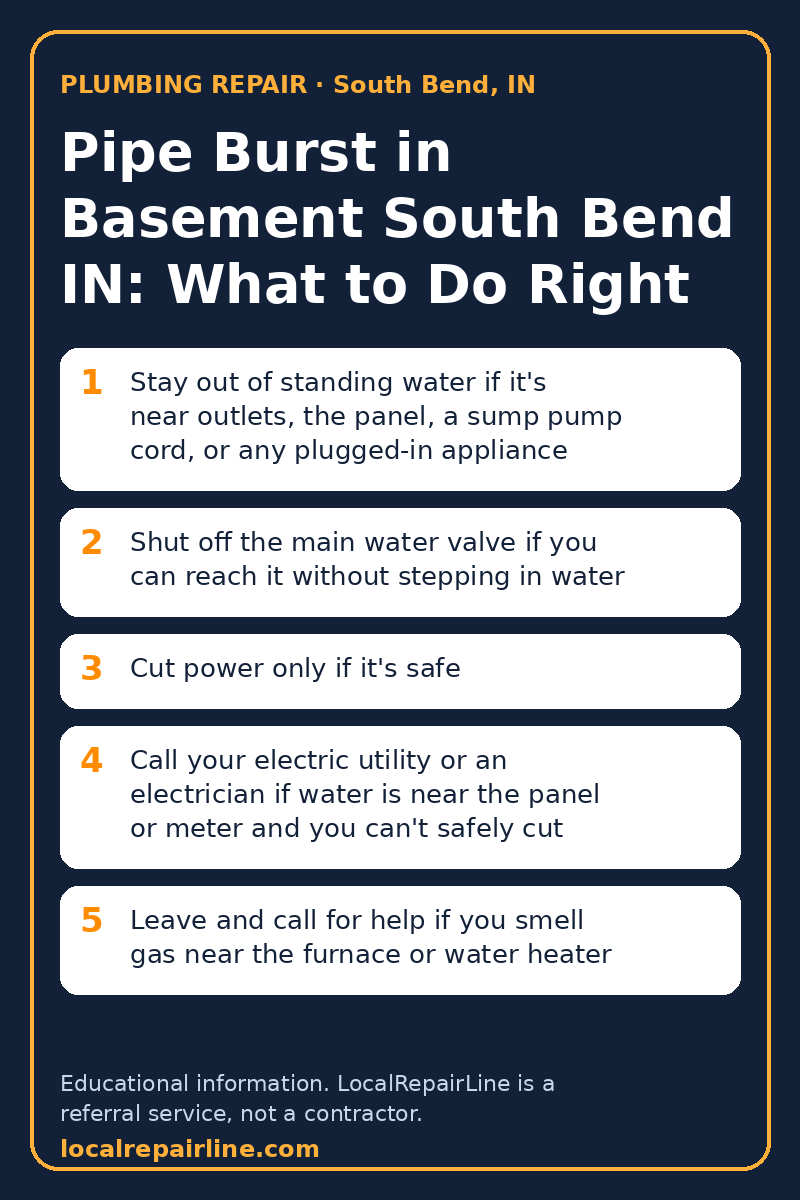
How to Find and Shut Off Your Main Water Valve in a South Bend Basement
In most homes, the main shutoff is where the water line enters the house. Check the basement wall that faces the street, often near the water meter and the water heater. Some sit in a utility corner or crawl area.
There are two common types:
- Ball valve (lever handle): Turn the handle a quarter turn so it sits crosswise to the pipe. That's closed.
- Gate valve (round wheel): Turn it clockwise, several full turns, until it stops. Don't force it past that.
Once it's closed, open a faucet on the top floor to drain the line and ease the pressure. Then check whether the flow in the basement slows or stops.
If there's a second valve on the street side of the meter, that one usually belongs to the water utility. Don't wrench on it.
Stop here and call a plumber if...
This is the point to talk to a local plumbing pro in South Bend, IN instead of guessing, and LocalRepairLine is one place to start. Make the call if any of these are true:
- Water is still flowing after you close the main.
- The valve is stuck, leaking at the handle, or won't turn without force.
- The split is inside a wall or ceiling and you can't see it.
- Water is near the electrical panel, furnace, or water heater.
- You can't tell where the water is coming from.
A stuck valve is a real problem, not a nuisance. Forcing an old valve can snap it and make the flood worse. A plumber can shut things down at the right spot and fix the valve too.
Is It a Burst Pipe, a Frozen Pipe, or Groundwater? How to Tell
Not every wet basement is a burst pipe. Spring in the South Bend area is often wet, with saturated ground and heavy rain, and seepage can look a lot like a plumbing leak.
Here are some clues that help sort it out:
- Burst or split pipe: Water sprays, drips, or runs from a pipe or fitting. It keeps coming even on a dry day. It usually stops, or slows sharply, once the main is closed.
- Frozen pipe: A faucet gives you a trickle or nothing. You may see frost on an exposed pipe near an outside wall. It may not be leaking yet.
- Groundwater seepage: Water creeps in at the floor edge or where the wall meets the slab. It often shows up after heavy rain or snowmelt and can look muddy. Your water use isn't the cause.
A simple test helps. With the main shut and no one running water, see if the wetting continues. If it does and the weather has been rainy, groundwater is a likelier cause, and that's a drainage problem rather than a plumbing one.
If a pipe is frozen but hasn't leaked, leave the main closed until someone has looked at it. Never use an open flame to thaw it.
What to Do While Water Is Standing in the Basement
Once the main is off and the electrical risk is handled, you can start limiting damage. Keep it simple.
Move what you safely can: boxes, rugs, and anything cardboard or fabric. Lift items onto shelves or upstairs. Leave heavy furniture alone if you'd have to wade through water to reach it.
Don't plug in a wet-dry vacuum or a box fan if you're standing in water or if the outlets are wet. Use a pump or a vac only on a dry, safe circuit with a properly grounded cord, and keep the cord out of the water.
If your sump pump is running normally, leave it alone. If it's submerged or the power is off, don't touch it.
Open upstairs windows only if the weather allows. In a deep cold snap, you don't want to chill the rest of the house and stress more pipes.
Document the Damage Before You Clean Up
It feels backward to take photos before cleaning, but your insurance claim will thank you. Do this once the area is safe to be near.
- Take wide photos of each room, then close-ups of the pipe and wet areas.
- Shoot a slow video that pans the whole basement.
- Photograph the water line on walls and any damaged belongings.
- Save the failed pipe section if the plumber removes it. Ask them to set it aside.
- Keep the plumber's notes and invoice. They describe the cause and repair, which can be handy to have when you talk with your insurance company.
Then call your insurance company. Policies vary in how they treat a sudden pipe break compared with groundwater seepage or surface flooding, so the cause of the water may affect your claim. Read your policy or ask your agent what's covered and what isn't.
Why Pipes Burst in South Bend Winters (and the Thaw Surprise)
South Bend sits near Lake Michigan, so winters bring lake-effect snow and long stretches of cold. Basement plumbing along exterior walls, near rim joists, or by drafty windows takes the worst of it.
Here's the part people miss. A pipe often splits while it's frozen, but the ice acts like a plug. Nothing leaks until the ice melts.
Northern Indiana can swing from a below-zero cold snap to a quick warm-up. When the pipes thaw, the water comes through the split. That means the worst flooding can start hours after the cold breaks, sometimes when no one is looking at the basement.
After a hard freeze, check your basement as the weather warms. Look along exterior walls and around the water heater and meter.
Don't just patch one spot
A clamp, wrap, or push-on fitting can stop a small split for the moment. But if a pipe split from ice, the runs around it have gone through the same stress. They may be thinner or stretched, even if they look fine.
A patch may hold, or it may just move the failure a few feet down the line. Ask the plumber to check the nearby pipe and fittings, and talk through whether replacing a longer stretch makes sense. Costs vary by house, and the right call depends on pipe age, the pipe material, and how much of the run sat in the cold.
FAQ
Should I shut off the power to my basement?
Only if the panel is dry and you can reach it on dry footing. If water is near the panel or meter, stay back and call your electric utility or an electrician.
Will insurance cover a burst pipe?
It depends on your specific policy, and the cause of the water may affect what's covered. Read your policy or ask your agent before repairs begin, and take photos first.
How soon should I start drying things out?
Start as soon as the area is safe, because materials that stay wet can develop mold. Costs vary by house, so ask a plumber or restoration pro what your walls and flooring need.
What if the pipe is frozen but not leaking?
Leave the main closed until someone has looked at it, and never use an open flame to thaw it. A plumber can check for hidden splits before the ice melts and the water starts to flow.
Need a plumbing repair pro in South Bend, IN?
Talk to an independent local contractor who serves your area.
📞 Call (833) 350-0420Plumbing repair in South Bend, INCall hours: 8am–8pm ET, 7 days