Does Insurance Cover Frozen Pipes in Kalamazoo, MI? Key Facts
You typed something like "does insurance cover frozen pipes Kalamazoo MI" into a search bar, so you're probably standing near a cold wall or a dry faucet. Here's the short version: the first question to ask is whether the pipe actually burst, because that can change how your policy applies. A policy that pays for sudden water damage from a burst pipe may not pay for a pipe that's merely frozen. The details in your policy matter a lot.
This guide covers what tends to be paid, what tends to be denied, and what to do in the first hour so you don't weaken your own claim.
Does Insurance Cover Frozen Pipes in Kalamazoo, MI? The Short Answer
It depends on whether the pipe has burst.
A frozen pipe that hasn't burst is a maintenance problem. Your policy may treat thawing it as your own cost, because no sudden damage has happened yet.
A burst pipe that suddenly floods your kitchen, basement, or ceiling is different. Your policy may cover the resulting water damage, such as soaked drywall, flooring, and cabinets. That coverage usually comes with conditions, and your deductible applies.
Policies differ from company to company. Read yours, or ask your agent to point you to the sections on "sudden and accidental" water damage and freezing.
Need a plumbing repair pro in Kalamazoo, MI?
Talk to an independent local contractor who serves your area.
📞 Call (833) 350-0420Plumbing repair in Kalamazoo, MICall hours: 8am–8pm ET, 7 daysYour call may first be answered by a short screening service that asks what the problem is and where you are. Stay on the line and you will be connected to an independent local pro.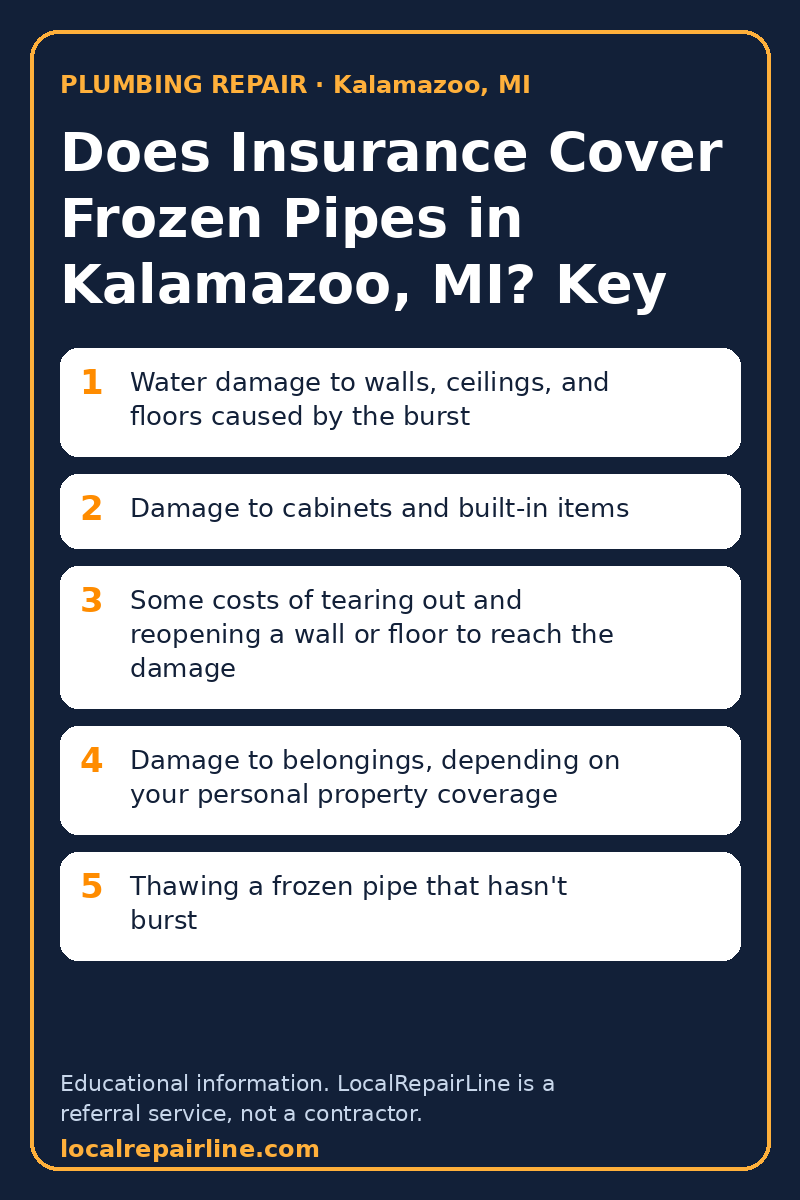
What's Usually Covered vs. Denied After a Pipe Bursts
Kalamazoo gets lake-effect snow, below-zero nights, and sharp swings between cold and thaw. Pipes in exterior walls and crawl spaces take a beating in that kind of weather. When one splits, here's how things commonly sort out.
Often covered (check your policy):
- Water damage to walls, ceilings, and floors caused by the burst
- Damage to cabinets and built-in items
- Some costs of tearing out and reopening a wall or floor to reach the damage
- Damage to belongings, depending on your personal property coverage
Often not covered:
- Thawing a frozen pipe that hasn't burst
- Replacing the split section of pipe itself (a policy may treat this as the repair of the failed part)
- Damage the insurer says came from neglect or lack of maintenance
- Slow leaks or moisture that went unaddressed for a long time
- Flooding from outside the house, which is a separate type of coverage
The pipe repair itself is the cost people regret most. Your policy may pay for the mess the water made but not for the pipe that caused it. Costs vary by house, depending on how hard the pipe is to reach and how much of the line is damaged.
Why Claims Get Denied: Heat, Maintenance, and Vacant-Home Clauses
Certain clauses can decide a claim. Know them before winter, not after a loss.
Failure to maintain heat
Your policy may expect you to keep the house heated enough to protect the plumbing. If you turned the thermostat way down to save on bills, or the furnace quit and nobody noticed, an insurer may argue you didn't take reasonable care.
Policy language is often vague about a specific temperature. So the safest habit is to keep the heat on at a steady, moderate setting through cold snaps, even when you're out.
Vacancy and travel clauses
If you're away for a stretch of winter, some policies limit coverage after the home has been unoccupied or empty for a set period. Snowbird trips and long holiday travel can trigger this. Ask your agent how your policy defines "vacant" and "unoccupied," and what steps they expect, such as having someone check the house.
Neglect and wear
A pipe that was already leaking, corroded, or left exposed in an unheated crawl space can lead to a "neglect" argument. Your policy may ask whether the problem was foreseeable and preventable.
This is where Kalamazoo's older homes come in. Plumbing in uninsulated exterior walls or crawl spaces is more exposed to repeated cold-and-thaw cycles. If an adjuster sees a long-known weak spot, expect questions.
What to Do Right Away When Pipes Freeze in a Kalamazoo Winter
Speed matters, and so does the order. Here's a simple first-hour sequence:
- Shut off the main water supply. Know where the valve is before you need it. Turning it off stops the flow into a split line.
- Turn off electricity to wet areas if water is near outlets, appliances, or the panel, and only if you can do so safely. If in doubt, stay out and call for help.
- Take photos and video of the pipe, the water, and all damage before you move anything.
- Start reasonable cleanup. Remove standing water, move belongings, and run fans or dehumidifiers. Many policies ask you to take reasonable steps to limit further damage, so check your wording. Damage that grew because you waited could be disputed.
- Keep receipts for anything you buy or hire to protect the house.
- Call a plumber, then your insurance company. You can call both quickly, but the plumber is the one who stops the problem.
When to stop guessing and call a plumber
If water is already leaking, a pipe looks bulging or split, or no water comes out of the taps during a cold snap, this is the moment to call a local plumbing pro in Kalamazoo, MI through localrepairline.com instead of guessing. Shut off the main first.
A plumber can stop the damage, find where and why the pipe failed, and write up what they found and fixed. That written record is what your claim needs.
Don't take a torch or open flame to a pipe. It's a fire risk, and it can make a weak pipe fail.
How to Document Damage and Work With Your Plumber and Adjuster
Claims go smoother when the story is clear and backed by paper. Think of it as three pieces: what failed, why, and what it cost.
Ask your plumber for a written note or invoice that covers:
- Where the pipe failed and what type of pipe it was
- The likely cause, such as cold exposure in an exterior wall or crawl space
- What repair was done and the date
- Any conditions they noticed, like missing insulation or a drafty gap
Keep this next to your photos, receipts, and a simple log of dates and phone calls with your insurer.
When the adjuster visits, show them everything, including the failed pipe if the plumber kept it. Be honest about the thermostat setting and recent travel. A clear, honest account backed by records leaves less room for confusion than one with gaps.
One more thing: watch for slow damage. Late-winter thaws can reveal a split line only once temperatures rise and water starts flowing. Drywall can stay damp behind a wall, and mold can show up weeks later. Tell your adjuster about hidden moisture as soon as you suspect it, and don't assume the first inspection caught everything.
Preventing Frozen Pipes in Older Kalamazoo Homes
Prevention is cheaper than a claim, and it keeps your record clean. Focus on the weak spots in older houses:
- Insulate exposed pipes in crawl spaces, basements, garages, and along exterior walls
- Seal drafts around rim joists, vents, and where lines enter the house
- Keep the heat on at a steady setting, even when you travel
- Open cabinet doors on exterior walls during cold nights so warm air reaches the pipes
- Let a faucet drip during extreme cold on lines that have frozen before
- Disconnect and shut off outdoor spigots before hard cold arrives
- Know your main shutoff and make sure everyone in the house can find it
If a particular pipe froze once, it will likely do it again. A plumber can look at rerouting or better protecting that run. Costs vary by house, based on access and how much of the line needs work.
When to Call a Local Plumber Instead of Waiting on the Claim
Don't wait for an insurance answer to deal with an active problem. Claims can take time, and water keeps spreading while you wait.
Call a local plumber when you see water, a split or bulging pipe, or a dead faucet in the cold. Also call if a pipe thawed on its own and you're unsure whether it cracked. A small split can stay hidden until the weather warms.
You can sort out the claim with the plumber's report in hand. Stopping the damage first protects both your home and your claim.
FAQ
Does homeowners insurance cover a burst pipe from freezing?
It may, for the resulting water damage, depending on your policy wording, such as whether the burst was sudden and whether you kept up reasonable care. The pipe repair itself may not be covered, and your deductible applies. Check your policy language or ask your agent.
Will insurance pay to thaw or repair a frozen pipe?
That depends on your policy, but a pipe that's only frozen and hasn't burst may not count as covered damage yet. Check whether your policy lists thawing and basic pipe repair as covered or treats them as ordinary home maintenance. If the pipe does split and causes sudden water damage, the damage may be covered even when the pipe repair is not, so check your policy and talk with your agent.
Need a plumbing repair pro in Kalamazoo, MI?
Talk to an independent local contractor who serves your area.
📞 Call (833) 350-0420Plumbing repair in Kalamazoo, MICall hours: 8am–8pm ET, 7 days