Does Insurance Cover Frozen Pipes in Lansing, MI? What to Know
Searching "does insurance cover frozen pipes Lansing MI" usually means one of two things. Water is already where it shouldn't be, or a hard cold snap is coming and you're nervous. Either way, the answer depends on a few details that are easy to miss.
This guide covers what policies tend to pay for, what can get claims denied, and the order of steps that protects you. It also covers the tricky case of a pipe that's frozen but hasn't burst yet.
Policies differ, so treat this as a general guide and not a read on your specific coverage.
Short Answer: Does Insurance Cover Frozen Pipes Lansing MI Homeowners Worry About?
It can, when a pipe bursts suddenly and water damages your home, but it depends on your policy. Some homeowners policies treat a sudden burst as a covered event, usually if you kept up the home and took reasonable care, so check your policy wording.
The key word is sudden. Many policies are written to cover abrupt, accidental damage. Yours may also list exclusions for slow leaks, neglect, or damage that could have been prevented.
A pipe that's only frozen is a different story. If nothing has burst and nothing is wet, there may be no damage to claim, and the plumbing repair could fall on you. More on that below.
Need a plumbing repair pro in Lansing, MI?
Talk to an independent local contractor who serves your area.
📞 Call (833) 350-0420Plumbing repair in Lansing, MICall hours: 8am–8pm ET, 7 daysYour call may first be answered by a short screening service that asks what the problem is and where you are. Stay on the line and you will be connected to an independent local pro.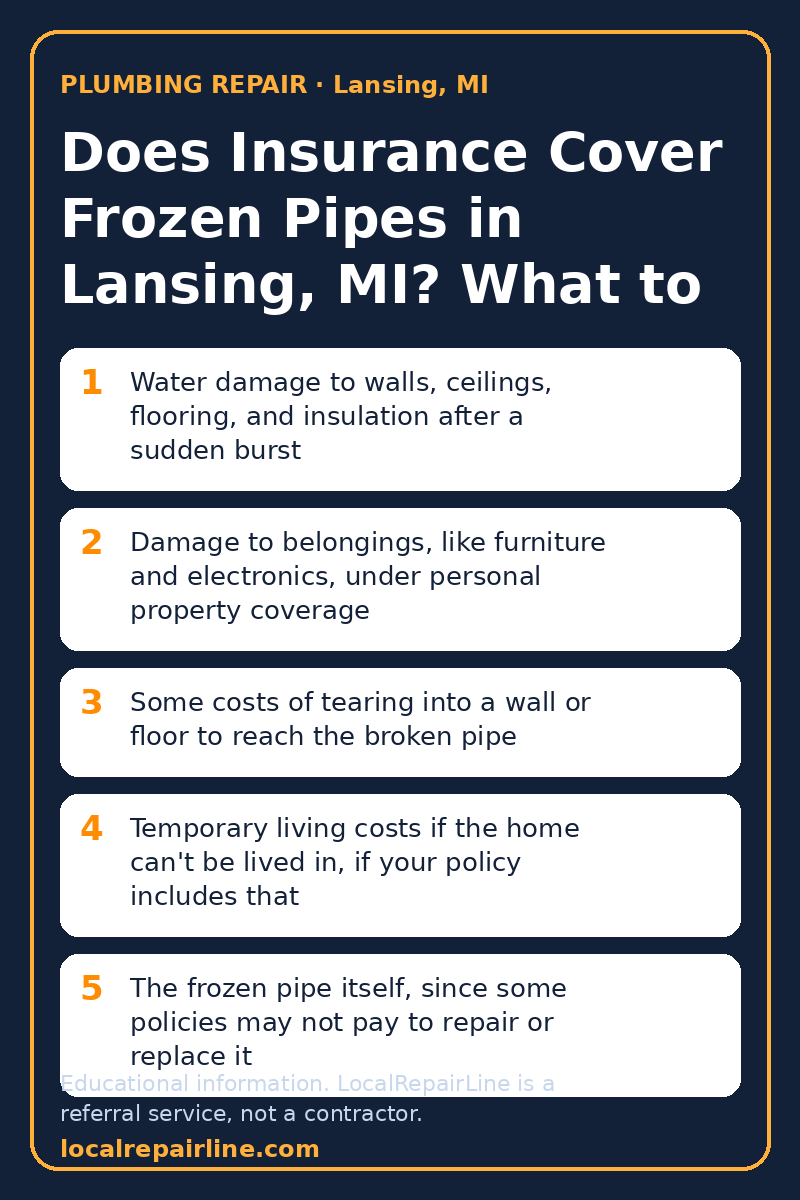
What Policies Often Cover (and What They Often Don't)
Think of coverage in two buckets: the damage the water does, and the pipe itself. Your policy language controls the details, but here is a common pattern.
Often covered, depending on your policy:
- Water damage to walls, ceilings, flooring, and insulation after a sudden burst
- Damage to belongings, like furniture and electronics, under personal property coverage
- Some costs of tearing into a wall or floor to reach the broken pipe
- Temporary living costs if the home can't be lived in, if your policy includes that
Often not covered, or only partly:
- The frozen pipe itself, since some policies may not pay to repair or replace it
- Damage from a leak that went on for a long time
- Damage tied to neglect, such as heat left off
- Flooding from outside the house, which is usually a separate type of coverage
- Your deductible, which you pay before the insurer pays anything
Whether a deductible makes a small claim worth filing is worth thinking through. Costs vary by house, and a minor repair may land below your deductible anyway. A big water mess may well exceed it.
Common Reasons Frozen-Pipe Claims Can Get Denied
A claim can be denied when the loss doesn't fit what the policy covers, or doesn't look sudden and accidental. Here are some common sticking points.
Heat was off or set very low
Many policies expect you to take reasonable care of the home. If it sits cold during a Lansing deep freeze, that expectation may come into question. Some policies also call for keeping the home heated or shutting off and draining the water system if you're leaving.
The home was vacant or seasonal
If your home is empty or seasonal, your policy may have special conditions, so read yours closely. If you were away for a stretch and no one checked on the place, how long the water ran can become a major question.
Slow or ongoing leaks
A drip behind a wall that has been wetting drywall for weeks looks like maintenance, not an accident. That's why finding the leak early matters.
Missing proof of cause
If there's no clear record of what failed and why, the cause can be hard to establish. Cleaned-up, repaired, and thrown-away evidence can make a claim harder to support.
Skipping reasonable steps after the loss
Most policies expect you to protect the property from further damage. Letting water run while you wait for a callback can cost you.
Frozen but Not Burst: Why Thawing Pipes Can Be Your Own Cost
Here is a pattern that can catch people in Lansing. Milder weather fades, Arctic air drops in, and temperatures fall well below zero overnight. A pipe in an exterior wall, crawl space, or garage freezes solid. Nothing leaks, because the ice is acting like a plug.
Then the weather warms, or you crank the heat, and the ice melts. If the pipe split during the freeze, water now pours out of the crack. Late winter and early spring make this worse, with repeated thaw-and-refreeze swings that can split a pipe overnight and only show the leak once things warm up.
That timeline matters for your claim in two ways.
- While it's only frozen: With no break and no water damage, there may be nothing to file. Thawing a frozen pipe or insulating it is usually a cost you cover yourself.
- After it splits and floods: The resulting water damage is the kind of sudden loss many policies cover, if you didn't ignore obvious warning signs.
The gray area is in between. If you noticed a frozen line and did nothing, your policy may exclude damage that could have been prevented. Acting on a frozen pipe promptly, and having that documented, helps you.
Thawing it yourself with an open flame is dangerous and can start a fire. A hair dryer or warm towels on an exposed pipe is the gentle approach. If you can't see or reach the pipe, that's a call for a plumber.
What to Do in the First Hour Before You File a Claim
When water is on the loose, order matters. Stopping the damage comes before the paperwork.
- Shut off the main water valve. Know where it's before you need it. If you can't find it or can't turn it, that's an emergency call.
- Cut power to wet areas if it's safe. If water is near outlets, panels, or appliances, don't wade in. Call for help instead.
- Take photos and video. Capture the burst pipe, the wet areas, damaged belongings, and the date and time. Do this before you move things.
- Contain what you can. Mop up, move valuables, and set out towels or buckets. Keep receipts for anything you buy to limit the damage.
- Call a local plumber. Have them stop the leak and write down what they find.
- Contact your insurance company. Report the loss and ask what they need from you.
You can reverse steps 5 and 6 if the insurer's claim line is faster to reach. Just don't delay stopping the water to wait on anyone.
Keep any broken pipe sections if the plumber can spare them. They can help show what failed.
How a Plumber's Documentation Strengthens Your Claim
A claim generally needs to show two things: the damage was sudden, and the cause was what you say it was. Your own photos help, but a plumber's written findings can add useful support.
A useful write-up from a local plumbing pro can include:
- Where the pipe failed and what type of pipe it was
- Signs the failure came from freezing, such as a split along the pipe wall
- Whether the line was exposed or in a poorly protected spot
- What was done to stop the water and repair the line
- Photos taken before anything was changed
This is the point to talk to a local plumbing pro in Lansing, MI, such as those you can find through localrepairline.com, instead of guessing. A pipe may still be frozen, leaking inside a wall, or about to give way as it thaws, and you can't tell by looking. A plumber can stop the water, find hidden damage, and put the cause in writing before repairs begin.
Ask for the report before the pipe is replaced and the wall is closed up. Once the evidence is gone, it's hard to get back.
Preventing Frozen Pipes During a Lansing Cold Snap
Prevention matters for your pipes and for your claim. Many policies expect reasonable care, and cold snaps often arrive after a mild stretch, before many people have insulated or protected anything.
- Keep the heat on. Set it at a steady, comfortable temperature, even if you're away.
- Open cabinet doors under sinks on exterior walls so warm air reaches the pipes.
- Let a faucet drip on the coldest nights. Moving water is harder to freeze.
- Insulate exposed pipes in garages, crawl spaces, and basements.
- Disconnect garden hoses and shut off outdoor spigots before deep cold.
- Seal drafts near pipes, such as gaps around where lines enter the house.
- Have someone check the house if you'll be gone for days, and consider shutting off and draining the system.
If you've had a freeze scare before, a plumber can point out the vulnerable spots in your particular house.
FAQ
Does homeowners insurance cover a burst pipe from freezing?
It can, if the burst was sudden and accidental and your policy covers that kind of loss. Many policies also expect reasonable care of the home, such as keeping the heat on, so read the conditions and exclusions in yours. Your policy wording and your insurer have the final say, so ask them about your specific coverage.
Need a plumbing repair pro in Lansing, MI?
Talk to an independent local contractor who serves your area.
📞 Call (833) 350-0420Plumbing repair in Lansing, MICall hours: 8am–8pm ET, 7 days