Emergency Furnace Repair Denver CO: What to Do First
Your furnace quit, the house is cooling off, and the forecast says it's getting colder. Before you panic, it helps to sort out what's truly urgent. This guide covers emergency furnace repair in Denver, CO: what to check, what to never ignore, and how to stay safe while you sort out your next steps.
Is Your Furnace Problem Really an Emergency?
Not every dead furnace is a middle-of-the-night crisis. Some problems are dangerous. Others are miserable but can wait until morning.
Here's a quick triage.
Call for help right now if:
- You smell gas, or hear a hissing sound near the furnace or gas lines
- A carbon monoxide alarm is sounding
- You smell burning, see smoke, or notice scorch marks near the furnace
- The house is dropping toward freezing during a cold snap
- Someone in the home is an infant, elderly, or medically fragile and the temperature is falling
Usually safe to wait until business hours if:
- The house is still comfortable and the weather isn't extreme
- The furnace is running but heating weakly
- You hear an odd noise, but there's no smell, no alarm, and heat is still coming out
- You have a safe backup heat plan for the night
If indoor temperatures keep falling and the forecast is cold, take that seriously and plan a safe warm room while you line up help. How quickly a house cools depends on its insulation, the wind, and how cold it is outside.
Need an HVAC repair pro in Denver, CO?
Talk to an independent local contractor who serves your area.
📞 Call (833) 669-0233HVAC repair in Denver, COCall hours: 8am–8pm ET, 7 daysYour call may first be answered by a short screening service that asks what the problem is and where you are. Stay on the line and you will be connected to an independent local pro.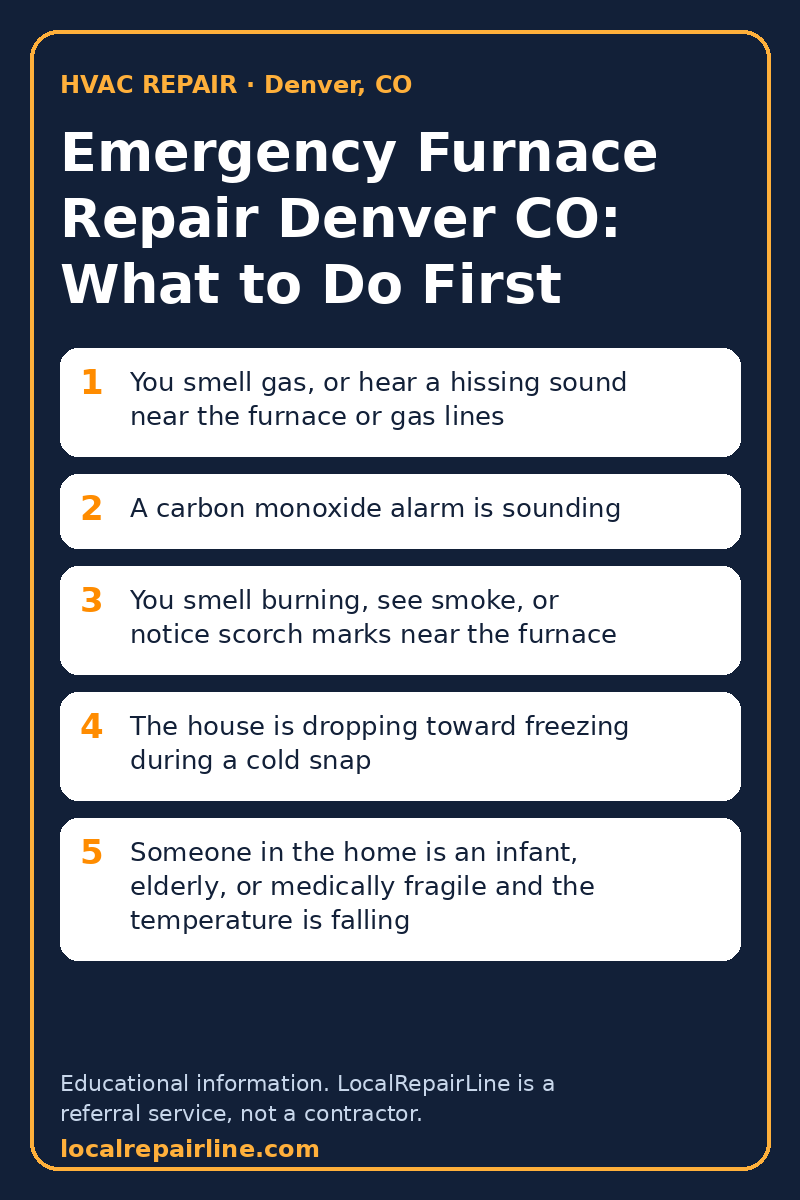
Safety First: Gas Smell, Carbon Monoxide Alarms, and Burning Odors
Safety problems come before any troubleshooting. Don't try to fix these yourself.
If you smell gas
Leave the house right away. Don't flip light switches, use a lighter, or start the furnace again. From outside or a neighbor's home, contact your gas utility or emergency services.
If a carbon monoxide alarm goes off
Get everyone outside into fresh air, pets included. Headache, dizziness, nausea, and confusion can all be warning signs. Don't go back in until emergency responders say it's safe. A furnace that triggered a CO alarm needs a professional look before it runs again.
If you smell burning
A brief dusty smell the first time the heat runs each fall is common. A strong, lingering burning, electrical, or hot-metal smell is different. Turn the furnace off at the thermostat and the switch, and call a pro.
Quick Checks to Try Before You Call (Thermostat, Power, Filter, Pilot or Igniter)
If there's no gas smell and no alarm, a few simple checks can sometimes get you running again. They take a few minutes.
- Check the thermostat. Make sure it's set to "heat," the temperature is set well above the room temperature, and the batteries are fresh if it uses them.
- Check the power. Look at your breaker panel for a tripped breaker. Also find the furnace's on/off switch, which looks like a regular light switch, usually near the unit, and make sure it's on.
- Check the filter. A badly clogged filter can make a furnace shut itself off from overheating. If it's gray and packed with dust, replace it.
- Check the vents and registers. Make sure they're open and not blocked by furniture or rugs.
- Check the igniter or pilot. Newer furnaces use an electronic igniter. Older ones may have a pilot light. If you don't know how to relight yours safely, check the owner's label on the unit. If you aren't sure, stop here.
Don't open up the furnace cabinet, bypass safety switches, or keep resetting the unit over and over. A furnace that shuts down is often doing so for a reason.
This is the point to call a local pro
If the thermostat, power, breaker, and filter are all fine and the furnace still won't start, it's time to stop guessing and talk to a local HVAC pro in Denver, CO, such as the team at https://localrepairline.com. The same goes right away if there's a gas smell, a CO alarm, or the house is cooling during a cold snap.
When you call, have this ready:
- Your furnace's age and brand, if you know them
- What it's doing, such as clicking, running and then stopping, or silent
- What you already checked
- Whether anyone in the home is vulnerable to cold
Why Furnaces Fail During Denver Cold Snaps
Denver weather can swing from mild, sunny days to a sharp Arctic blast with little warning. A furnace that barely ran for weeks may then have to run nearly nonstop. That's often when a weak part, a dirty burner, or a clogged filter finally gives out.
Denver also sits at a high elevation, which is a fair thing to bring up with a local HVAC pro. Ask whether your furnace is set up properly for your elevation, including how it handles combustion and airflow.
Dry air adds its own quirks. Dust builds up, and a furnace that sat idle through a long mild stretch may have gathered more of it than you'd think.
Heavy snow can also arrive early in autumn or late in spring. Heating trouble isn't limited to the middle of winter, so don't assume you're safe just because the calendar says October.
How to Keep Your Home Safe and Warm Until Your Furnace Is Fixed
Sometimes a repair can't happen right away, or a part isn't on hand. A few steps can make the wait safer.
- Shrink the space you're heating. Close doors to unused rooms and gather everyone in one room.
- Layer up. Use blankets, hats, and warm socks, and keep kids and older adults close to the warmest spot.
- Block drafts. Rolled towels at door bottoms help, and closing curtains keeps some heat in.
- Protect pipes. In a hard freeze, open cabinet doors under sinks on exterior walls and let a faucet drip slowly.
- Use space heaters carefully. Plug them directly into a wall outlet, keep them clear of bedding and curtains, and never leave them running while you sleep or are away.
Never use a gas oven, grill, camp stove, or outdoor heater to warm the house. They can produce carbon monoxide. The same goes for a generator, which must stay outdoors and well away from windows and doors.
If the house gets truly cold and the repair is delayed, staying with family or friends overnight is a reasonable choice, especially for babies, older adults, or anyone with health concerns.
What to Expect from Emergency Furnace Repair Denver CO Visits and How Costs Add Up
A typical furnace repair visit starts with questions about what happened. From there, local HVAC pros commonly check safety controls, power, gas supply, igniter, flame sensor, airflow, and the condition of the filter and blower. What they find shapes the next steps.
Costs vary by house, but a few things consistently push the bill up or down:
- Timing. Ask how the time of day affects scheduling and billing.
- The failed part. A small sensor is a different job than a blower motor or control board.
- Parts availability. If a part has to be ordered, you may need a temporary plan.
- Furnace age and access. Older or hard-to-reach units can mean more time.
- Diagnosis versus repair. Ask whether the visit and the repair are billed separately.
Ask for the cause in plain words, and ask them to put the scope and parts in writing before work begins. A good technician will explain what failed and what the options are.
Repair or Replace? Decisions Worth Making Calmly, Not at Midnight
Cold and stress make people agree to things quickly. Some choices are worth slowing down for.
Repairs people often regret rushing include:
- Paying for a major part on an old furnace without asking about its overall condition
- Agreeing to a full replacement without a second opinion when the house is safe overnight
- Accepting a vague plan that doesn't list what's being fixed
- Choosing a new furnace without checking that it's sized properly for your home
A small repair on a furnace in decent shape is often reasonable. If the unit is old, has failed repeatedly, or the repair is large, replacement may make sense. If you can get through the night safely, you can compare options in daylight.
FAQ
Is a furnace not working an emergency?
It depends. A gas smell, carbon monoxide alarm, burning odor, or a house rapidly losing heat in cold weather is an emergency. A furnace that fails on a mild day, with safe backup warmth, can usually wait for normal business hours.
What should I do if my furnace stops working in the middle of the night?
Check for gas smells or alarms first, and get outside if you find either. If all is calm, check the thermostat, the power switch, the breaker, and the filter. If it still won't start and the house is getting cold, call a local HVAC pro and set up a safe warm room until the heat is back.
Why is my furnace blowing cold air or not turning on?
Common causes include a thermostat set wrong, a tripped breaker, a clogged filter, a failed igniter, or a safety control that shut the unit down. Cold air can also mean the burners shut off before the heat built up. Since some causes involve gas or electrical parts, a technician should handle anything past the basic checks.
How much does an emergency furnace repair cost in Denver, CO?
Costs vary by house, so there's no single number that fits everyone. The biggest factors are which part failed, how old and accessible the furnace is, whether a part has to be ordered, and how the timing of the visit affects billing. Ask for the cause in plain words, and ask them to put the scope and parts in writing before any work begins.
Need an HVAC repair pro in Denver, CO?
Talk to an independent local contractor who serves your area.
📞 Call (833) 669-0233HVAC repair in Denver, COCall hours: 8am–8pm ET, 7 days