Furnace Blowing Cold Air in Denver, CO? Causes and Fixes
If you typed furnace blowing cold air Denver CO into a search bar, you're probably standing next to a vent on a chilly day, wondering why nothing warm is coming out. Good news: the cause is often simple, and a few checks take only minutes.
This guide covers the quick fixes first, then the problems Denver weather adds. It also explains when to stop and call a pro.
Furnace Blowing Cold Air Denver CO: Why It Happens (Start Here)
A furnace blows cold air when the blower is running but the burners aren't lit, or when the heat shuts off before it reaches your ducts. The blower is the easy part. The heating side has to start, stay lit, and vent safely.
Most causes fall into a few groups:
- Settings: the thermostat fan is on "On" instead of "Auto," or the mode is wrong.
- Airflow: a clogged filter makes the furnace overheat and shut the burners off.
- Venting: snow, ice, or debris blocks the outside pipes on a high-efficiency furnace.
- Condensate: the drain line freezes or clogs, and the furnace locks out.
- Ignition and sensors: a dirty flame sensor or failed igniter keeps the flame from staying on.
- Gas or controls: a closed gas valve, a gas supply problem, or a control board fault.
Denver's weather makes some of these more likely. A mild, sunny stretch can leave your furnace idle for days, then a cold front arrives and it has to run hard. Anything marginal, like a dirty sensor or a partly clogged filter, tends to fail right then.
Need an HVAC repair pro in Denver, CO?
Talk to an independent local contractor who serves your area.
📞 Call (833) 669-0233HVAC repair in Denver, COCall hours: 8am–8pm ET, 7 daysYour call may first be answered by a short screening service that asks what the problem is and where you are. Stay on the line and you will be connected to an independent local pro.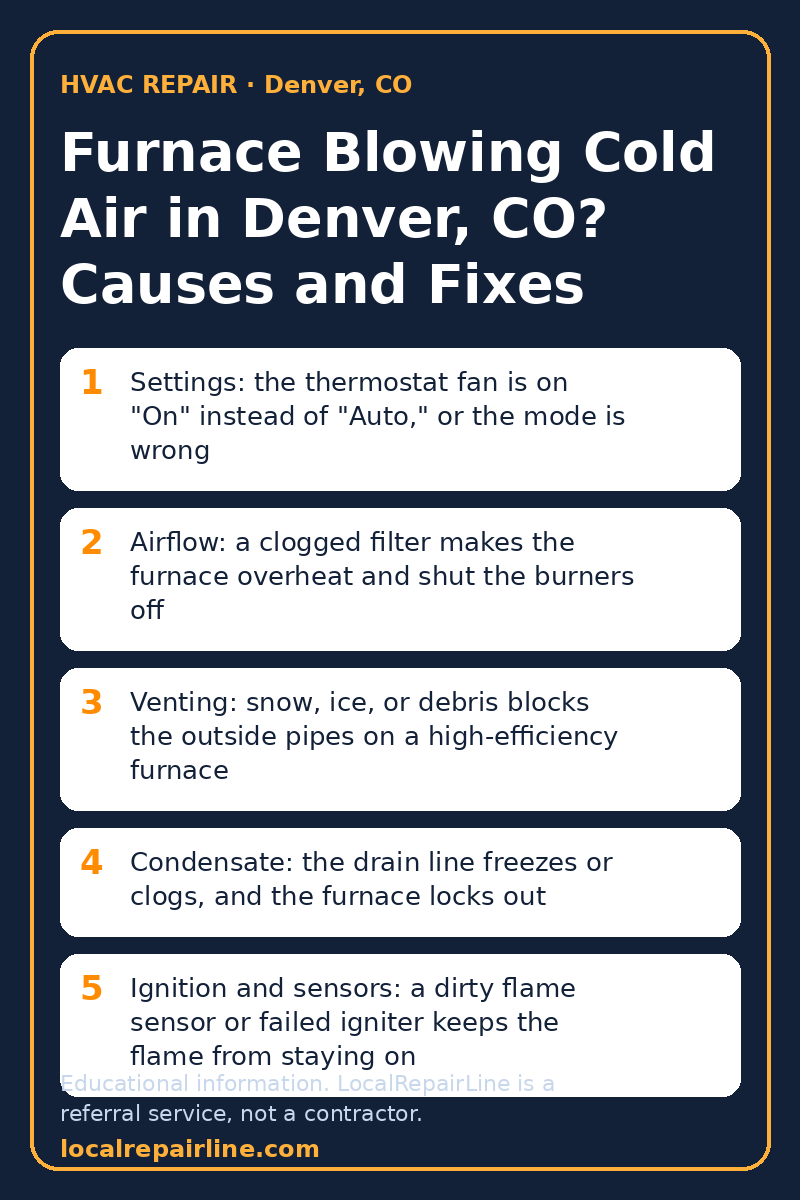
Quick Checks to Try First
Start here before you assume something is broken. None of these require opening up the furnace.
- Check the thermostat. Make sure it's set to "Heat" and a few degrees above room temperature. If it has batteries, replace them.
- Switch the fan to "Auto." With the fan on "On," the blower runs constantly and can push out room-temperature air between heating cycles.
- Look at the filter. If it's gray and clogged, replace it. A blocked filter can make the furnace overheat and shut the burners off while the fan keeps running.
- Check the furnace switch and breaker. The wall switch near the furnace can get bumped.
- Open your vents and returns. Move furniture or rugs away from them.
- Look at the status light, if there's one. Many furnaces flash a code through a small window. Note what you see, since it helps a technician later.
If the furnace starts making warm air after any of these, you're done. Keep an eye on it for a day or two to make sure the problem doesn't return.
Denver Winter Causes: Snow-Blocked Vents and Frozen Condensate Lines
High-efficiency furnaces pull in air and push out exhaust through plastic pipes, usually white PVC, that run through an outside wall or the roof. They also make condensation, which drains through a small line. Denver weather can interfere with both.
Snow or ice over the outdoor vent pipes
Denver can get snow in fall and spring as well as winter. Heavy, wet snow can drift against the wall or bury the pipe ends, and ice can build up around the openings.
When air can't get in or exhaust can't get out, safety switches shut the burners off. The blower may keep running, so you get cold air.
Here's how to check safely:
- Find the pipe ends outside, usually one or two plastic pipes near the foundation or roofline.
- Gently clear snow away by hand or with a soft broom.
- Don't chip ice with a sharp tool, and don't pour hot water on the pipes.
- Never cover or plug the openings, and keep anything from being stacked in front of them.
After clearing the snow, give the furnace a few minutes. It may restart on its own, or you may need to reset it at the thermostat.
Frozen condensate lines during cold snaps
Denver is known for sudden cold snaps and big day-to-day temperature swings. If the condensate drain runs through an unheated space or along an exterior wall, the water can freeze. Once the line backs up, a safety switch can stop the furnace from heating.
You might notice water around the furnace, a gurgling sound, or a furnace that tries to start and then quits. Thawing the line yourself isn't always simple, and a leak can damage floors. A technician can show you ways to keep it from freezing again.
The first hard freeze after a long idle fall
Fall can stay mild for a long time. A furnace that sat unused for weeks is then asked to run all night when the first hard freeze hits. Dust on the sensor, a stuck part, or a clogged filter can show up right then.
Dirty Flame Sensors, Ignition Problems and Lockouts Explained
If the burners light and then go out after a few seconds, the flame sensor is a common suspect. It's a thin metal rod that tells the furnace there's a flame. When it gets coated with residue, it can't "see" the flame and the furnace shuts the gas off as a safety step.
Other ignition problems have similar symptoms:
- Failed igniter: the furnace tries to start but never lights.
- Gas supply issue: a closed valve or a problem on the gas side means the burners never get fuel, so the blower runs with nothing to heat the air.
- Control board fault: the furnace skips steps in its startup sequence or doesn't respond at all.
Many furnaces will try to light a few times, then "lock out" to protect your home. A lockout can last until you cut power for a short time or until a technician resets the system. If it locks out again right away, something real is wrong, and repeated resets won't fix it.
Cleaning a flame sensor is a common repair, but it means working near gas and electrical parts. If you aren't comfortable with that, leave it to a technician. And if you ever smell gas, leave the house and contact your gas utility from outside.
When to Stop and Call a Pro
Some problems are fine to check yourself. Others are not, and for those you can find a local Denver furnace pro at localrepairline.com. Call a heating technician if:
- The furnace locks out more than once after you've done the basic checks.
- You see water pooling around the furnace or hear clicking with no flame.
- You smell gas, smoke, or burning, or a carbon monoxide alarm sounds.
- The status light shows a code you can't make sense of.
- The furnace is old and you're not sure where the trouble starts.
Don't bypass safety switches or jam anything into the furnace to force it to run. Those switches are there for a reason. If a carbon monoxide alarm goes off, get everyone outside first.
What Repairs Can Cost
Costs vary by house. Simple fixes, like a fresh filter or a thermostat setting change, are usually the smallest jobs, and you can often handle them yourself. A sensor cleaning, a new igniter, or a condensate fix is a mid-sized repair that typically takes a technician visit and sometimes a part. A control board, blower motor, or heat exchanger problem is a bigger job, with larger parts and more labor time.
A few things move the price:
- How easy the furnace is to reach
- The age of the unit and whether parts are still made
- The time of year, since cold snaps keep technicians busy
- Whether the repair fixes the cause or just the symptom
If the repair is a big one and the furnace is older, ask the technician to explain the tradeoff between repairing and replacing. Getting a second opinion is reasonable.
FAQ
Why is my furnace blowing cold air but the thermostat says heat?
The blower can run even when the burners aren't lit. Common causes are a clogged filter, a dirty flame sensor, a blocked vent pipe, or a frozen condensate line. Start with the thermostat, fan setting, and filter, then check outdoor vent pipes for snow.
Is it normal for a furnace to blow cold air at startup?
A short burst of cooler air at the start of a cycle can be normal, since the furnace needs a moment to warm up. If the air stays cool for more than a few minutes, or the furnace shuts off before the house warms, something is wrong. Check the filter and settings first.
Can a dirty filter really make a furnace blow cold air?
Yes. A clogged filter restricts airflow, which can make the furnace overheat and shut the burners off for safety. The fan may keep running, so you feel cool air at the vents. Replacing the filter is a quick fix you can often do yourself.
Should I keep resetting the furnace if it keeps going cold?
One reset after clearing a vent or changing a filter is fine. If it fails again right away, repeated resets won't solve the cause and may hide a safety issue. Call a technician instead.
How can I keep my condensate line from freezing in Denver?
The line is most at risk where it runs through an unheated space or along an outside wall during cold snaps. A technician can look at your setup and suggest ways to protect or reroute it. Costs vary by house, so ask for the options before work begins.
Need an HVAC repair pro in Denver, CO?
Talk to an independent local contractor who serves your area.
📞 Call (833) 669-0233HVAC repair in Denver, COCall hours: 8am–8pm ET, 7 days